Community-Built Pedro 2.0 Robot Arm Makes Robotics Education More Accessible
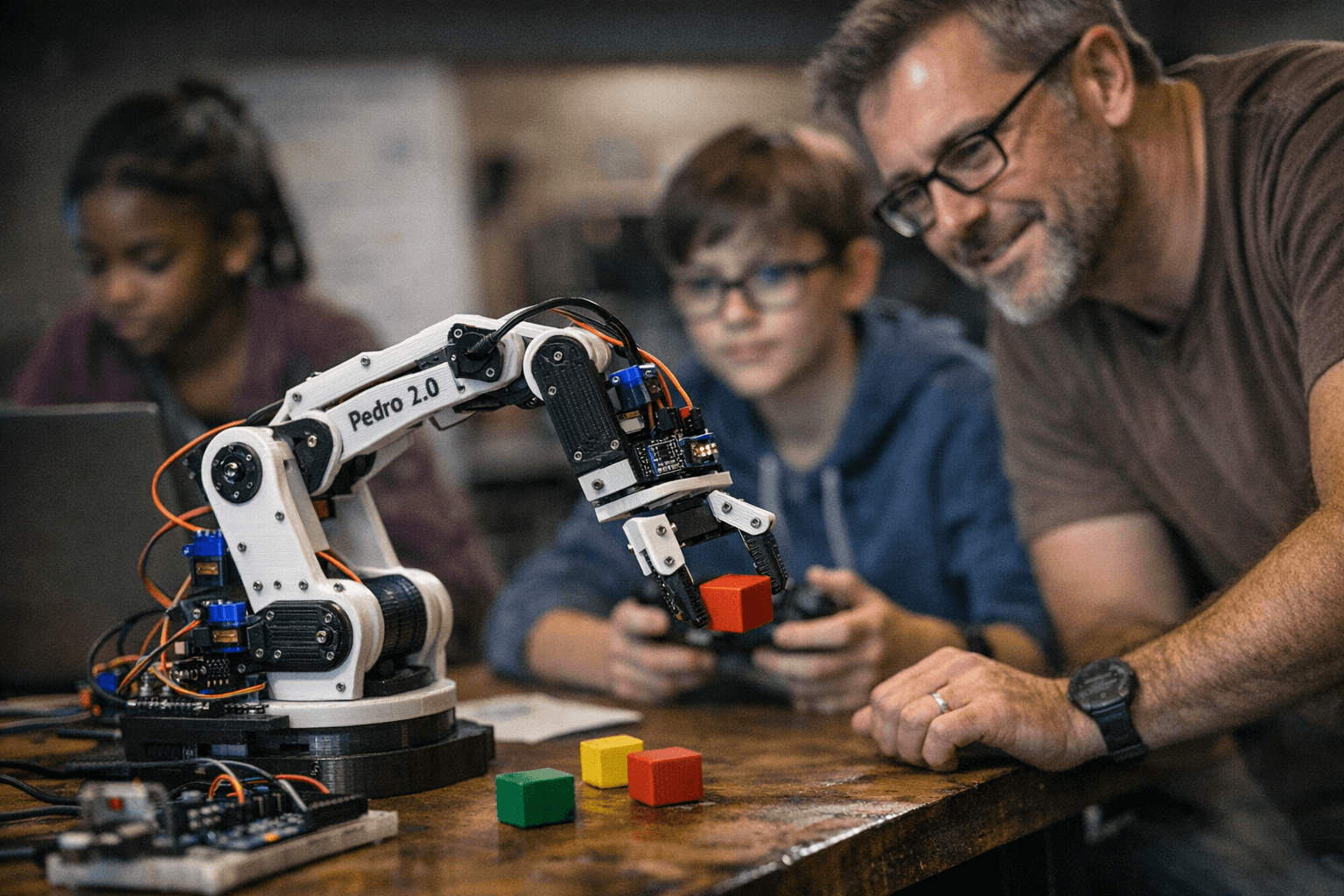
Pedro 2.0 is a fully 3D-printable robot arm built for STEAM education — snap-together assembly, SG90 servos, Arduino, and wireless control via nRF24L01, no special printer required.

If you've ever wanted to get a student (or yourself) hands-on with a real robot arm without spending four figures, Pedro 2.0 is worth a serious look. Pedro 2.0 is a simple 3D-printable robot arm intended for STEAM education, and the entire mechanical structure comes off your print bed. No exotic hardware, no machined parts, no excuses.
Pedro is a sophisticated mini robotic arm designed to be entirely 3D printed and assembled without any tools. Equipped with four mini servo motors and powered by a custom-made Arduino-compatible board, Pedro can be controlled remotely using an nRF24L01 module. It also features two ball bearings for enhanced precision in its movements. The wireless remote control via the nRF24L01 is a practical touch: it means students can operate the arm without being tethered to a USB cable during demonstrations.
The parts list is deliberately approachable. The arm uses standard 9g servos you can buy for around $15 for ten of them on Amazon. As for the printer itself, there's no gatekeeping here: any old FDM machine should do the job just fine if it's calibrated properly, and whether you're a kid or a kid at heart, learning about science and engineering can be a lot more fun if it's practical. Pedro prints on any standard FDM printer and assembles in under 10 minutes without screws or glue, ideal for educators and young learners.
Pedro 2.0 didn't emerge from a vacuum. Pedro began in 2016 as a simple DIY robotic arm, 3D-printed, powered by an ATmega328, and assembled with screws and a screwdriver. Pedro is officially Open Source Hardware certified (UID: FR000025), a label that guarantees transparency, reusability, and compliance with open-source standards. All design files, including STL, STEP, Gerbers, and firmware, are available under an Apache-2.0 license, inviting contributions and forks.
Pedro sits at the accessible end of the 3D-printed robot arm spectrum. On the more advanced end, James Gullberg's six-degree-of-freedom arm, also documented on Hackaday, takes a very different engineering approach. Built primarily from 3D-printed components, Gullberg designed it explicitly as an experimental learning platform, using the build to investigate a wide variety of joint and reducer designs. The base runs a planetary gear drive; the shoulder and elbow rely on split-ring planetary gearboxes for high torque density relative to their size. For sensing, Gullberg integrated alternating magnets into the output ring gear, monitored via a magnetic encoder. The wrist switches things up entirely with an inverted belt differential. It's a masterclass in using a 3D printer to prototype mechanical concepts that would cost a fortune to machine.
Meanwhile, the 20sffactory Community Robot Arm occupies its own lane as a dedicated collaboration project. The 20sffactory Community Robot Arm started in January 2019 as a maker support group on Facebook for makers attempting to build the original RobotArm by Florin Tobler. The group has expanded into a bigger community since 2019. It was developed based on the original design by Florin Tobler with multiple rounds of open hardware and software modification. Graphical contents and CAD files are licensed under CC BY 4.0 License. The robot can be driven by Arduino or ESP32 controller combined with other low-cost standard components, and the open-source designs and software empower makers, students, educators, programmers, and designers to build one affordably and make improvements according to their own needs.
With a one-time subscription fee, you can access the Resource Page that maps out and documents the BOM, build procedures, software, instructions, and tips. Advanced makers can skip straight to the 20sffactory GitHub repository for full open-source code and docs. The page, its graphical contents, and CAD files are licensed under CC BY 4.0, while the Community Firmware is licensed under GNU-3.0.
The philosophy driving all three of these projects is the same one that makes the maker community compelling: nothing replaces building the real thing. Pedro 2.0 is the lowest-friction entry point into that philosophy, and with SG90 servos that cost next to nothing and STL files ready to slice, the barrier to a working robot arm on your bench has never been lower.
This article was produced by Prism’s automated news system from verified source data, official records, and press releases, then run through automated quality and moderation checks before publishing. The system is built and supervised by the people who set the standards it runs under. Read our full AI policy.
Did this article answer your question?