Creality expands beyond printers with KliTek nozzle-changing system
Creality used its 12-year milestone to push KliTek as more than a printer launch. The real question is whether it makes multicolor printing easier, or just deepens the Creality stack.
Creality is trying to sell a workflow, not just a machine. On its 12-year anniversary, the Shenzhen company framed itself as a platform business built around hardware, software, cloud services, materials, and creator communities across more than 140 countries and regions, with more than 6 million printers shipped. That is a bigger pitch than the usual desktop-printer victory lap, and it puts KliTek at the center of a much broader bet: Creality wants to be the place where a job starts, gets sliced, gets printed, and eventually gets managed inside one ecosystem.
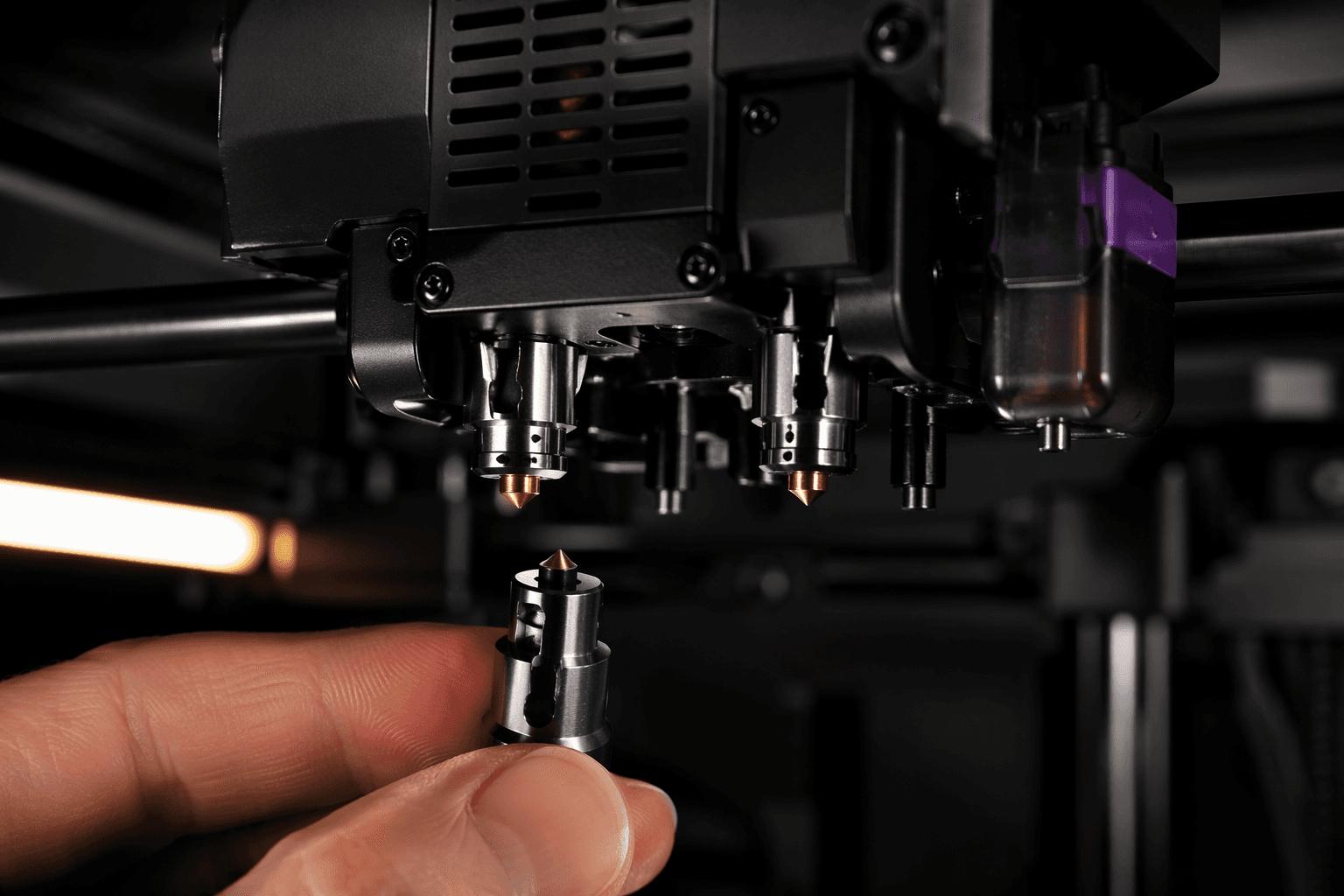
KliTek is aimed squarely at one of the most annoying parts of multicolor and multimaterial printing, the slow filament swaps, the purge waste, the color bleed, and the upkeep that comes with more complicated toolchains. Creality says the system uses a lightweight nozzle-changing mechanism with independent material pathways, with the goal of cleaner transitions and better support for flexible materials like TPU in the same job. Early teaser coverage has gone further, claiming nozzle swaps in under five seconds and color or material changes in under 15 seconds, but those numbers still read like launch-window promises until Creality locks them into a final spec sheet.
The hardware push only makes sense alongside the software. Creality Cloud already positions itself as a 3D printing platform with more than 1 million models, built-in slicing, and community features, and Creality Print 7.0 added AI smart analysis and automatic support detection. Creality’s AI documentation goes further, describing camera-based and lidar-based checks for issues like foreign objects, first-layer problems, and failed prints. The company has also kept pushing newer tools through the pipeline, including the latest Creality Print release, which came out on April 29, 2026. Put together, the message is hard to miss: Creality wants setup, calibration, and failure detection to happen inside its own software, not in a third-party stack.
That same ecosystem argument shows up in the rest of the lineup. The Falcon T1 is being promoted as a 5-in-1 laser workstation, while the Filament Maker M1 and Shredder R1 are meant to turn plastic waste into new filament on a desktop setup. Add the company’s claims of global scale, plus the KLITEK trademark filings under Shenzhen Creality 3D Technology Co., Ltd., and this no longer looks like a one-product story. KliTek is the sharpest example yet of where Creality is heading: toward a closed-loop maker platform that could make printing easier and more reliable, or simply make it harder to leave once you are in.
This article was produced by Prism’s automated news system from verified source data, official records, and press releases, then run through automated quality and moderation checks before publishing. The system is built and supervised by the people who set the standards it runs under. Read our full AI policy.
Did this article answer your question?