Creality Launches Desktop Shredder and Filament Maker to Recycle Print Waste
Creality's M1 extruder and R1 shredder hit Indiegogo at a $899 bundle price, but recycled-only output carries a ±0.1mm diameter tolerance that may clog tight filament paths.

Creality shipped its most ambitious hardware pitch yet: a two-machine desktop loop that shreds failed prints into granules and extrudes them back into spoolable filament. The Filament Maker M1 and Shredder R1 went live on Indiegogo on April 1, and the early-backer bundle price of $899 for both units is already drawing serious attention from the maker community, alongside serious questions about what the output filament is actually worth in the printer.
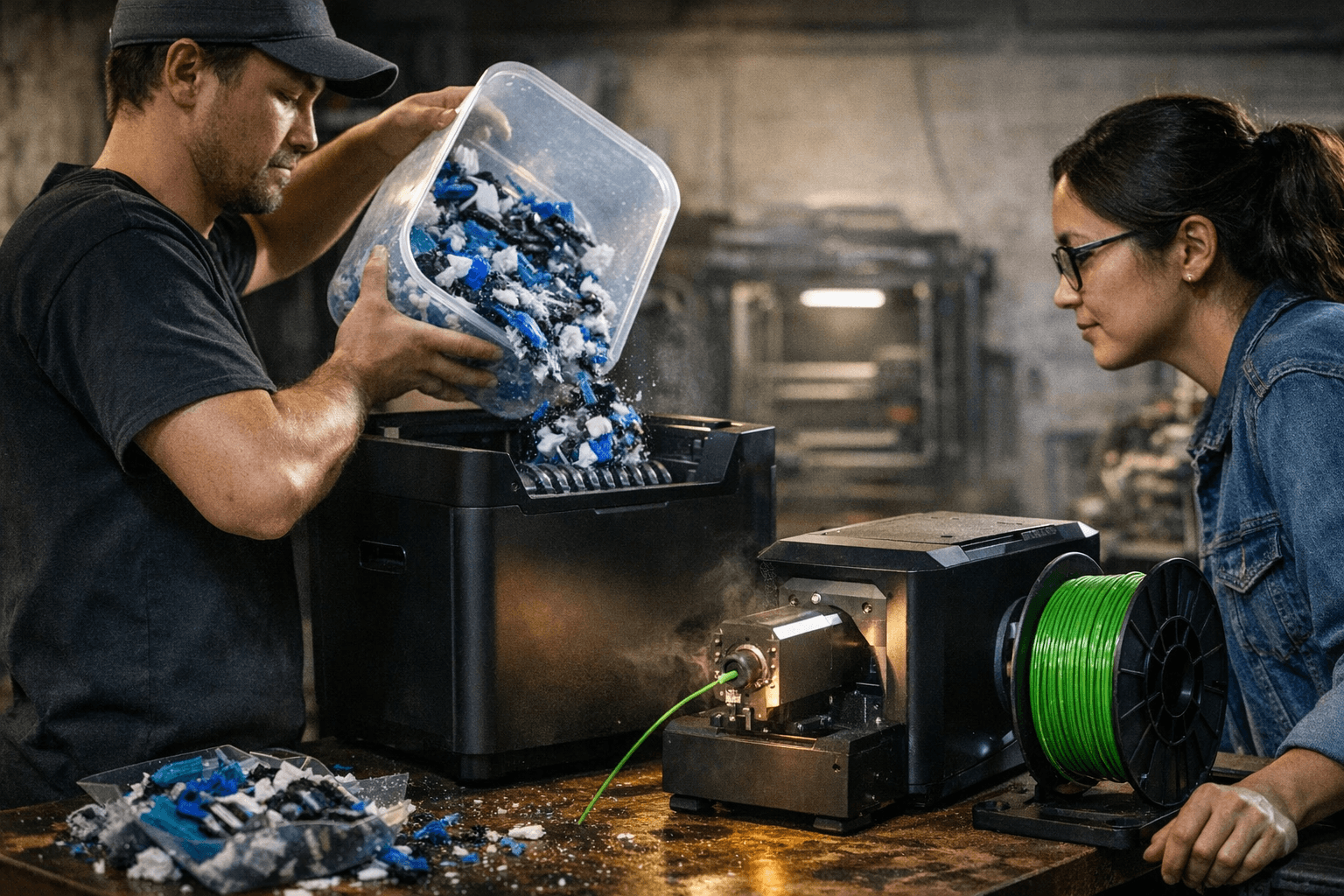
The workflow is straightforward on paper. The R1 accepts failed prints, support structures, and purge waste, shreds them down to uniform particles of 4mm or less, and dries the material in the same step, removing the need for a separate drying station. That granulate feeds into the M1, which extrudes and spools usable filament at a claimed output rate of up to 1kg per hour. Masterbatch pellets can be mixed in during extrusion, opening the door to custom color blends and additive compounds that would otherwise require sourcing specialty spools.
The diameter spec is where the math gets harder to ignore. Creality claims ±0.05mm tolerance when running 100% virgin PLA pellets through the M1, producing filament in the 1.70-1.80mm range. Switch to 100% recycled scrap from the R1, and that tolerance doubles to ±0.1mm, with diameter potentially ranging from 1.65mm to 1.85mm across a single spool. For context, premium commercial filament from brands like Bambu and eSUN typically holds ±0.02 to ±0.03mm. A ±0.1mm swing on a 0.4mm nozzle translates to a 5.7% variation in material cross-section per pass, which flow calibration and pressure advance settings cannot fully absorb. Creality's own recommendation to hit the tighter spec is a 1:1 blend of scrap and virgin pellets, which cuts waste savings roughly in half but recovers most of the diameter consistency.
Pricing tiers reflect a deliberate crowdfunding structure. The M1 alone carries a VIP early price of $649 against a listed MSRP of $1,149. The R1 prices in at $349 VIP versus a $649 MSRP. The $899 bundle is the headline offer for Indiegogo backers. A $50 refundable deposit reservation was also available ahead of the live campaign. Creality is targeting Q2 2026 for the first shipping wave, though regional logistics and the standard caveats of crowdfunding delivery apply.
Pre-campaign hands-on testing by content creator Embrace Making, documented on Hackaday in March, confirmed that M1-produced filament does print, with the diameter instability showing up in print quality but not causing outright failures when using Creality-supplied PLA pellets. The R1 unit was not part of that test. The Hackaday write-up also flagged that the spool winding mechanism needed refinement, with Creality acknowledging it was working on improvements ahead of production.
There are material compatibility boundaries worth mapping before backing. The R1 is designed for common single-material waste. Mixed-material loads, including any blend of PLA and TPU in the same batch, are explicitly flagged as incompatible. Processing mixed materials risks unstable extrusion or mechanical damage to the system, and Creality's spec sheet instructs users to discard those scraps separately rather than running them through.
For committed hobbyists already sorting their waste by material type, the M1 and R1 offer something no desktop pairing has delivered at this price point: a single-brand, matched workflow from shred to spool, backed by a manufacturer with the distribution reach to actually stock spare wear parts. For anyone printing at lower volumes or using a tightly toleranced filament path like Bambu's AMS, the ±0.1mm recycled-output variance is a real operational risk before a single real-world spool has shipped.
This article was produced by Prism’s automated news system from verified source data, official records, and press releases, then run through automated quality and moderation checks before publishing. The system is built and supervised by the people who set the standards it runs under. Read our full AI policy.
Did this article answer your question?