Creality M1 Filament Maker Aims to Recycle FDM Waste Into New Spools
Creality's M1 filament maker produced printable filament in early testing, though diameter variation remains a hurdle before production units hit the ±0.05 mm precision target.

Creality's M1 filament maker hit the community's radar when YouTuber Embrace Making got hands-on time with a pre-production prototype, turning failed prints and plastic waste into something that actually feeds back through a printer. The timing is pointed: desktop filament extruders have existed for years, but Creality is betting that brand weight and polish can do what smaller players haven't quite managed.
The core promise of the M1 is closing the FDM recycling loop. Creality intends to pair the machine with a companion shredder, the R1, so that failed prints can be shredded and re-extruded into usable spools rather than landfilled. "The sad reality of rapid prototyping is that you're going to generate a lot of prints that just aren't fit for purpose, even if your printer runs them off perfectly every time," as the Hackaday coverage framing the demo put it.
In Embrace Making's test run, the M1 produced filament that printed. That's the minimum bar, and it clears it. "Most importantly, the M1-produced filament does print. The prints aren't perfect due to the variation in diameter, but they turn out surprisingly well for home-made filament." The diameter inconsistency is the obvious rough edge on this pre-production unit, and Creality says production models will reach ±0.05 mm precision. Whether that claim holds up under real-world continuous extrusion remains to be verified independently.
Embrace Making also demonstrated color mixing and gradient filament on the M1, though those tests used raw PLA pellets rather than shredded material. That distinction matters: the recycling workflow, grinding failed prints into feedstock and pushing the result through the M1, hasn't been shown end-to-end yet. The R1 shredder is still in development, and there's no confirmed timeline for when it will be ready to test alongside the M1.
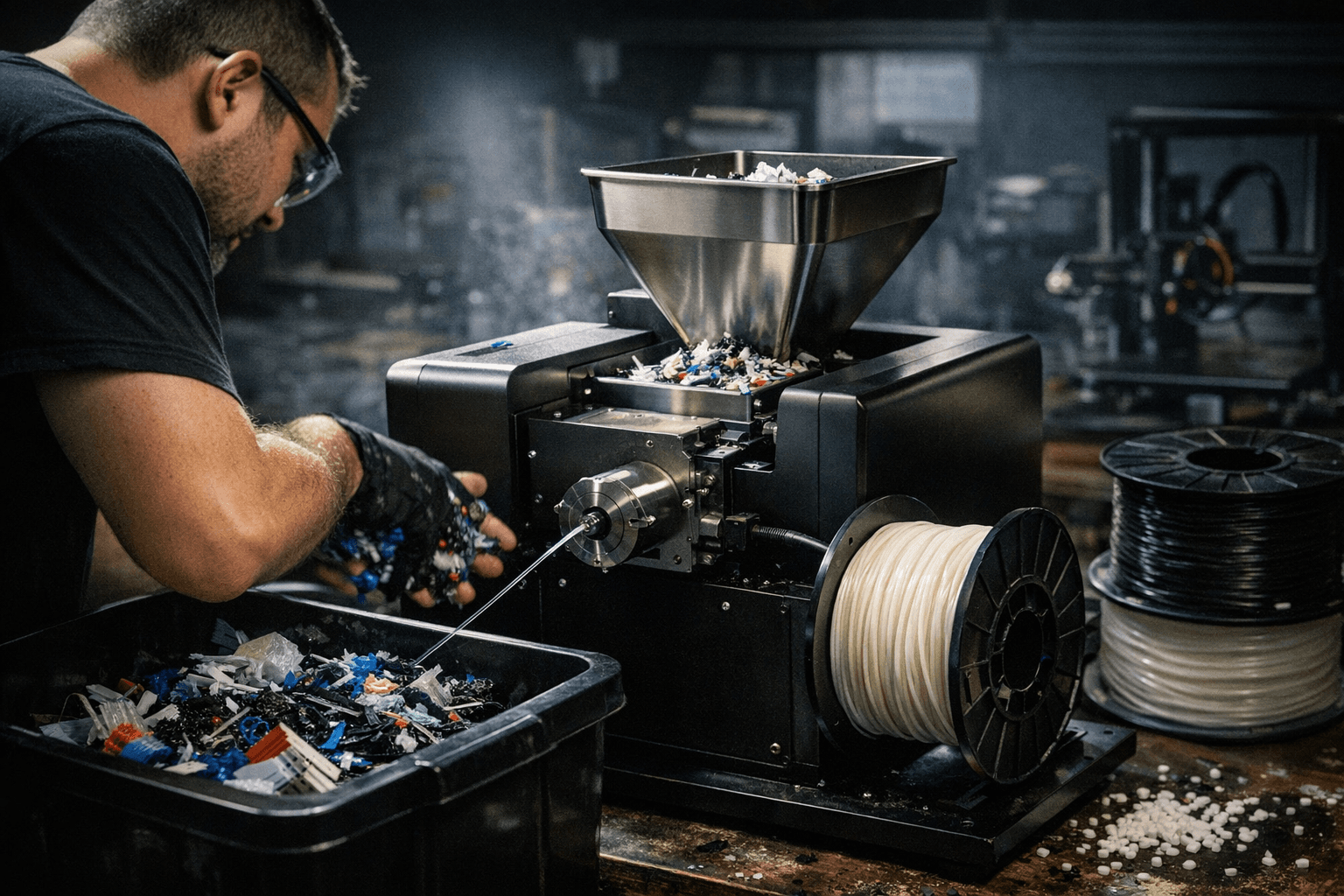
The winding mechanism produced a messy spool during Embrace's run, but Hackaday's analysis suggested the mechanical side was sound: "That's probably just software given that the winding mechanism did a pretty good job on the Creality-supplied spool." A software fix is a lower bar than a hardware redesign, so that particular issue looks solvable before production.
The community reaction split predictably. Some commenters pushed back on the novelty: "It's been 13 years since Filastruder's Kickstarter campaign. Similar machines have been available from no name ali sellers ever since." Others countered that Creality's real contribution isn't the concept but the execution: "Cost, reliability, and ease of use are what most for widespread usage. Ease of use and reliability have very much been lacking in prior works and this prototype addresses those issues."
Hackaday's own framing acknowledged the history directly: "This is hardly the first time we've seen a filament extruder." The sharper observation was the use-case caveat: if someone plans to run raw pellets through the M1 rather than shredded prints, it would be more direct to print from pellets in the first place. The M1's value proposition lives or dies on the shredder pairing, and that half of the equation is still unproven in public testing. Pricing and a production release date for either the M1 or the R1 have not been announced.
This article was produced by Prism’s automated news system from verified source data, official records, and press releases, then run through automated quality and moderation checks before publishing. The system is built and supervised by the people who set the standards it runs under. Read our full AI policy.
Did this article answer your question?