Creality Patents Nozzle-Swapping Print Head for Simpler Multicolor 3D Printing
Creality's new patent physically repositions entire nozzle modules instead of swapping filament, targeting the purge waste and idle-nozzle collision problems that plague desktop multicolor FDM.

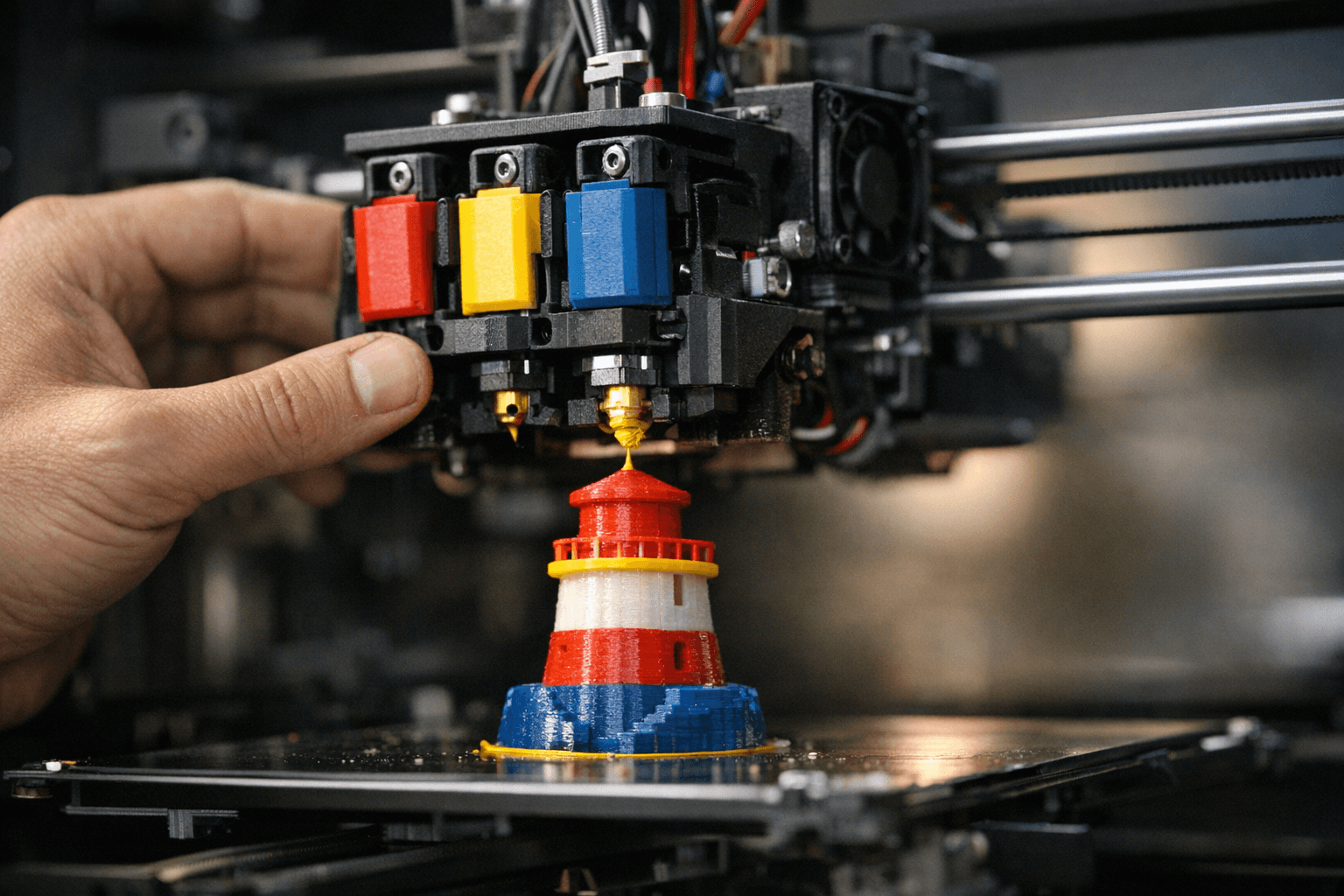
Creality filed a patent for a print head that treats each color as its own self-contained melting unit rather than a filament path through a shared hotend. The filing, titled "Printing Module, 3D Printer, and 3D Printing Equipment," describes a head carrying multiple melt channels, each with its own extrusion path, controlled by a switching mechanism that physically lifts inactive nozzles out of the print plane and drops only the active one to the lowest printing position.
The approach targets a genuine weak point in desktop FDM: single-nozzle systems that swap filament keep the carriage light but demand long flushing cycles, waste material, and stress the melt zone, while fixed multi-nozzle setups add mass, raise calibration effort, and carry the persistent risk of an idle nozzle dragging across a finished surface. Creality's patent tries to sidestep both failure modes by keeping inactive units physically elevated in standby, clear of the print.
The patent describes two switching variants. The first uses a drive to select the active melting unit directly. The second relies on a mechanical trigger: as the print head moves to a frame column, contact there actuates a transmission element and advances to the next unit, eliminating the need for additional motors, cabling, and control logic. That second approach is notable because it keeps the bill of materials low, a recurring priority in Creality's consumer-facing hardware strategy.
The design also includes a buffer mechanism with a spring-like section that absorbs tension spikes during filament loading and retraction, which is specifically aimed at brittle materials prone to cracking under rapid feed-and-pull cycles. An integrated cutting tool severs the filament close to the melt zone as part of the material-change sequence, keeping the transition clean without a separate purge tower accumulating on the build plate.
Multi-material and multi-nozzle architectures were a major focus across the broader 3D printing industry in 2025, as manufacturers competed to cut filament waste and reduce the manual intervention that multicolor printing still demands at the desktop level. The patent does not announce a specific printer model, so whether this system ships as a standalone machine, a modular upgrade head, or a reference design for future platforms remains open. What the filing does confirm is that Creality is architecting solutions below the firmware level, building mechanical answers to problems that software-side flushing routines have only partially solved.
This article was produced by Prism’s automated news system from verified source data, official records, and press releases, then run through automated quality and moderation checks before publishing. The system is built and supervised by the people who set the standards it runs under. Read our full AI policy.
Did this article answer your question?