Deep Learning Framework Optimizes LPBF Settings for Titanium Gyroid Lattice Printing
A deep learning surrogate model can evaluate thousands of titanium gyroid LPBF parameter combinations in milliseconds, promising fewer wasted builds.
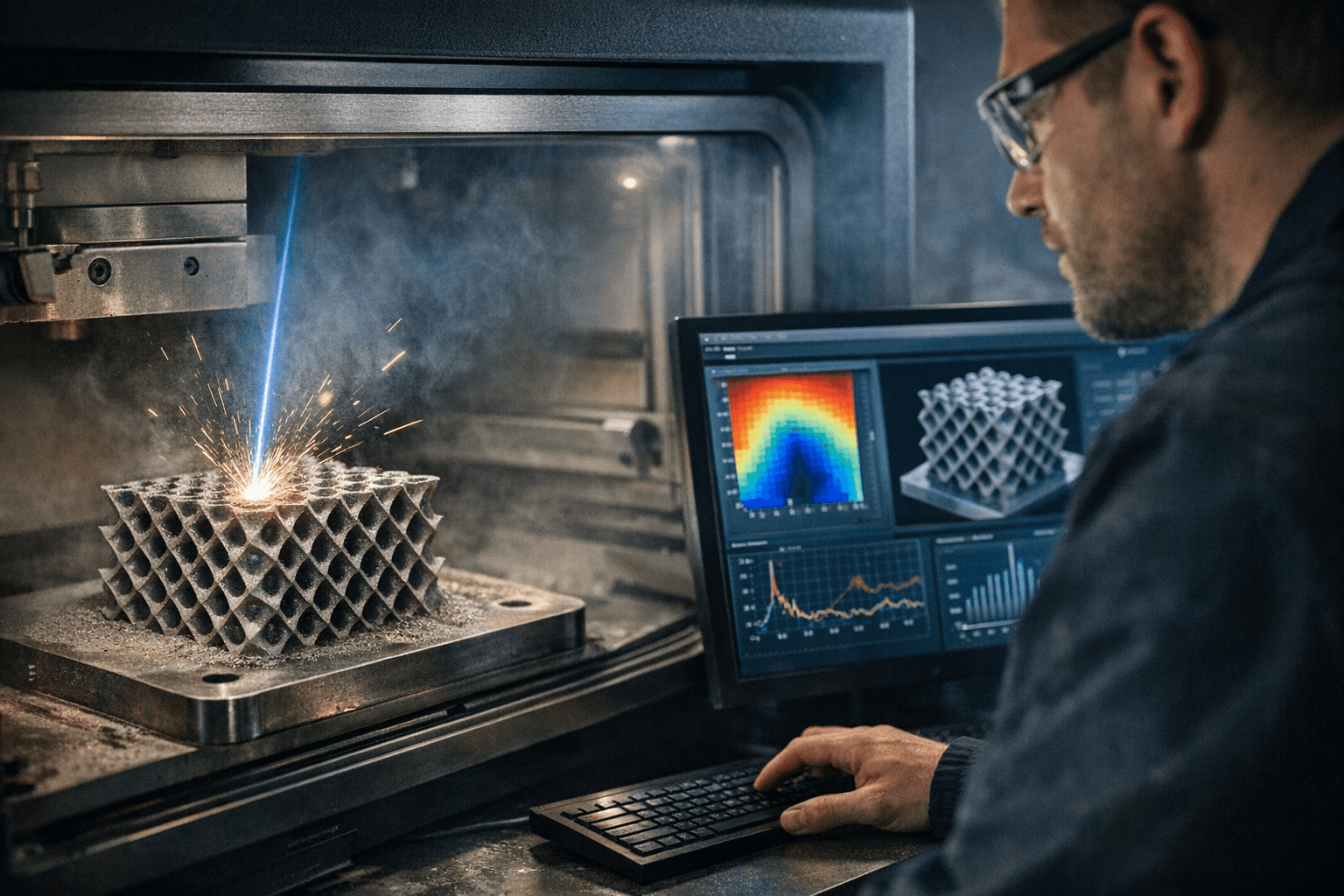
Researchers have published a new study in the *Journal of Manufacturing and Materials Processing* that takes aim at one of metal AM's most persistent headaches: the disconnected loop between designing a gyroid lattice and dialing in the LPBF process settings to actually print it reliably.
The full potential of metallic TPMS lattice structures has remained underexplored partly due to manufacturing limitations in achieving defect-free lattice architectures and an incomplete understanding of process-structure-property relationships. The new framework, reported by Kerry Stevenson at Fabbaloo on March 19, attacks that gap directly by treating geometry and process as a single co-optimization problem rather than two sequential ones.
The core of the system is a data-driven deep neural network surrogate that maps a combined set of inputs to the outcomes that matter for printability and performance. On the design side, the model takes in variables like unit cell size, wall thickness, and grading parameters for functionally graded geometries. On the process side, it ingests laser power, scan speed, hatch spacing, layer thickness, and scan strategy. The surrogate then predicts density, dimensional error, surface quality, and mechanical response in compression for any given combination of those variables.
That surrogate feeds a multi-objective optimizer capable of targeting something like maximizing stiffness-to-weight while simultaneously constraining printability. Processing parameters including layer thickness, laser power, scanning speed, hatching space, and scanning strategy play a crucial role in determining the final quality of manufactured parts, and the framework interrogates all of them at once rather than holding geometry fixed while sweeping process space, or vice versa.
The computational payoff is significant. "The surrogate model collapses a high dimensional search into millisecond predictions, so the optimizer can evaluate thousands of candidate blends of gyroid parameters and laser settings without tying up a machine." That speed matters enormously in practice: every physical test build in titanium LPBF represents real machine time, real powder cost, and real risk of a failed part.
The practical consequences the researchers point to are fewer wasted builds, tighter dimensional control, and more consistent mechanical properties across a print, with a particular callout for functionally graded lattices where printability can vary substantially from one region of the build to another. Graded TPMS structures are increasingly relevant in aerospace and biomedical lightweighting applications precisely because they let engineers tailor local stiffness, but that same local variation is what makes them tricky to print defect-free.
A related body of work on LPBF of the Ti-6Al-2Sn-4Zr-6Mo alloy, published separately, illustrates the kind of property scatter that motivates this kind of surrogate-driven approach. Researchers studying that alloy across a matrix of laser power, scanning speed, hatching spacing, and island size found porosity levels ranging from 0.07 to 1.04% and Vickers microhardness swinging between 330 and 441 across different parameter combinations. That roughly threefold spread in hardness from process choices alone underscores why a framework that jointly constrains geometry and process before committing to a build is worth developing.
The titanium gyroid focus does come with a caveat the researchers are upfront about: the co-optimization concept is transferable to other TPMS families and materials only if sufficient training data exist to build the surrogate. Schwarz P, Schwarz D, and other TPMS topologies would each require their own experimental foundation. For the metal AM community, that points toward a future where the real competitive moat is not just the optimizer, but the dataset behind it.
This article was produced by Prism’s automated news system from verified source data, official records, and press releases, then run through automated quality and moderation checks before publishing. The system is built and supervised by the people who set the standards it runs under. Read our full AI policy.
Did this article answer your question?