DMG MORI Federal Services Wins $400K DOE Grant to Optimize LPBF with Supercomputing
DMG MORI Federal Services landed a $400K DOE supercomputing grant to automate LPBF process optimization alongside Oak Ridge National Laboratory.
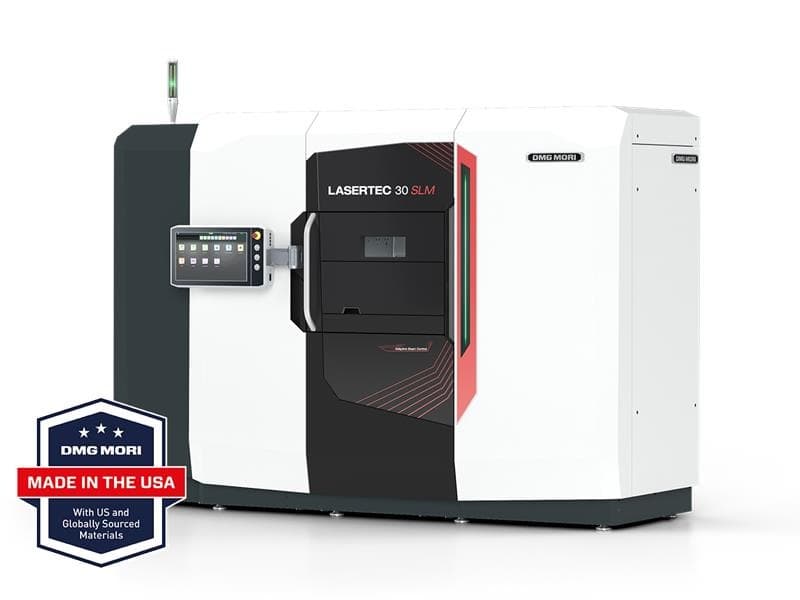
DMG MORI Federal Services has secured a $400,000 award from the U.S. Department of Energy under the High-Performance Computing for Manufacturing (HPC4Mfg) program, pairing the company's LPBF platforms with the supercomputing muscle of Oak Ridge National Laboratory to build automated, AI-driven process optimization tools for metal additive manufacturing.
The project, announced February 23, 2026, represents one of 12 grants funded under the DOE's broader $4.8 million investment in high-performance computing for U.S. manufacturing competitiveness. DMG MORI Federal Services, the Hoffman Estates, Illinois-based division that works directly with the U.S. government and its prime contractors, will collaborate with ORNL in Oak Ridge, Tennessee, where some of the world's most powerful supercomputing systems are housed alongside decades of early-stage AM materials science research.
The technical goal is pointed: develop an automated, laser-specific process optimization tool built specifically for DMG MORI's LPBF systems. The collaboration will leverage ORNL's supercomputing resources, advanced simulation, and AI-driven modeling to attack the persistent pain points that anyone running LPBF at production scale knows well — inconsistent repeatability, cost overruns, and the qualification burden that keeps metal AM parts from moving off the build plate and into certified supply chains. The work focuses on producing energy-critical components, where those challenges carry particular weight.
Fred Carter, Head of R&D for DMG MORI Federal Services, framed the collaboration in a press statement: "This collaboration allows us to pair DMG Mori's advanced laser powder bed fusion platforms with ORNL's world-class high-performance computing and materials science expertise. Together, we will develop data-driven tools that enhance process control, improve repeatability, and strengthen the competitiveness of U.S. manufacturing."

The HPC4Mfg program has been funding national lab and industry pairings of exactly this kind since 2015, channeling supercomputing resources toward manufacturing process problems that are computationally expensive to model at scale. The DMG MORI award falls under the High-Performance Computing for Energy Innovation initiative, with funding attributed across sources to DOE's Advanced Materials and Manufacturing Technologies Office, the Industrial Technologies Office, and the Office of Critical Minerals and Energy Innovation.
For the LPBF community, the significance is in the automation angle. Parameter optimization for a new material or geometry on a powder bed fusion system is still largely an iterative, empirical process that burns time and powder. A simulation and AI-backed tool tied to DMG MORI's own hardware, validated against ORNL's computational resources, has the potential to compress that process substantially, with implications that reach well beyond any single build.
This article was produced by Prism’s automated news system from verified source data, official records, and press releases, then run through automated quality and moderation checks before publishing. The system is built and supervised by the people who set the standards it runs under. Read our full AI policy.
Did this article answer your question?