DTU 3D Prints Fuel Cell Design with 5x Power Boost
DTU's "Escape Flatland" project printed gyroid-shaped solid oxide fuel cells from 8YSZ ceramic, hitting 1 W/g power-to-weight, five times better than conventional flat stacks.
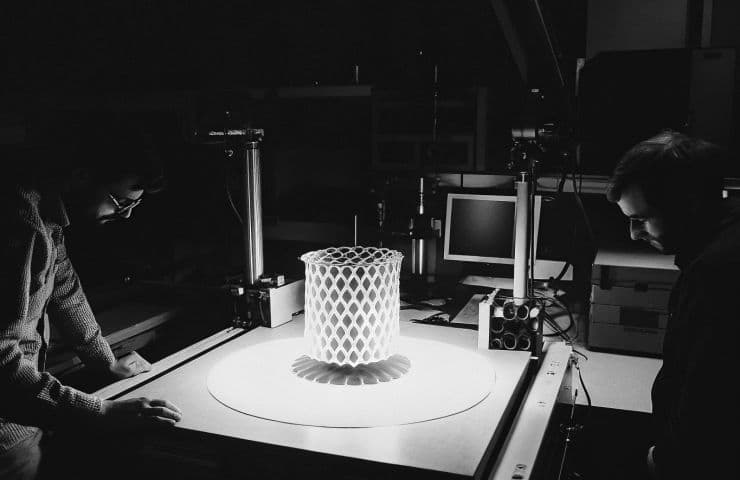
Prof. Vincenzo Esposito's team at DTU Energy didn't tweak an existing fuel cell stack. They threw the whole flat-layer paradigm out and printed something closer to a butterfly wing than a conventional electrochemical device, and the result, published in *Nature Energy*, is a solid oxide fuel cell (SOFC) hitting a power-to-weight ratio of approximately 1 W/g against the 0.2 W/g typical of planar architectures.
The project is called "Escape Flatland," which about says it all. For decades, SOFC development meant stacking flat ceramic layers separated by metal interconnects and sealed with gaskets, then incrementally squeezing efficiency improvements out of that same geometry. Esposito's group at the Department of Energy Conversion and Storage, with structural analysis contributed by Associate Professor Venkata Karthik Nadimpalli of DTU Construct, scrapped the stack entirely and replaced it with a monolithic gyroid: a triply periodic minimal surface structure that maximizes surface area within a given volume while remaining mechanically stable. The same geometry appears in butterfly wings, coral, and high-performance heat exchangers, but this is its first application in a solid oxide cell.
The hardware that made it possible is a Lithoz CeraFab system running lithography-based ceramic manufacturing (LCM). The material is Lithoz 8YSZ, Yttria Fully Stabilized Zirconia, used here as a self-supporting electrolyte membrane. LCM gave the team the resolution needed to print thin-walled gyroid structures as a single unit, something that had blocked this approach for years. Without sufficiently precise and reproducible ceramic printing, the inner gas-flow geometry and the gas-tight outer shell simply couldn't coexist reliably in one part.
What the monolithic design eliminates matters as much as what it prints. There are no metal interconnects. There are no sealants. Those two components have historically been the weakest links in planar SOFC stacks, adding weight, introducing thermal mismatch stress, and creating the corrosion and sealing failure modes that keep SOFCs out of aerospace and mobile applications. Removing them collapses the manufacturing process to five steps and cuts mass dramatically. Volumetric power density clears 3 W/cm³, and in electrolysis mode the cell produces hydrogen at a mass-specific rate of around 7×10⁻⁴ Nm³/h/g, roughly an order of magnitude above conventional planar stacks.
Johannes Homa, CEO of Lithoz, put it directly: "These components have traditionally been considered the Achilles heel in the quest for higher power density in commercial planar SOFC stacks. Their revolutionary monolithic concept eliminates the need to incrementally optimize exit points, paving the way for a complete rethink of fuel cell design."
The cell is also reversible. It runs in SOFC mode converting hydrogen to electricity, or flips to SOEC mode as an electrolyzer producing hydrogen. That switchability, combined with the elimination of metal parts, is what opens the door to aerospace and space applications where weight budgets are brutal and component count needs to stay low.
DTU has flagged LCM as a key enabling technology for the project and is planning to scale to industrial production. The leap from a lab-printed gyroid to volume manufacturing of complex monolithic ceramics is not trivial, but the 500% performance gain gives the team a strong argument for the engineering investment. For the 3D printing community, this is a clear proof point that ceramic additive manufacturing via LCM can do something that conventional subtractive or tape-casting processes genuinely cannot: produce a single-piece, gas-tight, thin-walled three-dimensional electrolyte with no post-assembly sealing required.
If DTU pulls off the scale-up, the fuel cell industry's relationship with flat stacks, metallic interconnects, and incremental optimization may be coming to a close.
This article was produced by Prism’s automated news system from verified source data, official records, and press releases, then run through automated quality and moderation checks before publishing. The system is built and supervised by the people who set the standards it runs under. Read our full AI policy.
Did this article answer your question?