Entry-Level 3D Printers Drive Market Rebound in Q1 2025
Budget printers are pulling 3D printing out of its slump, and that should mean fiercer competition, faster feature trickle-down, and better buying windows for home users.
The rebound starts with the cheapest machines
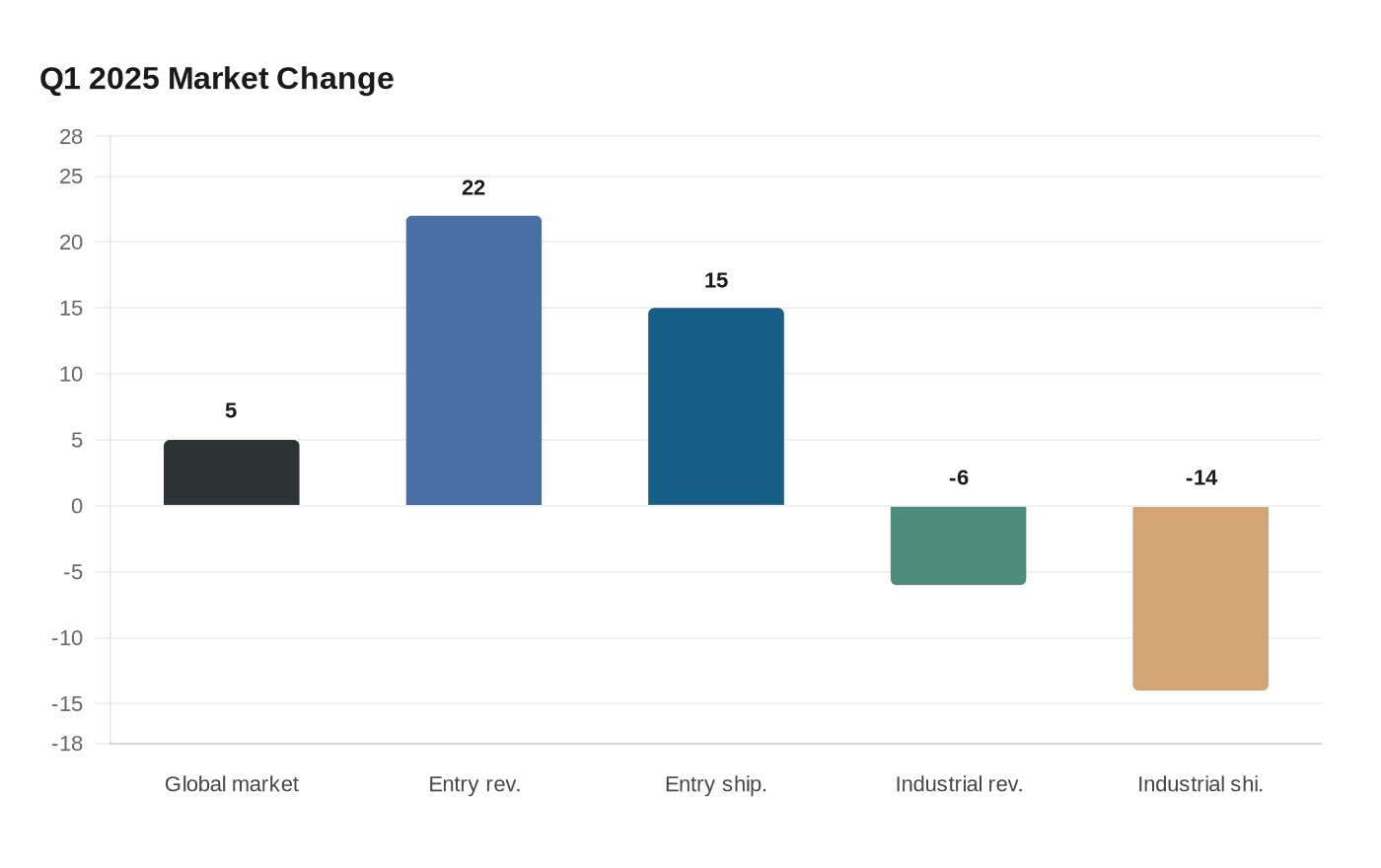
The clearest sign that desktop 3D printing is moving again is not a headline industrial contract or some six-figure factory cell. It is the budget shelf. CONTEXT says the global 3D printer market rose 5% year over year in Q1 2025, and that gain came entirely from entry-level systems, where revenues jumped 22% and shipments climbed 15% to more than one million units worldwide. At the same time, industrial revenue fell 6% and industrial shipments fell 14%, which tells you exactly where the energy is right now.
That matters because the entry-level tier, which CONTEXT defines as machines under $2,500, is where the hobby market lives. It is the broadest, most visible part of the industry, the place where new buyers arrive, community chatter starts, and feature expectations get reset. When that segment grows this hard, the whole market tends to feel it in lower prices, faster feature trickle-down, and more competition for the same wallet.
Why this rebound looks different from a normal uptick
This is not a clean, even recovery across the stack. CONTEXT’s fourth-quarter 2024 update showed a sector that was still under pressure almost everywhere else, with industrial printer sales down 6%, midrange sales down 18%, and professional shipments down 11%. Q1 2025 did not erase that weakness. It simply showed that consumer-facing printers were strong enough to drag the overall market back into growth.
The reason, according to CONTEXT’s Chris Connery, is part panic-buying and part real demand. Consumers and channel partners rushed purchases ahead of threatened U.S. tariffs on Chinese goods, while high interest rates, inflation, and unstable business conditions kept business spending soft. That mix matters for timing. Some of the quarter’s volume was clearly pulled forward, which means buyers should not assume every sale wave turns into permanent demand. But it also shows where confidence still exists, and that confidence is sitting squarely in the lower-cost bracket.
The brands setting the tone
The market signal gets even clearer when you look at the names driving the conversation: Bambu Lab, Creality, and Prusa. These are not fringe players. They are the brands shaping what hobbyists now consider normal, and each one has pushed the entry-level and prosumer line in a different direction.
Bambu Lab launched the H2D on March 25, 2025 as a hybrid personal-manufacturing machine, combining 3D printing with laser cutting, engraving, pen plotting, and cutting. That is a very specific kind of ambition. It says the winning machine is no longer just the one that lays down plastic cleanly. It is the one that folds several workshop tasks into one box and makes the whole experience feel simple.
Creality has taken a different tack with the K2 Plus Combo, which it positions around a 350 x 350 x 350 mm build volume and a multicolor, multi-material system. That is the sort of spec sheet that tells you where the race is headed: more color, more automation, and more capability packed into a machine that still lives in the reach of serious hobby buyers.
Prusa’s CORE One, announced in late 2024 and shipping from January 2025 at an introductory price of $1,199, adds another important marker. It shows that even a company with a deep reputation for reliability is pushing into a sharper value equation. A machine at that price does not just compete on print quality. It competes on what buyers can justify spending when they compare it against the rising feature set in the rest of the market.
What the market share shift says about buyer behavior
The most revealing year-end snapshot came from Context data showing Bambu Lab at 37% share of the sub-$2,500 segment in full-year 2025, overtaking Creality. That is not a small shuffle. It says the budget market is not only growing, it is reorganizing around newer brands that are winning share quickly.
Bambu Lab’s ecosystem is part of that story. MakerWorld reportedly reached about 10 million monthly active users by the end of 2025, with around 2.6 million original models and an 83% one-year retention rate. Those numbers matter because they show how a printer brand can turn hardware sales into a loop of software, content, and community momentum. In practical terms, that is the kind of flywheel that keeps a machine line hot long after launch day. It also helps explain why community-driven brands can pull ahead so fast in a category where specs alone used to be enough.
What this means for prices and features over the next 6 to 12 months
For buyers, the next 6 to 12 months should bring better value, but not necessarily universal price cuts. The smarter read is that feature-per-dollar is going to keep improving in the sub-$2,500 space as brands fight for share. Expect more multicolor and multi-material options, more enclosed designs, more automation, and more aggressive software integration as companies try to close the gap between “budget” and “premium” without actually charging premium prices.
That also means tougher competition and a likely flood of me-too machines. Once a few brands prove that speed, enclosure, and multicolor can sell at hobbyist prices, everyone else tries to copy the formula. The winners will be the machines that are not just fast on paper but actually pleasant to live with, with solid slicer support, reliable calibration, and an ecosystem that does not fall apart after the first spool change.
There is one caution flag, though. Because some of the Q1 surge was driven by tariff anxiety, the market may not translate that quarter into immediate across-the-board discounting. Instead, the next phase is more likely to show up as bundles, refreshed versions, and sharper spec battles. If you are shopping now, the best deal may be the machine that quietly inherits flagship features while the old guard scrambles to keep its price in line.
The bigger picture is simple: budget printers are not just recovering the market, they are redefining it. The brands that understand that shift will set the pace for the hobby over the next year, and the buyers watching from the sidelines will have more capable machines to choose from than they did before the slump ever started.
This article was produced by Prism’s automated news system from verified source data, official records, and press releases, then run through automated quality and moderation checks before publishing. The system is built and supervised by the people who set the standards it runs under. Read our full AI policy.
Did this article answer your question?