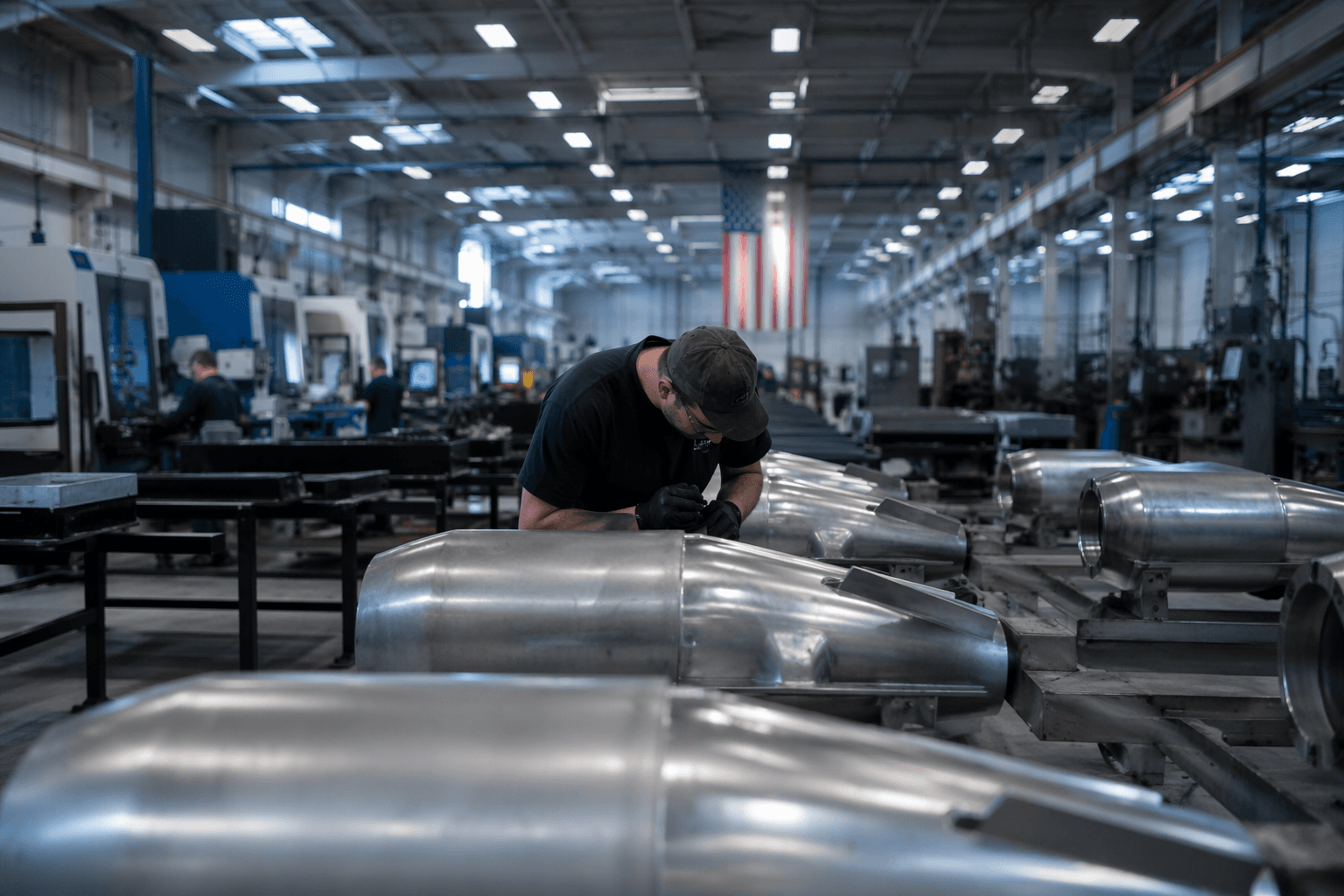
Eplus3D metal 3D printing reaches production at Hankook Precision Works
Hankook Precision Works has run 100,000 tyre sipe cuffs on Eplus3D’s EP-M300, moving the metal AM job from pilot to repeatable production.

Metal additive manufacturing has moved from evaluation to factory work at Hankook Precision Works, where Eplus3D’s EP-M300 has already produced about 100,000 tyre sipe cuffs with stable quality and consistent performance. A second EP-M300 was deployed after the first machine was installed at Hankook’s China facility in September 2025, ran pilot production, and then entered regular use.
That volume matters because tyre sipe cuffs are not showpiece parts. They need fine feature resolution, good surface quality, and tight repeatability, the sort of requirements that push conventional processes hard and make metal AM worthwhile when geometry and quality control matter more than sheer throughput. Eplus3D said the system was assessed on part quality, data security, production readiness, and overall cost performance before the workflow was brought into production.

The machine at the center of the program is Eplus3D’s EP-M300, a dual-laser system with a 300 x 300 x 450 mm build volume. Eplus3D said it supported the Hankook workflow with on-site training, process-parameter development, and part testing, underscoring that the project was built as an industrial process rather than a one-off parts demo. The company’s own pitch for the platform also leans on production-oriented features such as real-time monitoring, powder recycling, lower gas consumption, and longer filter life.

For Hankook, the project fits a broader effort that has been building for years. Hankook Precision Works launched its 3D Printing Convergence Technology Center in August 2023 at the Hankook Engineering Lab in Yuseong-gu, Daejeon Metropolitan City, Korea. The center spans about 661 square meters and is staffed by 15 experts overseeing the production process. Hankook & Company said demand for 3D-printed kerf was rising because of its role in EV tires and high-performance vehicles, where reduced noise, stronger grip, and better handling are critical.

Hankook said 3D-printed molds can shorten tire production time compared with conventional molds and help maintain consistent quality in multi-part puzzle molds. The company, founded in 1973, also said Hankook Precision Works was the first tire mold manufacturer in Korea to adopt a metal 3D printer in 2015, even as its tire-mold business continues to rely on 5-axis machining and casting technologies. The latest EP-M300 deployment shows that, in this corner of manufacturing, additive is no longer just about making complex shapes. It is about making them again and again, at production pace.
This article was produced by Prism’s automated news system from verified source data, official records, and press releases, then run through automated quality and moderation checks before publishing. The system is built and supervised by the people who set the standards it runs under. Read our full AI policy.
Did this article answer your question?