Institute of Mechanics CAS completes suborbital laser metal 3D printing test
A CAS Institute of Mechanics payload autonomously laser wire-fed metal 3D printed parts in a short microgravity window after a suborbital flight to about 120 km, then returned by parachute.
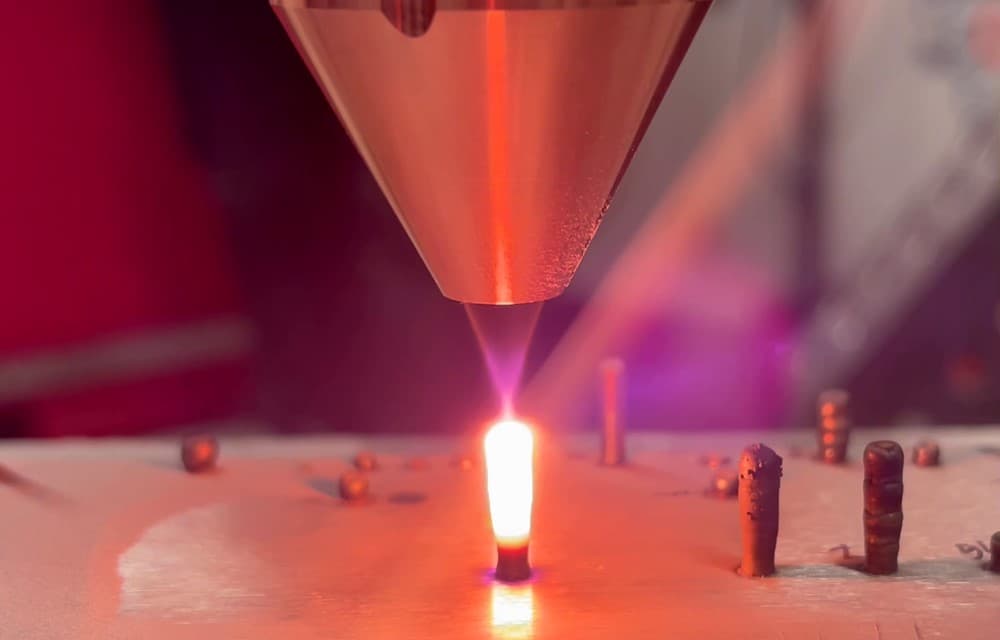
A retrievable experimental payload from the Institute of Mechanics at the Chinese Academy of Sciences autonomously fabricated metal components during a suborbital flight that crossed the Kármán line and reached roughly 120 kilometers before returning to Earth under parachute. The run marks a move from ground testing toward in-space engineering verification for metal additive manufacturing and gives researchers process data from a true microgravity environment.
The payload, identified by one developer as LAM-MG-R1, used laser wire-fed additive manufacturing to deposit metal in microgravity. Emake3d described the experiment as having "as its core objective to verify the feasibility of laser wire-fed metal additive manufacturing technology in the microgravity environment of space, obtain critical process parameters and performance data, and provide support for subsequent iterations of in-orbit manufacturing technologies." CAS characterized the flight as a milestone, saying, "This success marks China’s transition from ‘ground-based research’ to a new phase of ‘space engineering verification’ in metal additive manufacturing technology," and "Our overall technical capabilities have reached world-leading levels."
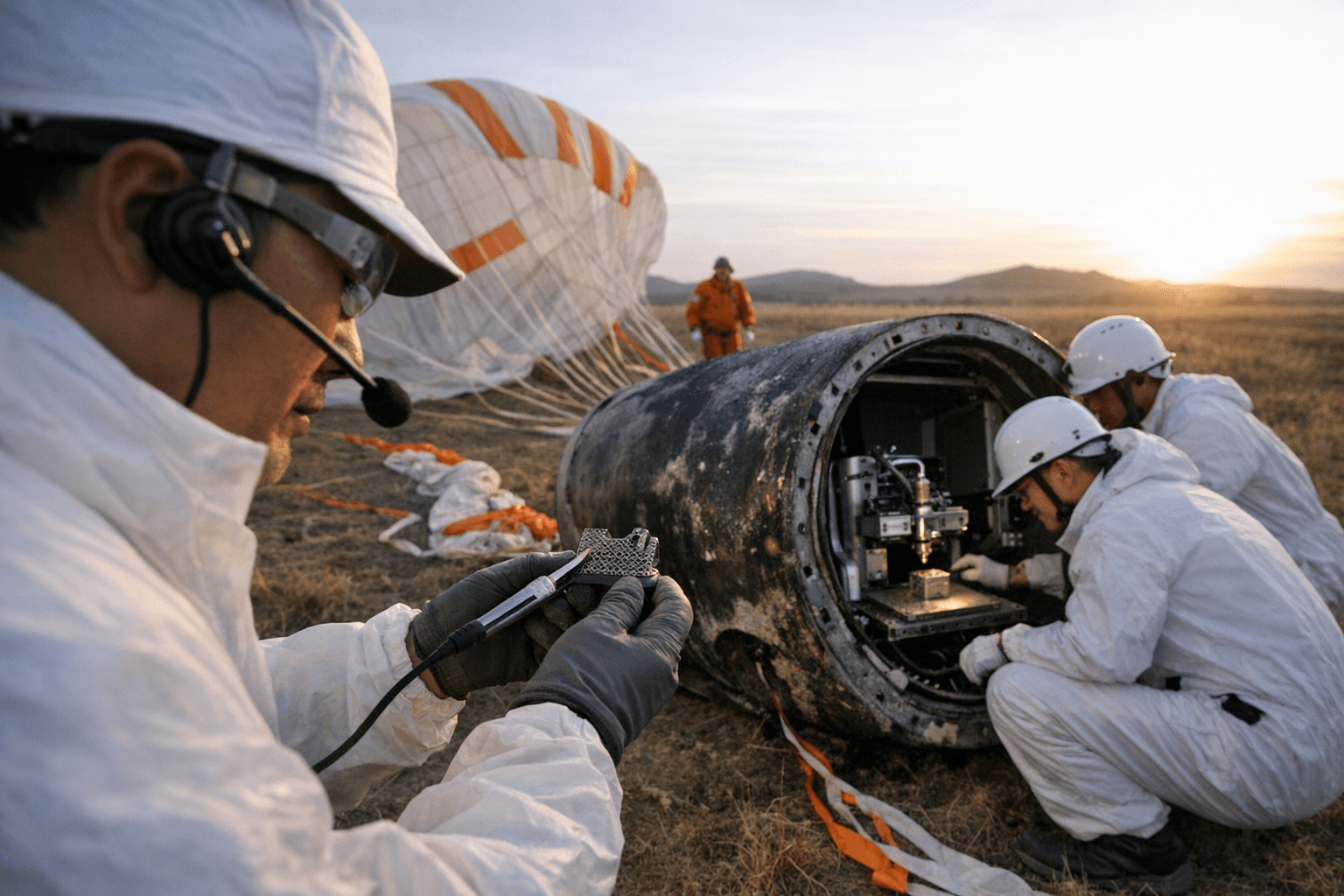
Flight details are consistent across reports: the reusable commercial suborbital vehicle lifted from Jiuquan Satellite Launch Center and reached an altitude near 120 km, producing a short microgravity window during which the experiment ran autonomously. The return capsule deployed a parachute and was safely recovered. Researchers plan to analyze returned samples and logged data for melt pool behavior, solidification, and the dimensional and mechanical properties of printed parts to assess how microgravity alters key process responses compared with Earth builds.
The mission tackles core challenges the metal-printing community has long discussed: stable material transport and shaping in microgravity, closed-loop full-process control, and high-reliability coordination between payload and vehicle flight profile. Those constraints make suborbital tests useful stepping-stones rather than replacements for sustained microgravity rigs. By comparison, metal printing aboard the ISS in 2024 produced multiple samples in sustained microgravity that were returned to Earth for detailed testing, while parabolic flight tests typically offer only seconds of zero gravity and limited layer deposition.
Reporting used different names for the launch vehicle across outlets, including Lihong-1 Y1, Lijian-1 Y1, and Li Hong No. 1; the naming variants appear to describe the same inaugural test flight from Jiuquan on Jan. 12. The suborbital platform is being developed as a multipurpose reusable spacecraft with ongoing testing aimed at integrating crew life-support systems and escape technologies to support low-cost suborbital research and eventual commercial space tourism.
For the desktop machinist and space-printing hobbyist this matters because it adds real microgravity process data to the community toolbox and advances wire-fed laser strategies that are already attractive for robust in-orbit fabrication. The next steps are detailed post-flight analysis of melt-pool and mechanical results, clarification of vehicle naming and payload specs, and follow-up flights that extend microgravity dwell time or move toward sustained orbital trials.
This article was produced by Prism’s automated news system from verified source data, official records, and press releases, then run through automated quality and moderation checks before publishing. The system is built and supervised by the people who set the standards it runs under. Read our full AI policy.
Did this article answer your question?