Low-cost, Rapid, Customizable Body-powered 3D-Printed Finger Prostheses Show Clinical Promise
A body-powered, 3D-printed finger prosthesis that can be modeled from nine measurements, printed in one day and built for about $30 showed feasible use and task gains in two work-related amputees in Korea.
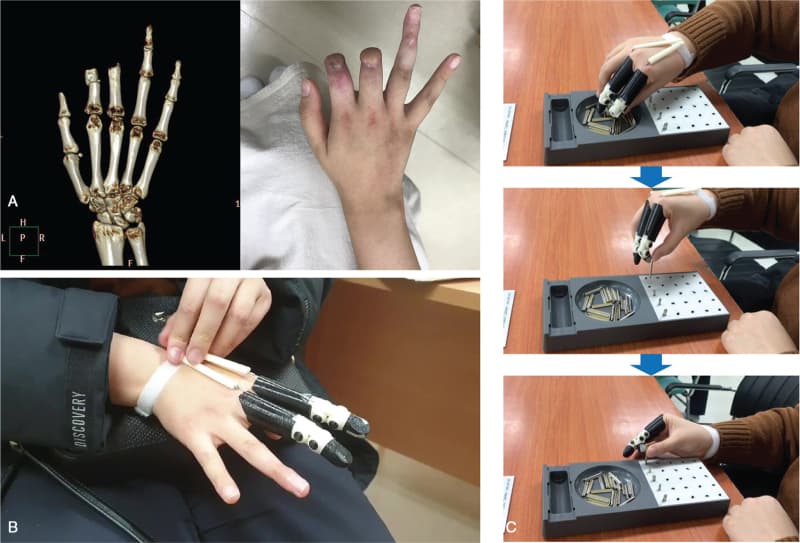
A pair of clinical case reports shows a body-powered, 3D-printed finger prosthesis can be produced in one day for approximately $30, modeled from just nine parameters, and delivered with prosthetic training to two work-related finger amputation patients in Korea. Authors Seung Hak Lee, Ja-Ho Leigh and Gangpyo Lee led the effort and concluded, "These case reports showed that body‑powered 3D‑printed finger prostheses are feasible."
The team wrote that they "fabricated 3D‑printed finger prostheses using a source code downloaded from e‑NABLE" and thanked the patients for participating. Author contributions list Seung Hak Lee, Ja-Ho Leigh and Gangpyo Lee on conceptualization, with Min-Yong Lee and Sol Han on data curation and Hyung Seok Nam, Eun Young Hwang and Jung Yeon Lee on methodology, reflecting a small clinical group moving an open-source design into hands-on practice.
Functional results were mixed but promising. Both patients "were satisfied with 3D‑printed finger prostheses and improved in functional evaluation." The first patient showed no definite improvement in hand function but demonstrated a COPM performance gain in cooking after training. The second patient "showed improved JHFT and COPM performance of typing after two months prosthesis training." The reports used COPM, JHFT and VAS among their assessment tools, and explicitly state that patients "underwent sufficient prosthetic training."
The authors emphasized the rapid, low-cost pipeline: "Modeling of the prosthesis can be performed easily by measuring only 9 parameters, and only 1 day was required for fabrication with a 3D‑printer." They contrasted the device cost to commercial options, noting "the cost of the 3D‑printed finger prosthesis in this study was very low (approximately $30) compared to the cost of a commercial body‑powered prosthetic finger, which can range from $4000 to $10,000." The meeting abstract accompanying the cases lists "Level of Evidence: Level I," even as sample size remained two patients.
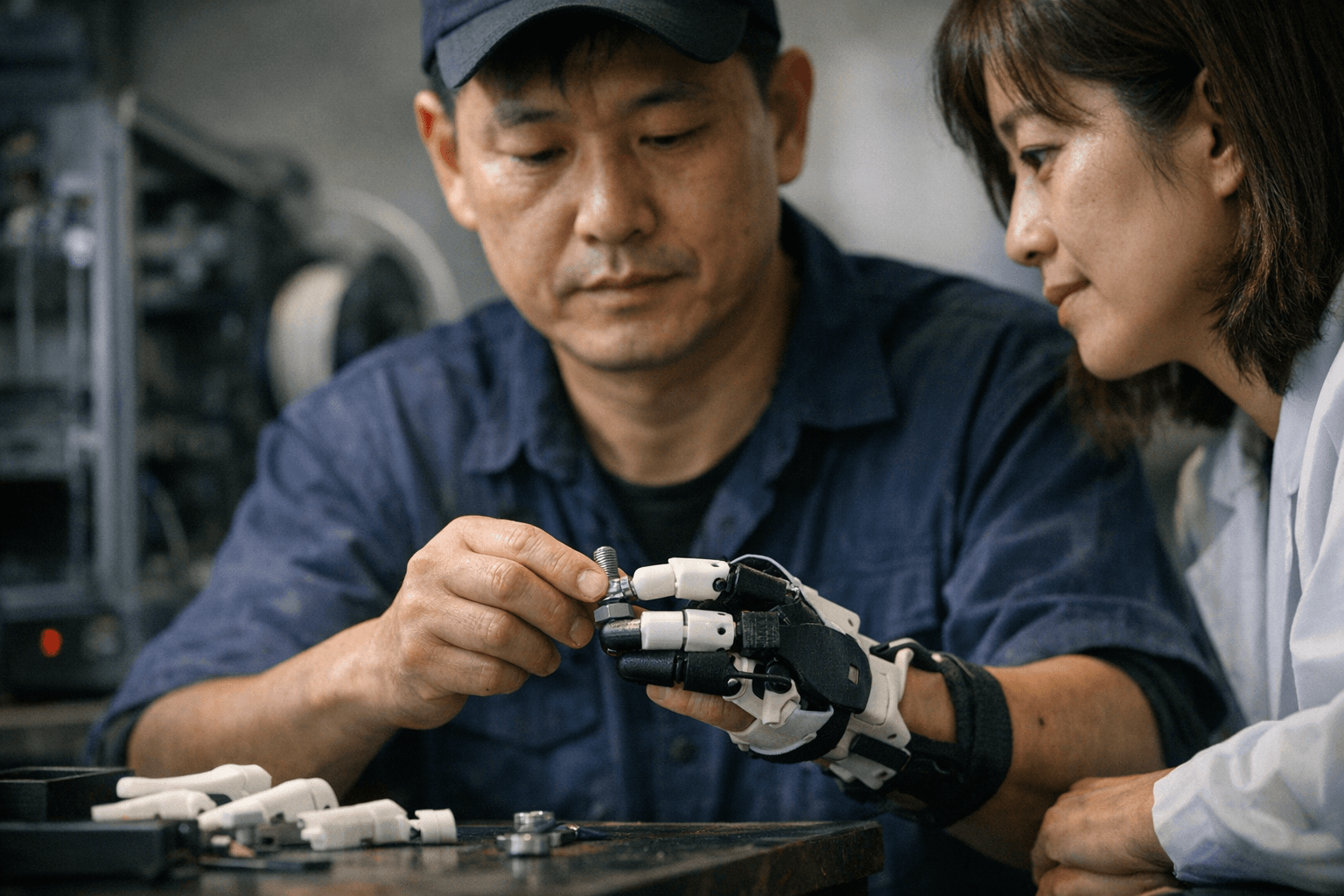
Design and manufacturing context highlights why body-powered partial-digit devices are being pursued. By avoiding motors, batteries and sensors, the devices use "cables, linkages and elastic returns to produce repeatable motion," and additive manufacturing "brings fast iteration, individualized geometry and the ability to align part strength with load paths during printing." Partial finger loss imposes constraints: less room for linkages, higher demand for comfort under shear, and a trade-off between cosmetic shape and functional leverage.
Other recent prototypes illustrate tradeoffs for materials and mechanics. Investigators printing on an Ultimaker 3 with PLA noted that "The hand achieves adaptive grasping even though it is made out of only two parts," while also reporting that "the material for the leaf spring was deemed 'not suitable' for durability and reliability over the long term." That work described internal components such as leaf springs, whippletree mechanisms and a driving link, and argued that a non-assembly design could aid delivery through local service networks.
The Korean authors close with a practical call: "We hope to provide a functional prosthetic finger at an affordable price. In the future, a large study with a 3D‑printed finger prosthesis should be performed to confirm the clinical effectiveness and cost‑effectiveness." The abstracts also caution that "conventional physical and occupational therapies (e.g. range of motion exercise) should be accompanied for better prosthetic use," underscoring that rapid, $30 devices may need paired rehabilitation and longer-term durability data before they shift clinical practice.
This article was produced by Prism’s automated news system from verified source data, official records, and press releases, then run through automated quality and moderation checks before publishing. The system is built and supervised by the people who set the standards it runs under. Read our full AI policy.
Did this article answer your question?