Magma fork aims to strengthen 3D prints with vertical material paths
Magma’s OrcaSlicer fork attacks FDM’s weakest link by injecting plastic into vertical channels, but patent overlap could keep it from mainstream slicers.
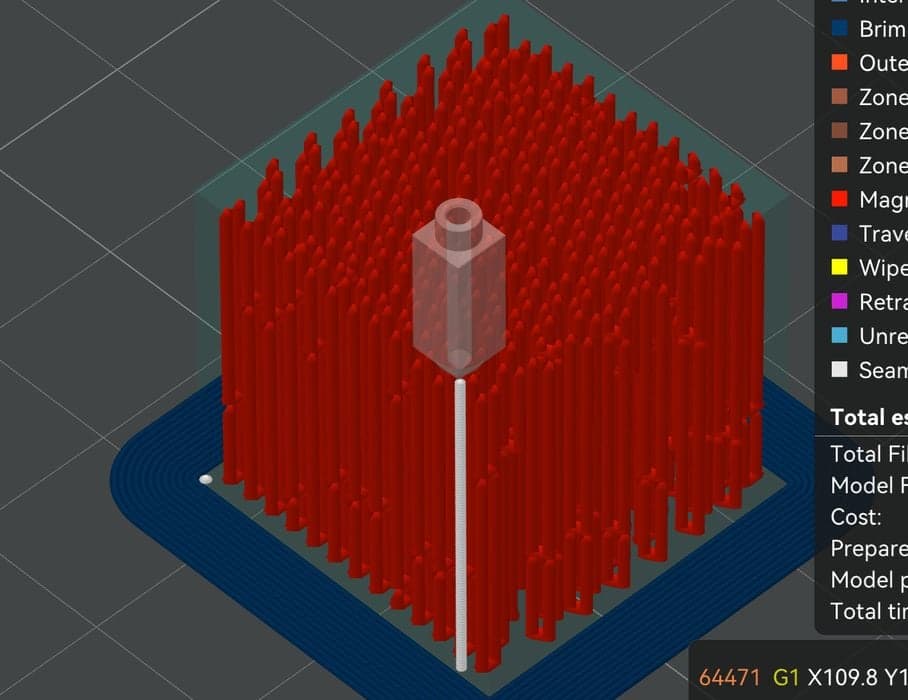
Magma tries to reinforce FDM prints from within by building vertical material paths inside the part. It targets a familiar failure mode: a part can look solid on the outside and still split along the Z axis when the layers give way. It does that without asking hobbyists to buy a new printer.
How Magma changes the toolpath
Magma is a fork of OrcaSlicer, the open-source G-code generator that already supports a broad spread of printer ecosystems, including Bambu, Prusa, Voron, VzBot, RatRig, and Creality. The Magma project adds a triangle-like infill structure that creates sealed vertical U-shaped channels inside the model. During the print, the nozzle drops into one of those channels, extrudes a column of plastic, lifts, and moves on to the next channel.
That shift in toolpath changes the direction of reinforcement. Standard FFF printing builds parts in layers, and the bond between layers is often the weak point. Magma tries to put material where layer lines are least helpful, giving the part internal columns that run ninety degrees to the usual stack. In plain terms, it is trying to make the inside of the part do more of the structural work before the outer shell ever comes into play.
In the project’s own README, the slicer-side concept works; at the time of that description, it had not yet produced a clean physical print. The final proof still depends on whether the printer can execute the path cleanly enough to turn the concept into repeatable parts.
What kinds of parts could benefit
Brackets, mounts, mechanical fixtures, and other load-bearing prints are exactly where layer-line failure is most frustrating. If Magma or a similar workflow can strengthen those parts without any hardware changes, it would fit neatly into the way many home users already slice and print.
Magma’s defensive publication presents the system as a complete software method for vertical reinforcement in FDM, using a triangular lattice infill pattern with hollow channels that are filled with injected molten plastic on a per-layer basis. It is an attempt to make the part’s internal structure behave more like a reinforced volume than a stack of flat slices.
The concept stays inside the slicer. No new extruder, no special filament, and no machine conversion are required in the concept as presented. In the concept as presented, molten plastic is injected into sealed lattice channels during printing for continuous solid Z-axis reinforcement, with no hardware modifications.
Why this is different from ordinary strength tuning
Most strength gains in hobby printing come from familiar settings: more walls, thicker top and bottom layers, denser infill, better orientation, or tougher materials. Magma is trying to change the geometry of the reinforcement itself. Instead of merely packing more plastic into the same layer-based structure, it introduces deliberate vertical paths that give the part internal support where layer adhesion is usually weakest.
If it works at scale, slicers would do more than lay out paths; they would shape how a part carries force.
The patent problem hanging over the idea
The biggest obstacle is not the toolpath. It is intellectual property. AIM3D GmbH and Create it REAL have already pushed a similar concept called Voxelfill, and AIM3D has a related patent, EP4100235B1, with an EP4100235A1 publication. Create it REAL and AIM3D announced their Voxelfill collaboration at Formnext in October 2023. In 2024, Create it REAL put the system at up to 81% of XY strength in the Z direction. By October 2025, Create it REAL had advanced Voxelfill technology available through REALvision Pro in an early-access phase.
Magma is not entering a blank field. A feature that looks like a clever open-source breakthrough can still brush up against earlier filings if the method overlaps too closely. For slicer developers, that can be enough to slow adoption, narrow distribution, or force major changes before a feature can land in a mainstream release.
Bricklayers, another strength-improving slicer idea, hit patent concerns in February 2025, including older Stratasys prior art and a more recent ADDMAN Group patent.
What to watch next
OrcaSlicer already has the ecosystem reach to matter, and Magma’s vertical injection concept targets one of the oldest complaints in FDM with a very specific answer: build inside the part, not just across the layers. The question is whether the implementation can move from a working slicer-side idea to a clean, reliable print path that hobbyists can actually trust.
This article was produced by Prism’s automated news system from verified source data, official records, and press releases, then run through automated quality and moderation checks before publishing. The system is built and supervised by the people who set the standards it runs under. Read our full AI policy.
Know something we missed? Have a correction or additional information?
Submit a Tip