Maker Recycles 3D Print Waste Into Reusable Parts With Molded PLA
Failed PLA prints became flat reusable parts in a toaster oven, and the mold even trimmed its own flash cleanly. The catch: PLA worked best.
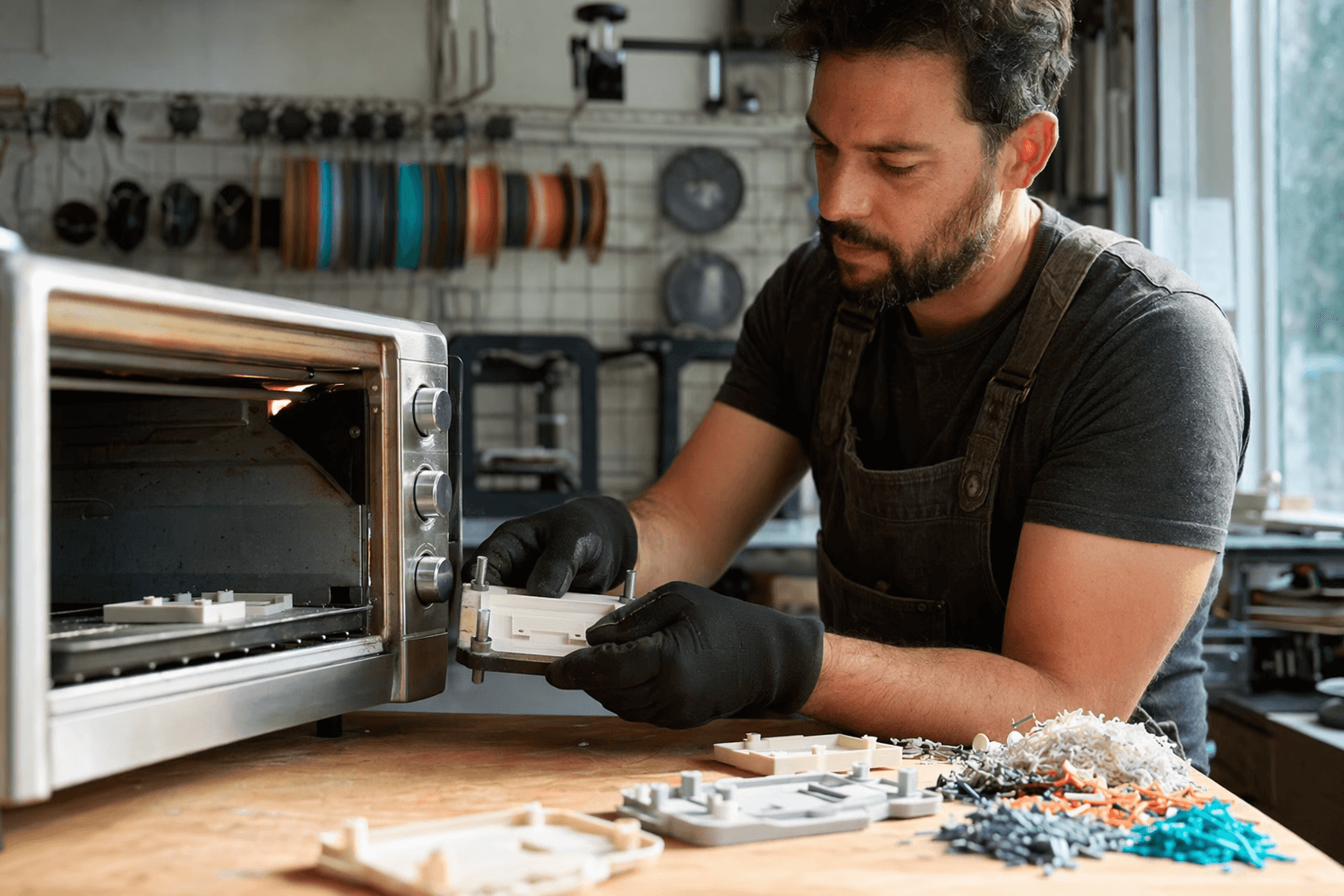
The pile beside a desktop printer finally has a second life in one maker’s shop. On future things, a low-tech compression-molding setup turned failed PLA prints, purge towers and support scraps into reusable flat parts and simple components using nothing more than a toaster oven, shredded plastic and 3D-printed molds.
The latest version of the process used a three-part mold printed in PHA, a change that opened the door to more complex geometries than the creator’s earlier, simpler setup. That detail matters because it moves the idea away from one-off recycling novelty and toward a repeatable bench-top method for small batches of tokens, game pieces, spacers and other parts that do not need industrial-grade tooling. The mold also cut off excess material cleanly at the parting lines, which reduced or eliminated post-processing and made the finished pieces look far more deliberate than the usual melted-plastic experiment.
The most practical lesson was that PLA is the easiest material to process in this setup. The creator revisited earlier tests to work through questions of material choice, temperature and handling, and found that LDPE and HDPE could also be formed, but only with different timings and temperatures. That kind of sensitivity is exactly why the workflow stays in the hobby lane: it is accessible, but it still demands attention. Even the tools mattered. Metal sticks were abandoned because they cooled the softened plastic too quickly, and wooden sticks gave the creator better control during compression.
For desktop makers, the appeal is obvious. The method offers a home-scale answer to the waste stream that builds up around FDM printing, especially when PLA is the dominant filament on the bench. The U.S. Environmental Protection Agency lists PLA and ABS among the most popular 3D-printing filament materials, and it also notes that 3D printers can emit ultrafine particles in the 1-to-100 nanometer range during printing. The EPA frames plastics management as a lifecycle problem, which fits the spirit of this experiment: reduce waste where it starts, not after the bin fills up.
That broader context also matches the state of the research. A 2024 review of recycled PLA in 3D printing said more work is still needed on the environmental, economic and social impacts of recycled PLA. Future things’ toaster-oven method does not solve everything, but it shows a realistic path for makers who want to turn dead prints into usable parts without building a filament-extrusion line first.
This article was produced by Prism’s automated news system from verified source data, official records, and press releases, then run through automated quality and moderation checks before publishing. The system is built and supervised by the people who set the standards it runs under. Read our full AI policy.
Did this article answer your question?