Metal Base Kickstarter Offers Desktop LPBF Metal 3D Printer at Low Cost
A Dutch startup's Metal 1.0 Kickstarter offers desktop LPBF for €8,500, but safe metal powder handling, nitrogen supply, and post-processing push the real cost far higher.
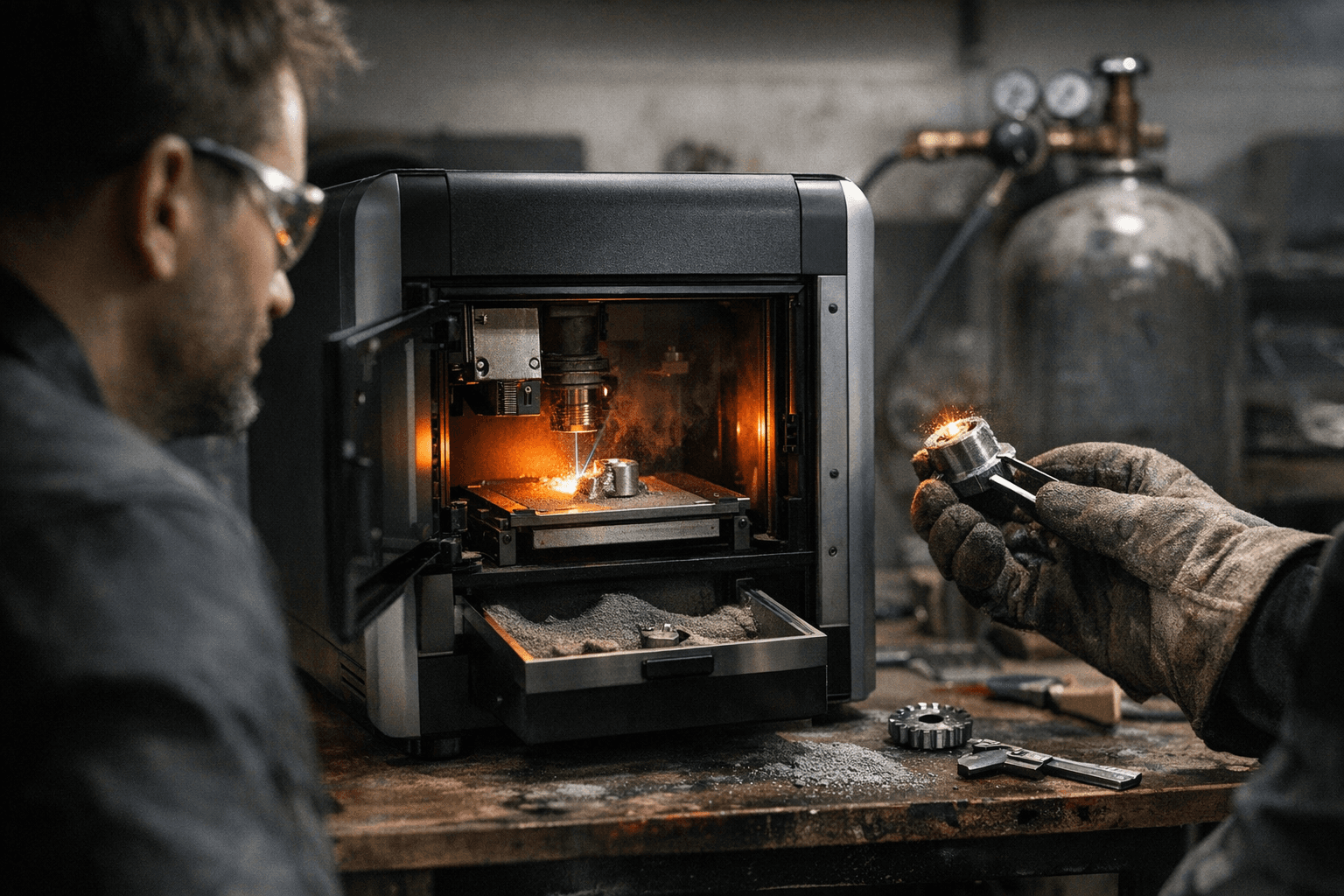
Before the Metal 1.0's Kickstarter campaign closes on April 16, the most important question is not whether a 60-watt diode laser can fuse 316L stainless steel in a desktop enclosure. It can, provisionally. The question is what it takes to do that safely in a garage or spare room, and whether the €8,500 base price reflects anywhere near the true cost of operating it.
Metal Base, a two-year-old Dutch startup headquartered in Geldrop, launched the Metal 1.0 on Kickstarter as an accessible entry point to laser powder bed fusion. The machine's cylindrical build chamber measures 128mm in diameter by 100mm tall, upgradeable to 150mm on the Z-axis, and runs on a standard household power connection drawing under 800 watts, with Klipper firmware handling motion control. Supported materials include 316L stainless steel, Inconel 718, and bronze, with copper flagged for future development.
Those specs read cleanly on a campaign page. The safety picture is harder to compress into a rewards tier.
Fine metal powder for LPBF, including Inconel 718 and stainless, is pyrophoric in the right concentrations, explosive when suspended in air, and an inhalation hazard that mandates respirators rated for metal particulate, not woodshop dust masks. Every powder loading, unloading, and depowdering operation needs to happen in a controlled environment with dedicated PPE, robust powder containment, and filtration capable of capturing sub-micron particles. The Metal 1.0 ships with a fully enclosed build chamber and safety interlocks, which addresses the in-process laser and atmosphere hazard. It does not resolve what happens when a user opens the machine, handles contaminated powder, or stores material between sessions.
Nitrogen is non-negotiable. The machine requires a continuous inert atmosphere to prevent oxidation during printing, sourced either from external cylinders or the optional onboard nitrogen generator, which adds approximately €1,000 to the base price and demands a substantial external air compressor to operate. Whether a compact onboard generator can maintain the purity and flow rates that Inconel 718 or fine stainless actually require is an open question; industrial facilities use dedicated gas supply for a reason, and the Metal 1.0 campaign has not published purity specifications for its generator option.
The laser itself warrants scrutiny. Industrial LPBF systems run fiber lasers at several hundred to 1,000 watts with galvanometer scanning. The Metal 1.0 uses a 60-watt 445nm diode without galvo, meaning significantly slower melt rates and longer per-layer exposure times. Metal Base claims near-full density on 316L and Inconel and says no downstream debinding or sintering is required. Those are substantial claims for a 60-watt diode system, and they need independently tested sample parts, not campaign renders, to evaluate. The layer height of 0.05 to 0.10mm is consistent with professional LPBF practice, but energy density at this power level, and the repeatability of a non-galvo motion system, remain unverified outside the company.
Before backing, run through the specifics: confirm what certifications ship with the machine, request documented energy density parameters and actual layer times at 60W, verify the nitrogen generator's rated purity against published inerting thresholds for each listed material, and ask for independently produced sample parts in both 316L and Inconel 718. Post-processing belongs in the budget from day one. Metal LPBF parts typically require support removal, controlled depowdering, optional machining and tumbling for surface finish, and potentially heat treatment before they carry structural load. Destructive testing is standard practice in any qualified metal AM workflow.
The Metal 1.0 represents a genuinely ambitious engineering project from a small Dutch team, and if the specifications hold under independent scrutiny, it could open a real new category of desktop metal fabrication. But €8,500 is the entry ticket. The full price of operating LPBF safely, in nitrogen, consumables, filtration, PPE, and post-processing tooling, is what separates a successful metal print from an expensive and potentially dangerous failure.
This article was produced by Prism’s automated news system from verified source data, official records, and press releases, then run through automated quality and moderation checks before publishing. The system is built and supervised by the people who set the standards it runs under. Read our full AI policy.
Did this article answer your question?