Microwave-Laser Hybrid System Cuts 3D Printed Ceramic Porosity by 85%
A 2.45 GHz microwave field added to laser ceramic printing slashed porosity by 85.5% to just 0.11% and boosted bending strength by 22.2%, reaching 373.8 MPa.
Porosity is the dirty secret of laser-printed ceramics. Every time a laser blasts through a powder bed, gas bubbles get trapped in the freezing melt, leaving microscopic voids that act as crack initiation sites. For structural ceramics destined for turbine blades or combustor liners, those voids are a hard engineering limit. Prof. Fangyong Niu's team at Dalian University of Technology just reported a fix that sounds almost absurdly low-tech: they added a microwave.
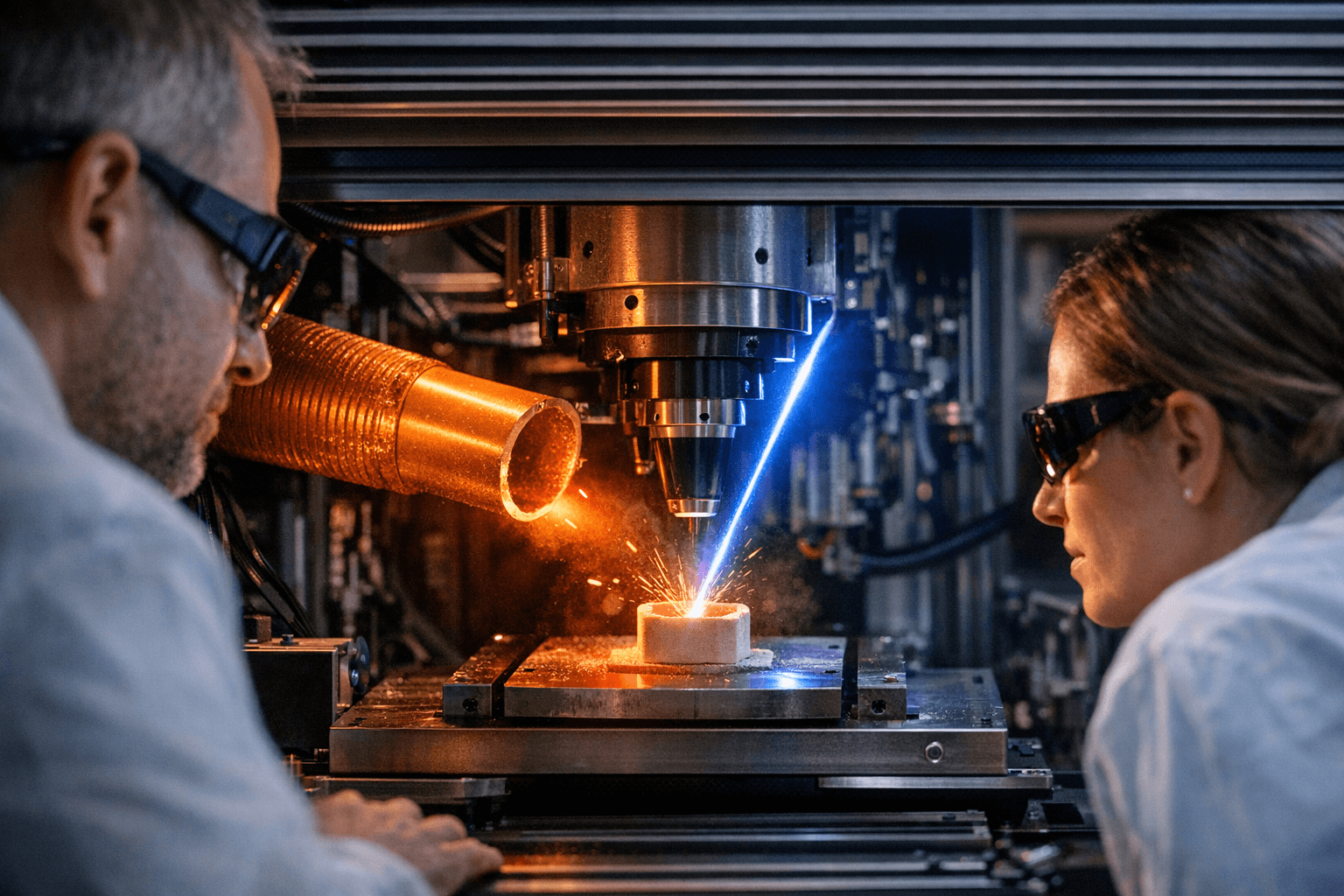
To eliminate these flaws, Prof. Niu's team built a hybrid machine where, as the laser melts the ceramic, the entire printing zone is bathed in a 2.45 GHz microwave field. The paper, titled "In-situ microwave-laser hybrid additive manufacturing for high-performance eutectic ceramics," was published in the International Journal of Extreme Manufacturing and authored by Xuexin Yu, Weiming Bi, Songlu Yin, Dongjiang Wu, Guangyi Ma, Danlei Zhao, and Fangyong Niu. The full paper appeared on February 23, 2026.
The material under test was nano-Al2O3/YAG/ZrO2 ternary eutectic ceramic, a three-phase oxide system prized for surviving the temperatures that destroy conventional alloys. To build components that can survive extreme industrial heat, engineers rely on multiphase oxide ceramics, but shaping these heat-proof ceramics into complex parts is incredibly difficult and energy-intensive. Laser directed energy deposition offers a path forward, but the rapid freeze cycle creates two persistent defects: directional microstructural growth, periodic coarse banding, and high porosity, severely limiting the components' mechanical properties and reliability.
The microwave field attacks both problems through distinct mechanisms. The first is thermal: microwaves penetrate and heat the material volumetrically from the inside out, keeping the tiny pool of liquid ceramic molten for 1.86 seconds, more than double the usual 0.85 seconds. That extended liquid window gives trapped gas bubbles time to escape before the melt locks solid. The team describes the second mechanism as a plasma effect: microwave energy triggers a "plasma effect" that ionizes the gas inside microscopic bubbles, essentially destroying them from the inside out and dropping porosity to near-zero. This extended duration, combined with a critically important in-situ plasma ignited by frequent collisions between laser-provided seed electrons and gas molecules, promotes dramatic densification.
On the layer boundary problem, Prof. Niu told Tech Briefs that "standard 3D printing leaves coarse 'scars' or bands between stacked layers due to uneven cooling," and that "our continuous microwave heating erases these harsh temperature gradients," seamlessly remelting those boundaries and allowing the material to grow into a uniform and highly stable component.
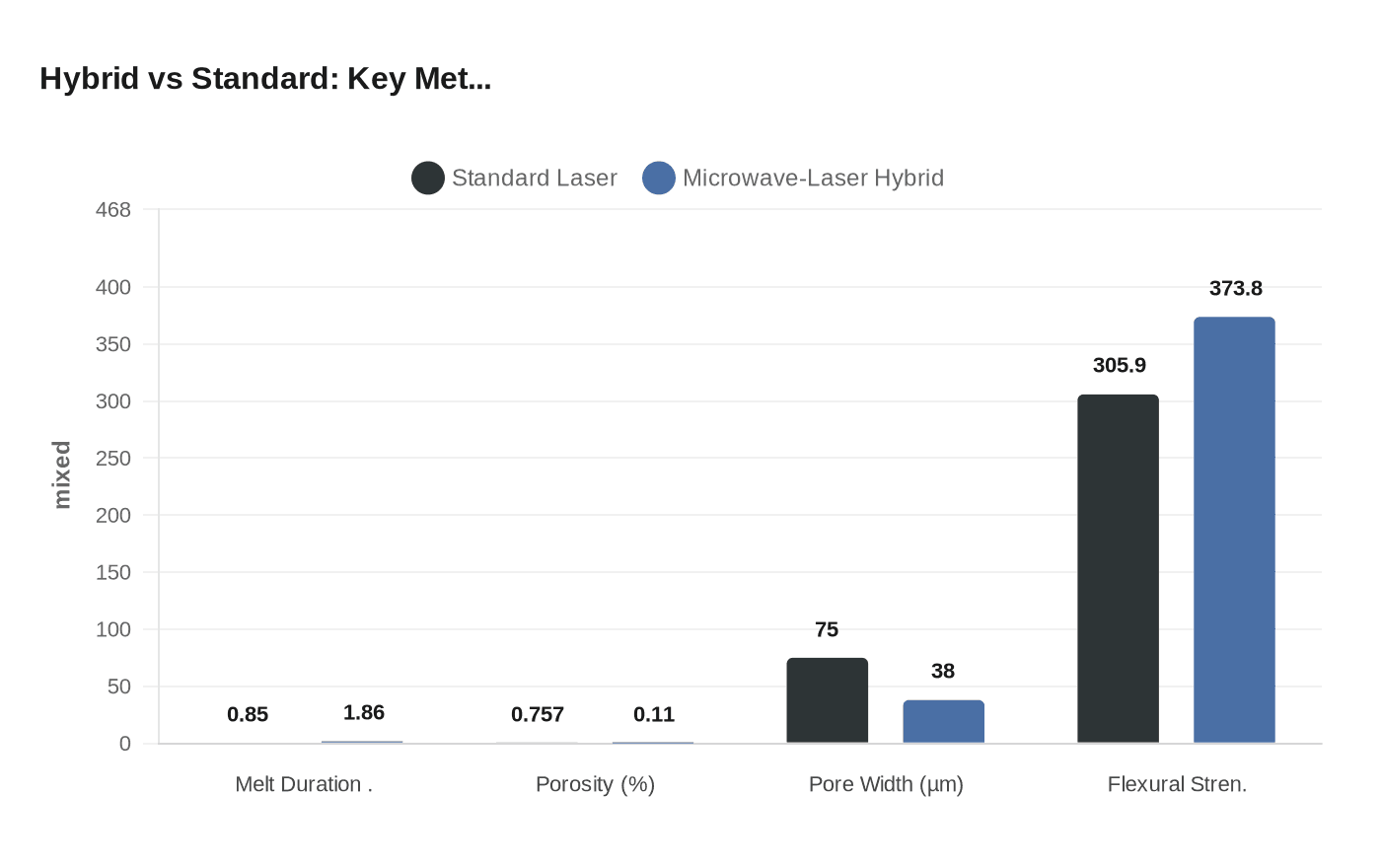
The numbers back it up. The microwave field slashed the total amount of empty space inside the ceramic by 85.5%, bringing the porosity down to a near-zero 0.11%, and the few remaining pores shrank by almost half, dropping to an average width of 38 micrometers. With fewer microscopic holes to act as starting points for cracks, the material can handle 22.2% more bending force before breaking, maxing out at 373.8 megapascals.
Engineering the hybrid machine itself was not trivial. Prof. Niu identified preventing microwave leakage in a highly dynamic manufacturing environment as the most daunting technical challenge. The solution involved a Silicon Carbide susceptor base: the team prints the component on an alumina substrate surrounded by a special SiC heating base, which acts like a "microwave sponge," absorbing the microwaves immediately and heating up like a high-tech hot plate. Cold ceramics do not absorb microwaves directly, so the SiC base provides the initial thermal coupling that gets the system running.
The researchers identified jet engine components, combustor liners, and power plant turbines as target applications. The current demonstration was limited to small-scale test bars produced under laboratory conditions, with the team noting that scaling the technique will require uniform microwave field application over larger volumes and real-time synchronization of the two energy sources. Prof. Niu has signaled broader ambitions for the approach: the team believes this multi-energy hybrid approach is not just a specific solution for AYZ ceramics but a broader platform technology with the potential to revolutionize the additive manufacturing of various advanced materials that are currently deemed "unprintable.
This article was produced by Prism’s automated news system from verified source data, official records, and press releases, then run through automated quality and moderation checks before publishing. The system is built and supervised by the people who set the standards it runs under. Read our full AI policy.
Did this article answer your question?