Mintion V1 filter cuts fumes in real-world Bambu Lab testing
A compact filter made ABS and ASA sessions easier to live with on a Bambu Lab H2S, and the real test is whether that daily usability is worth the price.
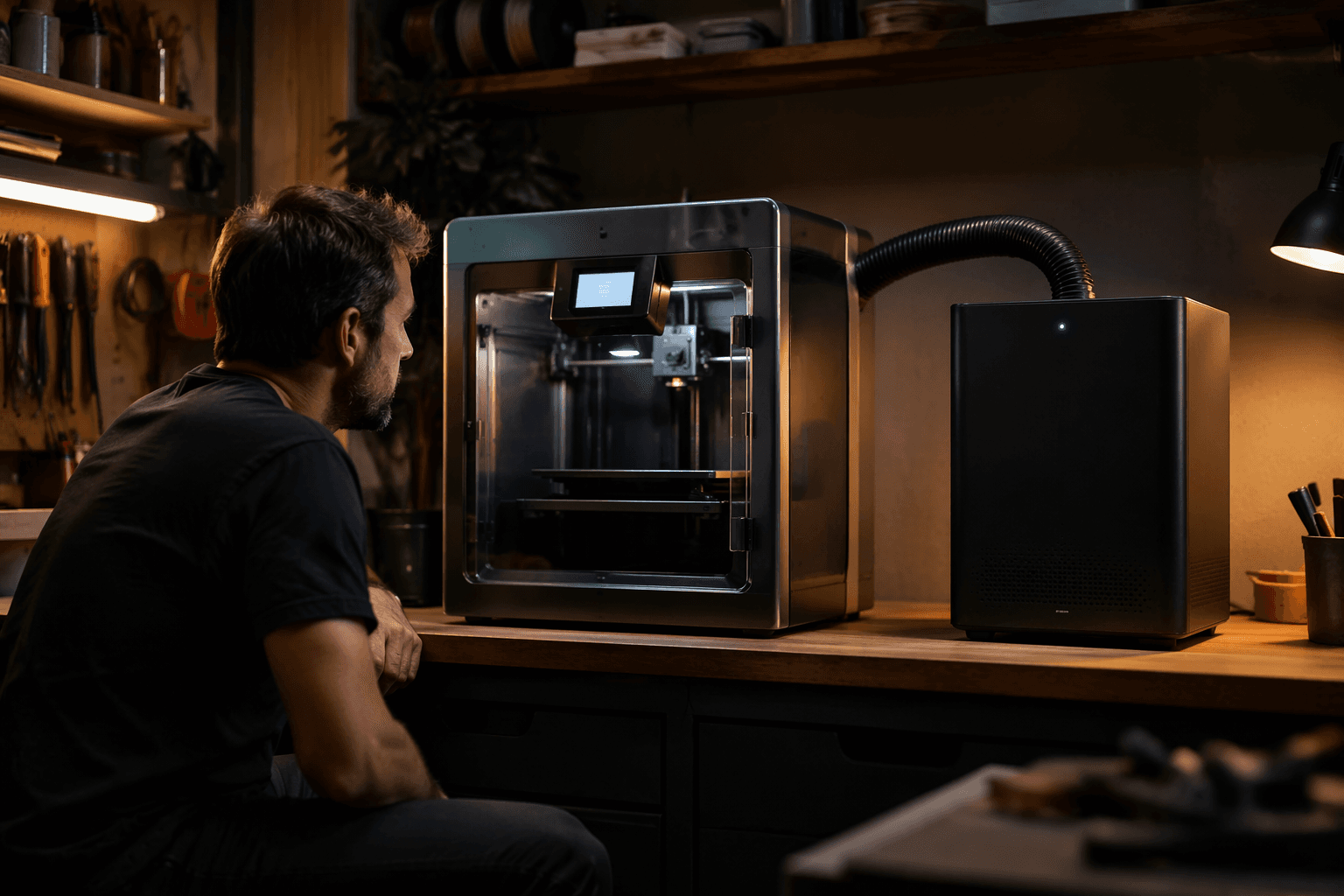
The Mintion V1 is aiming at one of the most frustrating parts of enclosed 3D printing: making ABS and ASA bearable inside a home office, garage, or small workshop. In real-world testing on a Bambu Lab H2S, the compact external filter did more than trim odor, it changed how comfortable the printer was to run across repeated engineering-material sessions.
Why this filter matters for enclosed printers
ABS, ASA, nylon, and polycarbonate are useful materials, but they also bring the familiar tradeoff of fumes, smell, and concerns about what is building up in the room while the printer runs. That is exactly where the Mintion V1 tries to earn its keep. Instead of being just another add-on, it is positioned as a practical response to a real day-to-day workflow problem, especially for enclosed printers that are already being pushed with hotter, more demanding materials.
That practical angle is backed by the broader safety context. The National Institute for Occupational Safety and Health says additive manufacturing can expose workers to potential safety and health hazards. The U.S. Environmental Protection Agency says 3D printers can emit volatile organic compounds and ultrafine particles in the 1 to 100 nanometer range, while the Occupational Safety and Health Administration maintains styrene guidance because styrene exposure is addressed in specific OSHA standards. For anyone printing ABS or ASA at home, that makes odor control feel less like a luxury and more like basic workspace management.
What the Mintion V1 actually is
Mintion markets the V1 as a filtration system for enclosed 3D printers, and the hardware is built around a three-stage stack. The standard setup combines a pre-filter for dust and larger particles, an H13 HEPA layer for ultrafine particles, and a 100 g activated-carbon bed for VOCs. Mintion also describes the unit as using a centrifugal fan, with airflow rated up to 60 cubic meters per hour, which is the kind of figure that matters when you are trying to move air rather than merely claim to clean it.
The pricing keeps it in impulse-buy territory for a lot of hobbyists. Mintion lists the V1 at $74.99 on its U.S. store, down from a regular price of $89.99, and the product is also shown at €65.95 in other pricing references. That puts it well below the kind of budget where a lot of makers would expect to see a meaningful quality-of-life upgrade, which is part of why it stands out.
How it fits into Bambu Lab workflows
The review focused on a Bambu Lab H2S, with ABS, ASA, nylon, and polycarbonate in regular rotation, and the machine was being used as an engineering-material workhorse. That is the right kind of stress test for a filtration accessory, because it checks whether the unit improves the actual experience of running tough filaments, not just whether it looks good bolted to a printer.
Mintion’s default connector is designed to fit Bambu Lab P1S and X1C machines, which makes the V1 especially relevant for one of the largest enclosed-printer ecosystems in the hobby space. For other printers, Mintion points users toward adapters from its connector library or the MakerWorld community. That makes the system more flexible than a one-size-fits-all accessory, but it also means the easiest path is clearly with Bambu Lab machines.
What changed in real use
The strongest argument for the Mintion V1 is not a spec sheet, it is the reviewer’s day-to-day experience. During several print sessions, the usual headaches associated with poorly managed ABS and ASA fumes did not show up. That is the kind of result that matters, because a filter only earns its place if it makes the printer easier to live with every time it runs.
There is also a useful nuance here: the V1 is not just being judged as an odor sponge. It is being framed as something that improves printability in the broader sense by keeping the workspace more usable. If the printer is enclosed, the parts are hot, and the material choice is stubborn, a filtration unit can make the difference between tolerating a print and running it confidently overnight.
Installation is meant to stay in hobbyist territory
Mintion clearly designed the V1 for a straightforward install. The guideline calls for removing screws from the back of the printer, attaching the filter interface and waste-outlet cover, and connecting the included 24V DC power supply. That is exactly the sort of process that works for makers who do not want to turn a weekend upgrade into a wiring project.
The workflow is simple enough that it fits into the way many enthusiasts already modify enclosed machines. There is a duct connection to the printer exhaust, basic screw-in attachment at the back, and then power. For a product focused on usability, that matters almost as much as the filtration itself, because a good filter that is annoying to install quickly becomes a shelf item.
How Mintion expects it to be used
Mintion says the standard filter set should last about three months under roughly eight hours of daily use with general-purpose filaments. That gives buyers a practical replacement horizon rather than a vague promise of long life. It also helps set expectations for anyone running the machine often enough that consumables matter.
The company also points out a more aggressive configuration for ABS and ASA users. In that setup, the pre-filter can be replaced with a second activated-carbon stage, creating a HEPA H13 plus dual carbon stack for stronger odor control. That is a smart option for the exact crowd most likely to care about this product, because it acknowledges that ABS and ASA are not the same as casual PLA printing and need a more focused approach to VOC management.
A small upgrade with a clear payoff
The Mintion V1 does not try to reinvent enclosed printing. It tries to remove a friction point that every ABS and ASA user knows too well, then do it at a price that is low enough to feel approachable. After real sessions on a Bambu Lab H2S, the verdict is less about flashy hardware and more about comfort, consistency, and whether the printer can live in the same room as the rest of your day.
That is where the V1 makes its case. If the problem is fumes, odor, and keeping an enclosed machine usable in a normal workspace, Mintion’s filter looks like the rare accessory that earns its footprint the moment the printer starts warming up.
Know something we missed? Have a correction or additional information?
Submit a Tip