MIT's VisiPrint Previews Photorealistic 3D Prints Before Production to Cut Waste
VisiPrint needs just a slicer screenshot and a photo of your filament to render a photorealistic preview, before you waste a single gram on a test print.
One in three spools of filament ends up in the landfill. That figure, drawn from studies Maxine Perroni-Scharf cites in her research, is what drove the MIT EECS graduate student and MathWorks Fellow to build VisiPrint: a photorealistic preview system that shows you exactly what your FDM print will look like before the first layer touches the build plate.
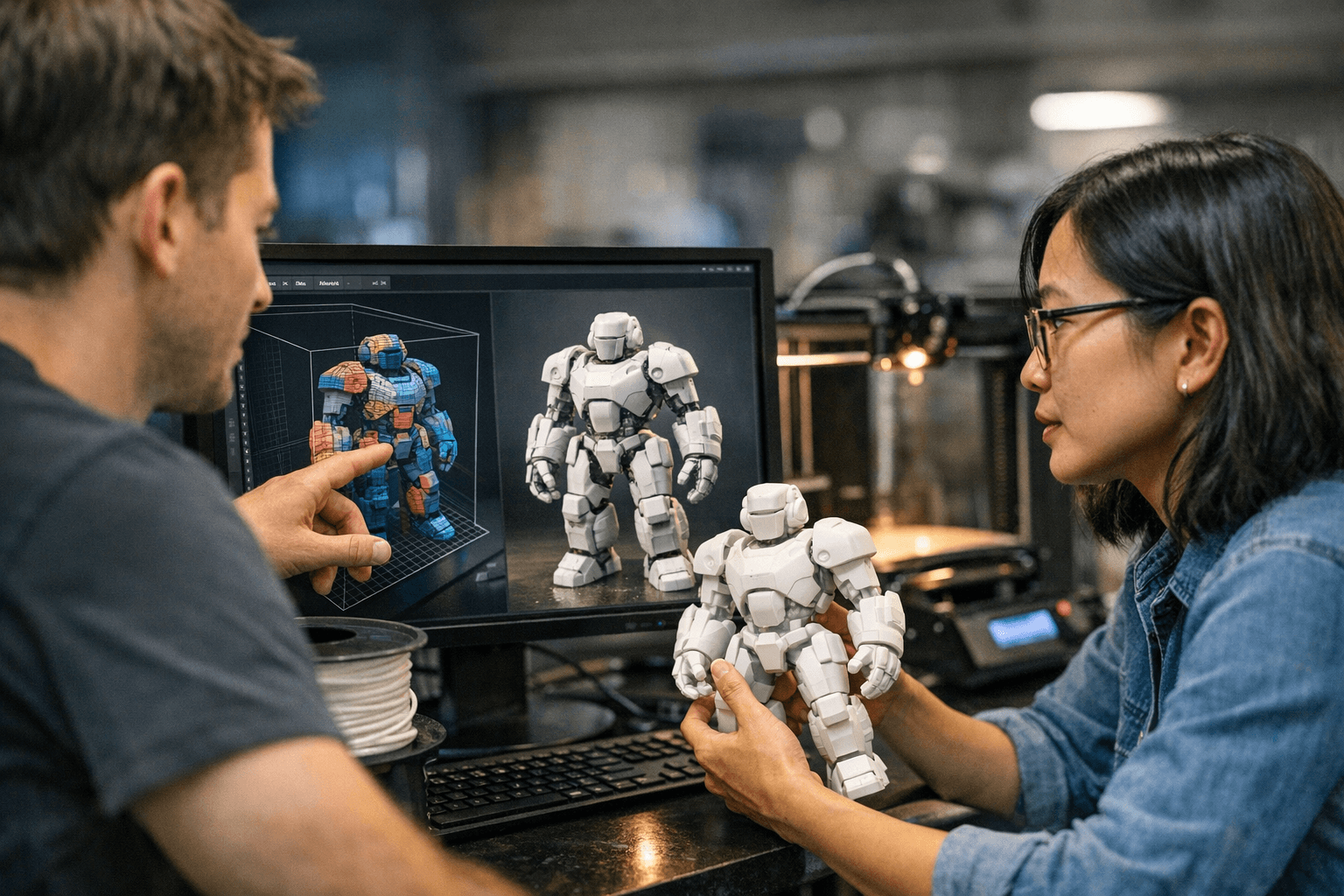
VisiPrint was developed in collaboration with Princeton University and the Gwangju Institute of Science and Technology. Unlike the flat, untextured geometry views in Cura or the time-intensive manual material setup required in Blender, it needs only two inputs: a screenshot from your slicer and a single photograph of your filament, sourced from a product listing or shot from a printed sample. Two AI models split the work. A computer vision model extracts appearance data including color, gloss level, and translucency from that material image. A generative AI model then maps those properties onto the object's geometry, while a depth map and edge map enforce the actual slicing pattern the nozzle will follow, the detail that general-purpose image generators consistently get wrong, often distorting geometry and applying incorrect layer patterns.
The result is a preview that renders gloss variations across curved surfaces, translucency in thin-walled sections, and visible layer lines that reflect your actual print profile, exactly the class of surface artifacts that cause a print to fail a visual inspection after hours of build time. Previews generate in approximately one minute on average, more than twice as fast as any competing method. In a user study, participants significantly preferred VisiPrint's output over all alternatives tested.
Patrick Baudisch, a professor of computer science at the Hasso Plattner Institute in Potsdam, Germany, framed the significance in historical terms: "'What you see is what you get' has been the main thing that made desktop publishing 'happen' in the 1980s." Before WYSIWYG, layout artists sent pages to press without seeing the result. Before VisiPrint, every FDM printer owner faced the same uncertainty.
The tool ships in two forms. VisiPrint UI is a standalone application compatible with any slicer software. For users already in Ultimaker's Cura, a dedicated plugin integrates directly into the existing workflow, lowering the barrier to adoption for one of the largest communities in consumer FDM printing.
If you want to evaluate VisiPrint against your current pre-print process, the capabilities worth testing break down clearly. First, whether gloss response on your chosen filament renders accurately across curved geometry. Second, whether thin-walled sections show realistic translucency. Third, whether the layer-line texture matches your actual slice profile. These are precisely the three properties that slicer previews, Blender placeholder materials, and general-purpose AI image generators all fail to capture consistently: slicer views show geometry without surface physics, Blender requires manual BSDF setup from scratch per material, and general AI tools lack physical slicing conditioning entirely.
The roadmap Perroni-Scharf has outlined includes fixing visual artifacts on models with extremely fine details and expanding optimization beyond material color into surface finish and structural properties. The paper and code are posted to GitHub, backed by an MIT Morningside Academy for Design Fellowship and an MIT MathWorks Fellowship, and the system is positioned for deeper integration across the FDM toolchain as those features arrive.
This article was produced by Prism’s automated news system from verified source data, official records, and press releases, then run through automated quality and moderation checks before publishing. The system is built and supervised by the people who set the standards it runs under. Read our full AI policy.
Did this article answer your question?