Mosquito proboscis repurposed as ultrafine 3D printing nozzles for microprints
Researchers used female mosquito proboscises from ethically sourced, deceased lab colonies as ultrafine dispense tips, achieving 18–22 μm lines and cutting costs substantially.
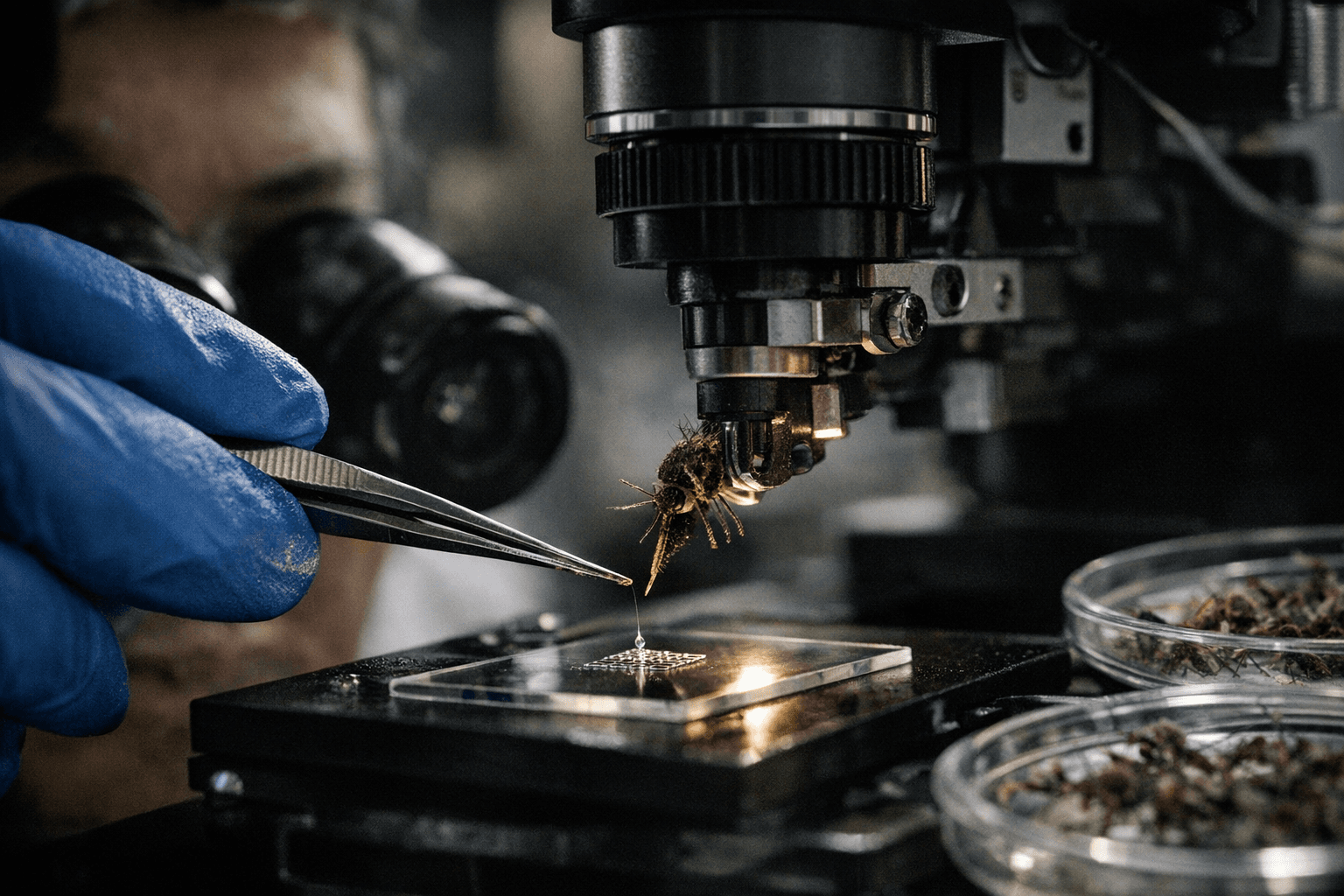
A team from McGill University and Drexel University demonstrated that the feeding tube, or proboscis, of female mosquitoes can serve as an ultrafine dispense tip for high-resolution 3D printing, a technique the Drexel news release calls "3D necroprinting." Published in Science Advances, the work shows line widths down to roughly 18–22 micrometers, about twice as fine as many commercial dispense tips, bringing true microscale direct-ink-writing to a cheaper, biodegradable nozzle option.
The researchers mounted individual mosquito proboscises to standard plastic tips using a small amount of resin, then integrated those biological nozzles into a syringe-based direct-ink-writing setup. They characterized the geometry and mechanical strength of the proboscises and ran print demonstrations that include microscale honeycomb and maple-leaf patterns, bioink scaffolds embedding red blood cells, and hydrogel deposition through pig skin to model transdermal drug delivery. The team emphasized the low cost, about $0.80 per proboscis compared with roughly $80 for some glass tips, plus biodegradability and surprising mechanical resilience as reasons the concept merits attention.
This matters for the 3D printing community because nozzle geometry and dispense diameter are limiting factors for microscale printing and soft-material patterning. A sub-25 μm tip opens finer feature control for polymer and hydrogel inks, capillary-driven assembly, and rapid prototyping of microarchitectures without investing in fragile, expensive pulled-glass capillaries or specialized microfabrication tools. The ability to deposit hydrogel through skin analogues also signals potential for benchtop labs and makerspaces exploring drug-delivery models and tissue engineering proofs of concept, provided they respect biosafety and ethical constraints.
Practical takeaways: the mounting approach is low-tech and compatible with syringe DIW rigs, so experimentalists can try similar setups on existing printers with syringe extruders. Expect to characterize each nozzle visually and mechanically before use; the team documented geometry and strength to validate function. Note the biological source was explicitly ethically sourced, deceased lab colonies, this is not about live-animal harvesting. Verify local biosafety rules and institutional approvals before handling biological material, and treat used nozzles as bio-waste for proper disposal.
Our two cents? This is a neat bit of biomimicry that turns an evolved microtool into a low-cost, high-resolution nozzle option. Try the technique first with inert inks and single-use setups, document your nozzle prep and print parameters, and treat biological tips as a specialty tool rather than a routine substitute for standard nozzles. If you want finer features without breaking the bank, a mosquito proboscis might be the tiny nib your toolbox is missing, but respect ethics and safety while experimenting.
This article was produced by Prism’s automated news system from verified source data, official records, and press releases, then run through automated quality and moderation checks before publishing. The system is built and supervised by the people who set the standards it runs under. Read our full AI policy.
Did this article answer your question?