New photocurable scintillators enable high resolution 3D printed detectors
A team of researchers developed a photocurable scintillator formula that uses coumarin 450 as a tertiary dye to control 405 nanometer cure light, enabling much finer vat polymerization printing of detector parts. The work shows practical production of complex, high resolution scintillator geometries on common desktop 405 nanometer printers while preserving meaningful light output and neutron gamma discrimination.
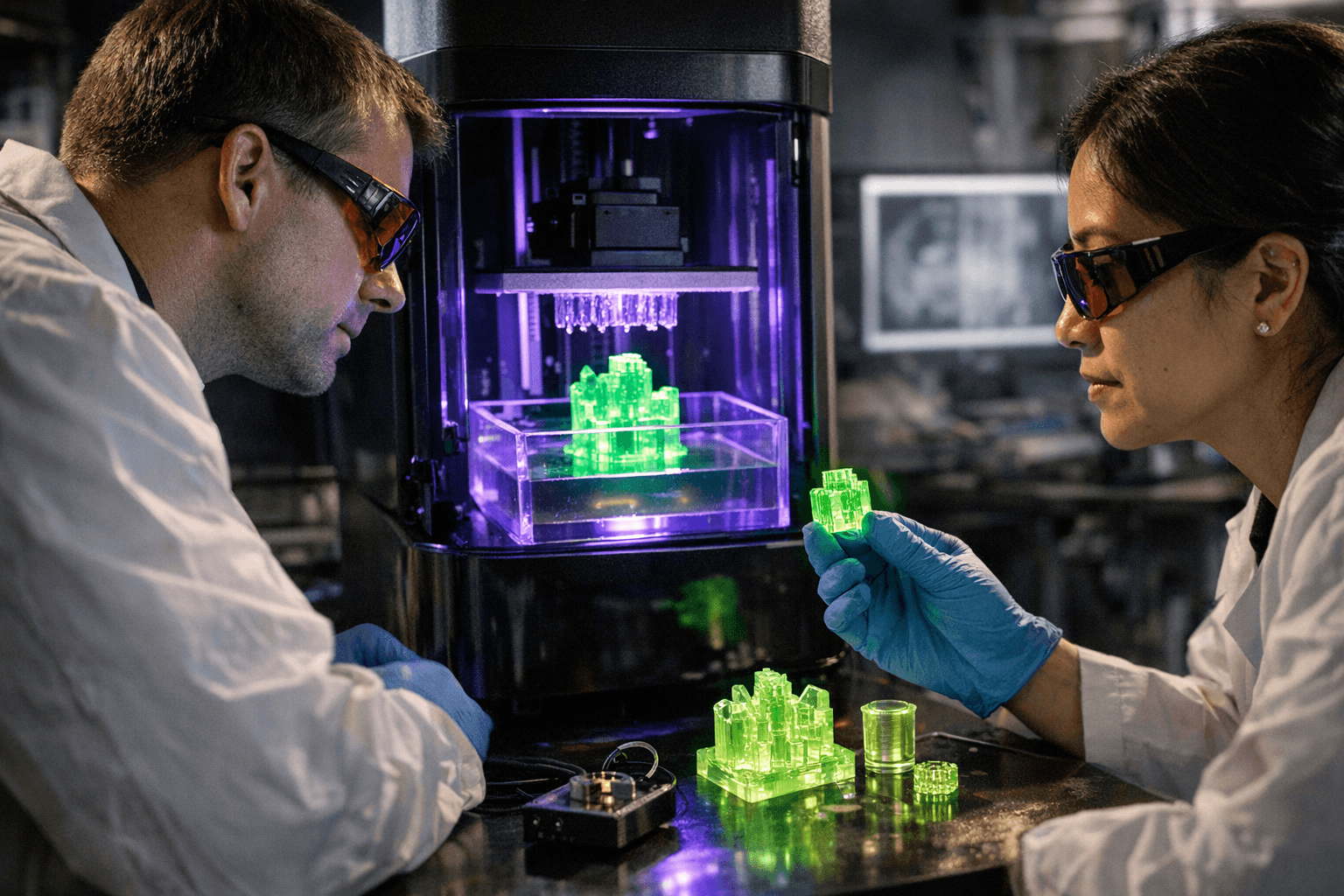
On December 29, 2025, a multi author team including Chandler Moore, Michael Febbraro, Juan Manfredi, Allen Wood, Daniel Rutstrom, Thomas Ruland, Brennan Hackett, and Paul Hausladen reported a photocurable scintillator formulation that dramatically improves resolution for vat polymerization 3D printing. The key change was addition of coumarin 450 as a tertiary dye to limit cure depth under 405 nanometer light, allowing printed features that are difficult or impossible with traditional subtractive methods.
The researchers compared bulk photocured samples and 3D printed parts with and without the tertiary dye through observational assessment and spectral response testing. All samples demonstrated pulse shape discrimination between neutron and gamma events, indicating intact detector functionality after printing. Inclusion of the tertiary dye had minimal impact on emission spectrum and light output, while producing a significant improvement in print resolution and ability to resolve unsupported features.
Practical print results are striking for the community. Unsupported freestanding pillars were resolvable down to 0.7 millimeter, and fully supported, integrated structures achieved feature resolution at or below 0.1 millimeter on off the shelf 405 nanometer desktop 3D printers. Scintillators produced by this method exhibited light output up to 50 percent of EJ 200 and delivered a pulse shape discrimination figure of merit up to 1.35 at 0.9 to 1.1 MeVee. Those metrics place printed scintillators in a useful range for lab scale detectors, prototypes, and custom shapes where conventional cast or machined parts are impractical.
For makers and community labs this opens several immediate possibilities. Create custom geometries for compact detectors, build integrated mounting and channels directly as part of the scintillator, and iterate designs rapidly without complex machining. The ability to print fine supported detail under 0.1 millimeter on accessible desktop printers makes experimentation possible for small labs and advanced hobbyists alike. Verify your equipment calibration and radiation safety procedures before experimenting, and account for the lower absolute light output relative to commercial scintillators when designing photodetector coupling and electronics.
The work demonstrates additive manufacturing as a practical route to functional scintillators with nontrivial geometries, expanding what can be prototyped and produced in community settings. Continued refinement of formulations and printing parameters should further close the gap with commercial materials, enabling more complex detector concepts and broader hands on experimentation.
This article was produced by Prism’s automated news system from verified source data, official records, and press releases, then run through automated quality and moderation checks before publishing. The system is built and supervised by the people who set the standards it runs under. Read our full AI policy.
Did this article answer your question?