NIST testbed reveals stainless steel powder dynamics in laser printing
A bad powder layer can sink a metal build before the laser ever fires. NIST's moving-camera testbed now watches stainless steel spread in real time.

The bottleneck in metal printing is often the layer nobody notices until it fails. In laser powder bed fusion, a streak, a clump, or a bit of debris in the powder spread can ruin everything built on top of it, which is why NIST’s latest testbed work matters as much as any laser tweak or slicer setting.
NIST’s powder spreading testbed was built to study how metal powder behaves as it is laid down, and the agency says the goal is to establish fundamental relationships between bulk powder characteristics and spreading performance. The updated system, described in a 2025 conference presentation, uses a camera that translates in sync with the recoater blade, so researchers can watch the full spreading sequence continuously instead of catching only a brief stationary window. That matters because the testbed is not just looking for pretty footage. It is built to capture powder formation, spreading, and depletion, and to spot transient events such as intermittent particle jamming that a fixed camera can miss.
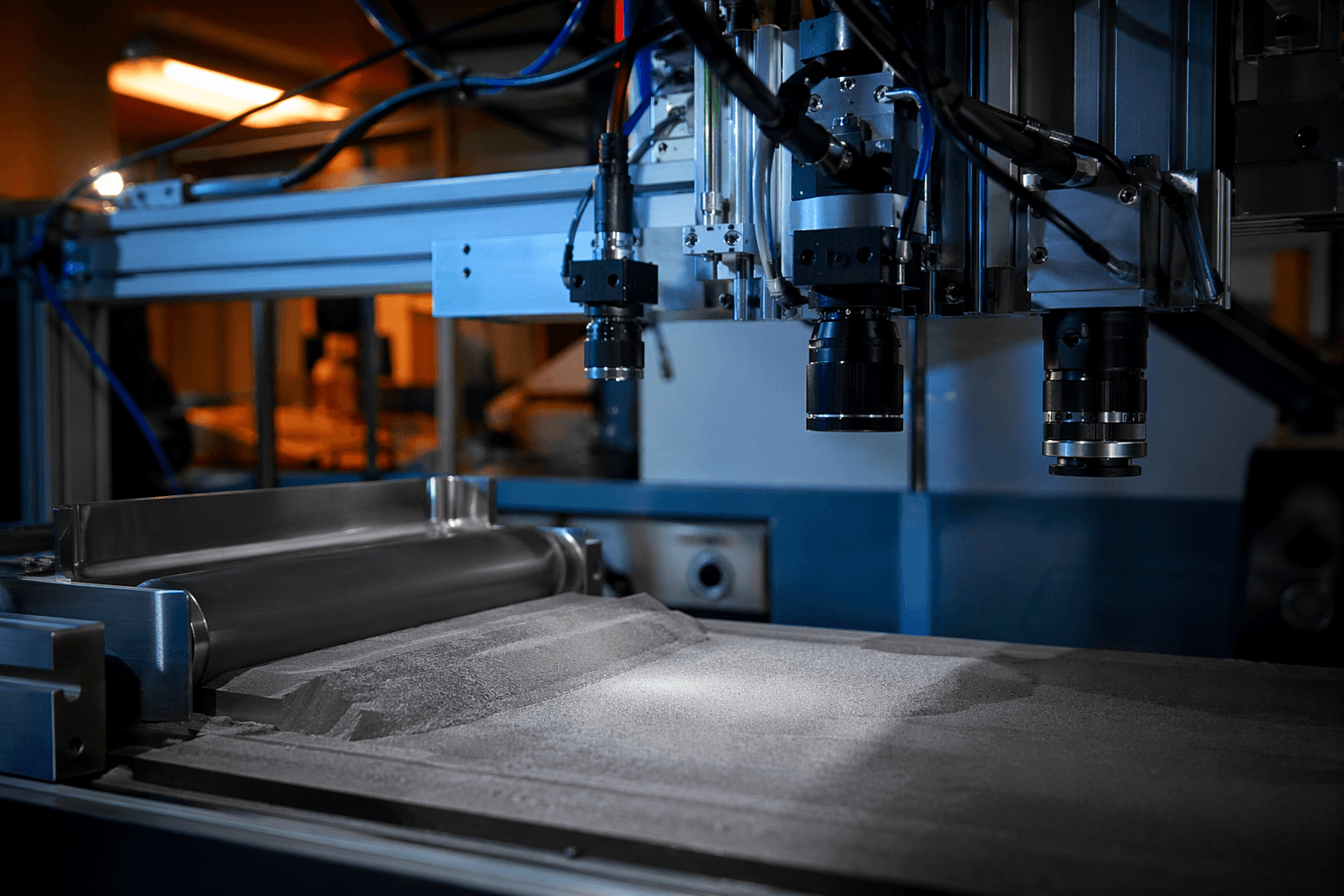
The setup sits inside a broader NIST push to make metal additive manufacturing more predictable. NIST says only a small number of custom spreading systems have enough cross-sectional imaging resolution for particle image velocimetry analysis, and the agency’s powder metrology lab is developing test methods, protocols, and exemplar data so U.S. industry can qualify powder feedstocks and get repeatable results. Researchers including Justin Whiting, Eric Whitenton, Aniruddha Das, Vipin Tondare, Jason Fox, Michael McGlauflin, Alkan Donmez, Shawn Moylan, Paul Witherell, and Callie Higgins have been tied to the work across NIST in Gaithersburg, Maryland.
NIST has already shown the testbed on reused stainless steel 17-4 PH powder feedstock. A December 5, 2023 video showed powder with a D50 of 38.4 microns spreading at 60 mm/s with a ceramic recoater blade and a 40-micron layer height. That kind of detail is exactly what matters when the agency’s challenge materials warn that anomalies like streaks and debris can leave uneven layers and trigger downstream printing problems.

The timing fits a bigger federal effort, too. On July 26, 2022, NIST awarded $3.7 million in grants to help remove barriers to metals-based additive manufacturing adoption. The agency’s powder-bed-fusion program says inconsistent part quality and low production efficiency are still holding the technology back, and powder spreading sits right at the center of both problems. Better visibility into that one step could mean fewer failed builds, less scrap, and a lot less guesswork when stainless steel parts come off the machine.
This article was produced by Prism’s automated news system from verified source data, official records, and press releases, then run through automated quality and moderation checks before publishing. The system is built and supervised by the people who set the standards it runs under. Read our full AI policy.
Did this article answer your question?