Northwestern 3D-Printed Neurons Communicate With Real Brain Cells
Northwestern’s printed neurons fired into mouse brain slices and got responses back, moving bioprinting from making structure to making communication.
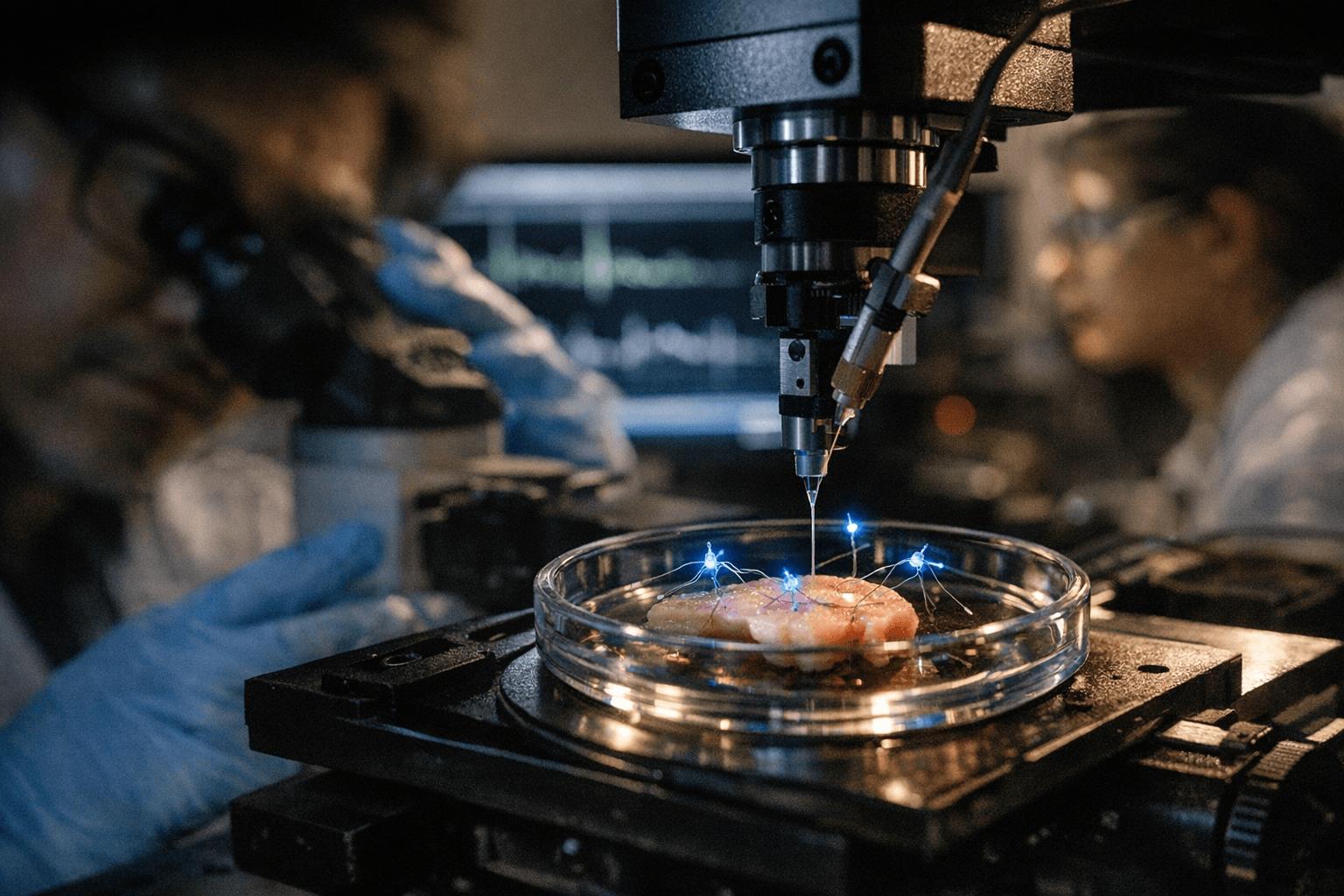
Northwestern researchers have crossed a line that matters to bioprinting: their 3D-printed neurons did not just look neuron-like, they sent signals into living mouse brain tissue and got responses back. That puts the work in a different class from the usual “printed tissue” headline, because the point here was communication, not just shape.
The study, published April 15, 2026 in Nature Nanotechnology, was led by Mark C. Hersam, the Walter P. Murphy Professor of Materials Science and Engineering at Northwestern’s McCormick School of Engineering, with Vinod K. Sangwan as co-leader. The devices were built with flexible, printable electronic inks instead of rigid silicon fabrication, a choice Northwestern says better fits the brain’s dynamic signaling patterns than conventional chip hardware.
In tests on slices of mouse brain tissue, the printed artificial neurons generated electrical activity realistic enough to activate living neurons. That is the detail that makes this more than another incremental bioprinting milestone. Earlier artificial-neuron projects mostly tried to imitate neural behavior. This one reportedly reached the point of talking to real brain cells and getting an answer.
Northwestern is positioning the work as a building block for brain-machine interfaces and neuroprosthetics, including future implants for hearing, vision, and movement. The university is also pushing the energy argument hard. It says the brain is about five orders of magnitude more energy efficient than a digital computer, which is a brutal comparison when you think about how much power modern AI systems and silicon-based computing chew through.
That is where the story moves beyond one clever lab demo. Hersam’s team is not talking about printing a replacement for a desktop GPU or a hobby machine. This is extreme research hardware, built for living tissue, and it points to a future where additive manufacturing is used to make functional biological systems, not just parts, shells, or scaffolds. Northwestern says the same approach could help develop more energy-efficient, brain-inspired computing and reduce the power demands of data-intensive AI.
For the 3D printing world, the real takeaway is simple: the frontier is no longer just printing form. Northwestern has shown printed devices can begin to behave like a communication layer for the brain itself, and that is a much bigger leap than printing another structure on a build plate.
Know something we missed? Have a correction or additional information?
Submit a Tip