Photocentric's JENI aims to automate resin printing at production scale
JENI is Photocentric's bid to turn resin printing into a lights-out production line, with wash, rinse, cure, and traceability built around the printer.

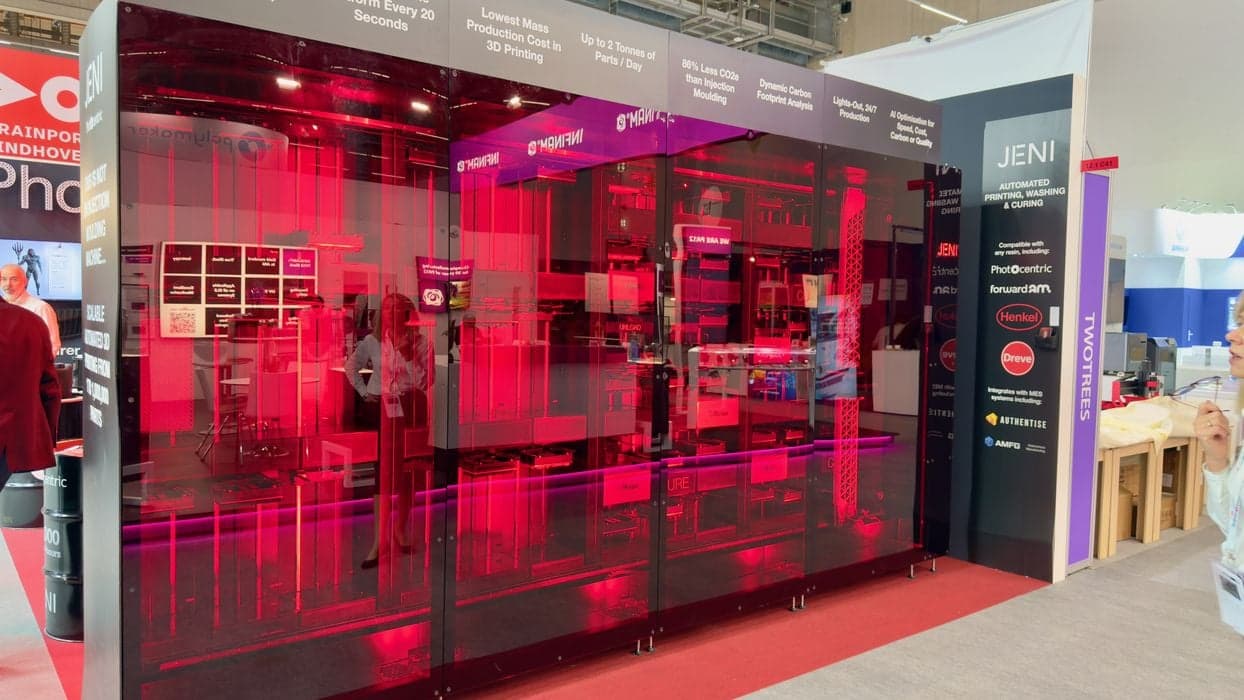
Photocentric is not pitching JENI as a bigger resin printer. It is pitching it as a production cell, a modular system that prints, washes, rinses, cures, and keeps jobs moving with far less manual handling. That distinction matters because resin bottlenecks are usually not about exposure settings or layer lines, they are about the boring parts in between, the handoffs that eat time, labor, and consistency.
What JENI is actually designed to do
The core idea is simple: stop treating the printer as the whole product and start treating the whole line as the product. Photocentric says JENI is intended for “automated 3D printing and processing at the speed and cost of injection moulding,” which is a very specific ambition and a very aggressive one. It is not aimed at replacing a bench-top machine on your desk; it is aimed at making resin production behave more like an automated factory cell.
That means the platform is built around multiple LCD-based printers and the surrounding post-processing steps needed to turn printed parts into finished output. Nodes inside each module can be configured as printers or as wash, rinse, cure, or other stations depending on the workflow. In practice, that is the sort of architecture that keeps a production farm fed without forcing someone to babysit every transfer.
Why the spinning-jenny analogy fits
The name is not subtle. The original spinning jenny multiplied textile output by letting one operator do the work of many spindles, and Photocentric is trying to make the same leap with resin. Instead of one printer doing one thing, JENI is meant to multiply throughput by coordinating many printers and many support stations under one system.
That is why the analogy works better than the usual “faster printer” framing. JENI is about reducing handling, not just raising speed. If you have ever watched a resin line stall because someone had to move parts between print, wash, rinse, and cure, the logic is immediately obvious: the machine is only part of the workflow, and the workflow is where the time disappears.
The numbers behind the pitch
Photocentric’s own specs are the part that make the concept feel less like marketing and more like a production claim. The company says a typical JENI creates about 1 tonne of product per day, can produce a platform of parts every 20 seconds, and uses a gantry that moves at 3 metres per second. It also says the system delivers 24.8µm x 16.8µm resolution, which tells you Photocentric still wants precision in the same breath as throughput.
The other detail that matters is the operating model. JENI is described as designed for 24-hour lights-out operation with no human involvement, and Photocentric says it is built to deliver OEE consistent with best-in-class injection moulding. That is the real bar here: not whether the parts look good on a shelf, but whether the line can keep running with predictable output and minimal downtime.
Photocentric also says the platform can lower CO2e by 86% when using bio-based resins, with embedded carbon calculation for each part. That kind of claim is easy to wave away until you remember how much resin manufacturing still depends on labor-heavy handling and fragmented steps. If the line really runs as advertised, the sustainability angle is tied directly to efficiency, not just materials rhetoric.
How the system scales up and reconfigures
The reconfigurable part is where JENI starts sounding less like a product and more like an operating system for resin production. Photocentric says the platform can add modules, change nodes inside modules, run multiple products and multiple resins simultaneously, and integrate with external systems through an API and Manufacturing Execution Systems. That is the kind of control layer manufacturers care about when traceability matters as much as raw output.
The scale claims reinforce that ambition. Photocentric says the last system it sold featured 11 modules and more than 300 printers, which gives a real sense of how far the company is willing to push the format. A later configuration was described with seven modules and 124 resin printers, and that setup was said to be capable of producing more than 1.2 million small parts in eight hours. Those are not hobby-farm numbers; they are factory numbers.
Photocentric first debuted JENI at Formnext 2024, and a November 2025 post framed it as part of a broader manufacturing strategy built around reshoring, lower production costs, and more agile production. That arc matters because it shows JENI is being positioned as infrastructure, not as a one-off machine launch. Photocentric is arguing that the future of resin printing is less about individual printer specs and more about how well the whole production line can be automated.
Where this could trickle down
For advanced hobbyists and maker spaces, the useful part of JENI is not the size of the line. It is the architecture. Shared wash and cure stations, modular expansion, job traceability, and software that keeps printers continuously fed are exactly the kinds of ideas that make a multi-printer setup feel manageable instead of chaotic.
The trickle-down version of this future probably will not look like a 1 tonne-per-day factory cell. It will look like smaller farms with cleaner handoff logic, better queue management, and less human touch between print and finish. That is where the real lesson sits: the winning resin workflow is starting to look less like a printer collection and more like a coordinated system.
Photocentric’s bigger bet
JENI also makes more sense when you look at Photocentric’s broader hardware history. The company says it invented LCD 3D printers and is now focused on robotic digital manufacturing machines. Its LC Titan is still marketed as the largest LCD 3D printer in the world, with a 695 x 385 x 1200 mm build volume, a 32-inch 8K screen, and up to 86 mm/hr print speed.
That background explains why JENI reads like a logical next step instead of a random pivot. Photocentric has spent years chasing scale in LCD, and now it is folding that experience into a system that treats printing, washing, curing, software control, and production throughput as one problem. That is the part worth watching: not whether JENI is big, but whether its factory logic is the shape resin printing is heading toward.
This article was produced by Prism’s automated news system from verified source data, official records, and press releases, then run through automated quality and moderation checks before publishing. The system is built and supervised by the people who set the standards it runs under. Read our full AI policy.
Did this article answer your question?