Phrozen Sonic Mighty Revo 16K Review: Precision Resin Printing for Serious Hobbyists
The Revo 16K's 14 × 19 μm non-square pixels deliver genuine micro-feature gains on miniatures, but the $895 price tag and large-format resin workflow demand an honest look before you buy.
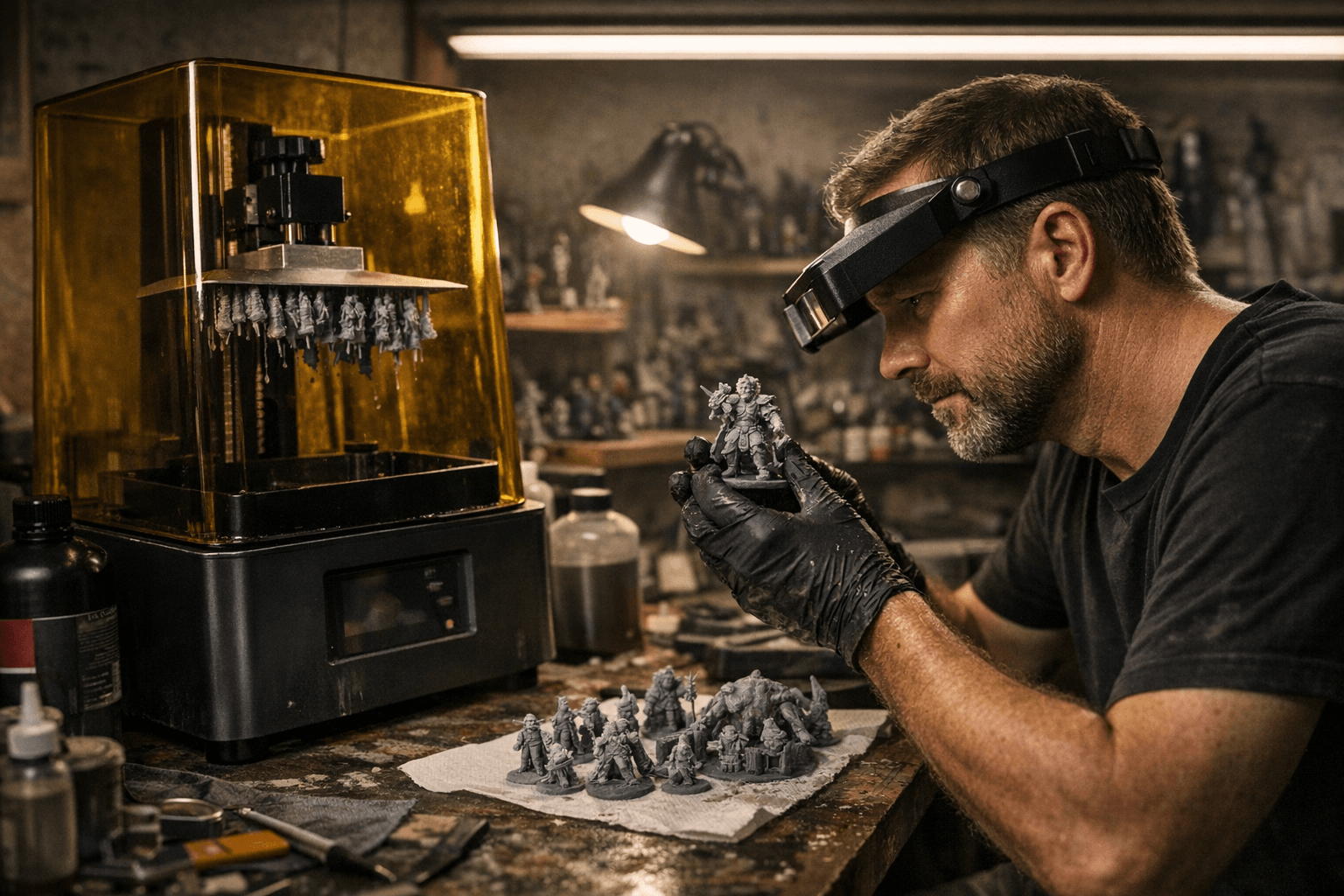
Phrozen's 16K upgrade to the Sonic Mighty Revo platform lands at roughly $895, and the spec sheet is genuinely impressive. But the real question isn't whether 15,120 × 6,230 pixels is a lot of resolution. It absolutely is. The question is: does that resolution show up on your build plate in ways that change what you can make, and is the total cost of ownership manageable for a serious hobbyist or small studio?
What the 16K actually means in print
The Revo 16K uses a 10.1-inch mono LCD with a non-square pixel geometry of 14 × 19 μm. That distinction matters more than most spec-sheet comparisons acknowledge. When a competing printer advertises a similar "16K" label, the actual XY pixel dimensions may differ significantly, producing different real-world detail characteristics even at nominally equivalent resolutions. The 14 μm axis on the Revo 16K is where the advantage lives: sub-millimeter sword pommels, chainmail texture, facial features on 28mm miniatures, and lettering on dental models all benefit from it in ways that a 28 or 35 μm printer simply cannot replicate.
Where the 16K is clearly visible: miniature faces, fine bas-relief on flat surfaces, and thread or weave detail on clothing sculpts. Where it becomes harder to justify: large terrain pieces, functional mechanical parts where dimensional accuracy matters more than surface texture, and props printed at 1:1 scale. If your workflow involves D&D armies or jewelry prototyping, the 16K option earns its place. If you primarily print cosplay armor panels or replacement brackets, the resolution upgrade delivers diminishing returns and the cost per liter of resin becomes the dominant variable.
Hardware that justifies the price
The mechanical platform is where the Revo distinguishes itself from budget-tier 16K competitors. The Z-axis runs on a ball screw paired with dual linear rails inside an aerospace-grade 6000-series aluminum frame. That combination matters for repeatability, not just raw quality: the Z-axis behavior stays consistent across a 235 mm travel range without the flex or wobble that cheaper lead-screw designs introduce at the top of tall prints. A ball-screw setup also ages more predictably, which is directly relevant to long-term cost of ownership.
The ParaLED matrix light source pairs with the 16K LCD to produce even illumination across the full 211.68 × 118.37 mm build area. Uneven lighting is one of the main causes of warping and delamination on large flat prints, so a well-characterized light source matters both for quality and consumable lifespan. The LCD itself is rated for over 2,000 operating hours, with higher light transmission and better heat resistance than prior-generation Phrozen screens.
Built-in resin heating and multi-point pressure sensors round out the hardware story. The heater brings resin to a consistent viscosity before each print, which meaningfully reduces failed layers during cold studio mornings. The pressure sensors monitor peel force in real time, triggering alerts if something goes wrong mid-print rather than letting a failed layer bond to the FEP and waste a full vat of resin.
Total cost of ownership: the honest math
A printer in this class costs more to run than its purchase price suggests. The vat uses Phrozen's PFA/ACF/nFEP film system, and the good news is that consumables are cross-compatible across the entire Mighty series, so you are not locked into a proprietary supply chain. Replacement FEP and the Mighty-series resin vat are widely stocked.
The real variable is resin. A build volume of 211.68 × 118.37 × 235 mm means large prints consume resin quickly, and you should budget for a wash station and UV cure setup capable of handling that footprint. A basic wash-and-cure machine sized for a smaller MSLA printer will leave partial curing on large flat-bottomed models. Budget for a Phrozen Cure Beam or equivalent station that actually accommodates the build plate dimensions, and factor in isopropyl alcohol or a dedicated wash solvent at volume.
Ventilation is non-negotiable at this scale. Larger resin volumes off-gas more aggressively than a small-format printer, and running the Revo in an enclosed, unventilated space is a health risk that gets worse as you increase batch sizes. Budget for an enclosure with an activated carbon filter, or ensure your workspace already has forced ventilation.
Software workflow: Chitubox, Lychee, and Formware
The Revo 16K works natively with Chitubox, which remains the most widely used resin slicer, and also supports Lychee Slicer and Formware Slicer. All three have active community profiles for the Revo platform. The workflow is deliberately "hands-on": you manage your own exposure settings, dial in resin profiles, and make support placement judgments. Connectivity covers USB, Wi-Fi, and Ethernet, and the Phrozen GO app handles remote monitoring across multiple units, which is useful if you are running a small print farm.
Exposure tuning is where new users will spend the most time initially. The non-square pixel geometry means that community exposure profiles from printers with square pixels will not transfer directly, and resin profiles need to be validated rather than just imported. Experienced users will find this straightforward; first-time resin printers will find the learning curve real, though Phrozen's documentation and the Revo community help.
How it stacks up against the competition
The most direct head-to-head is the Elegoo Saturn 4 Ultra 16K, which offers a larger build volume and competitive pricing. The Saturn 4 Ultra is a strong machine, but its chassis design does not support the same kind of LCD upgrade path that the Revo platform offers. An existing Revo owner can purchase the 16K Upgrade Kit and install a new optical engine without replacing the frame, ball screw, or motion system. That upgradeability is a meaningful differentiator over a two- to three-year ownership window: a 12K Revo purchased in 2023 can become a 16K Revo today without disposing of the mechanical foundation you already paid for.
The Anycubic Photon Mono M7 Max enters the picture if build volume is the primary requirement. It offers a substantially larger print area at a lower price point, but its Z-axis resolution and light-source consistency do not match the Revo 16K at the micro-feature scale. If you are printing 100mm figures rather than 28mm miniatures, the M7 Max is worth serious consideration. The Creality Halot-X1 Combo is another large-format alternative, but its ecosystem maturity and community profile support lag behind both the Revo and the Saturn lineups.
Who should buy this printer
Miniature creators, dental modelers, and small-batch jewelry producers will extract the full value from the 16K resolution and the mechanical stability of the Revo platform. The printer rewards those who already understand resin settings, support strategy, and post-processing discipline.
It is not the right machine for a first resin printer. The operational overhead, the exposure tuning requirements, and the resin volumes involved all presuppose some experience. For those stepping up from a smaller MSLA printer, the Revo 16K represents a genuine capability jump rather than a marginal spec improvement. The platform's upgradeability means that the aluminum frame and ball-screw Z-axis you buy today will still be relevant hardware when the LCD technology moves forward again, which is a form of future-proofing that most consumer resin printers do not offer.
This article was produced by Prism’s automated news system from verified source data, official records, and press releases, then run through automated quality and moderation checks before publishing. The system is built and supervised by the people who set the standards it runs under. Read our full AI policy.
Did this article answer your question?