Proterial Patent Proposes Grinding Thermoset Waste Into 3D Printing Filament
Proterial filed a patent to turn unrecyclable thermoset resin waste into FFF filament filler, with a proposed blend of up to 50% ground thermoset by mass.
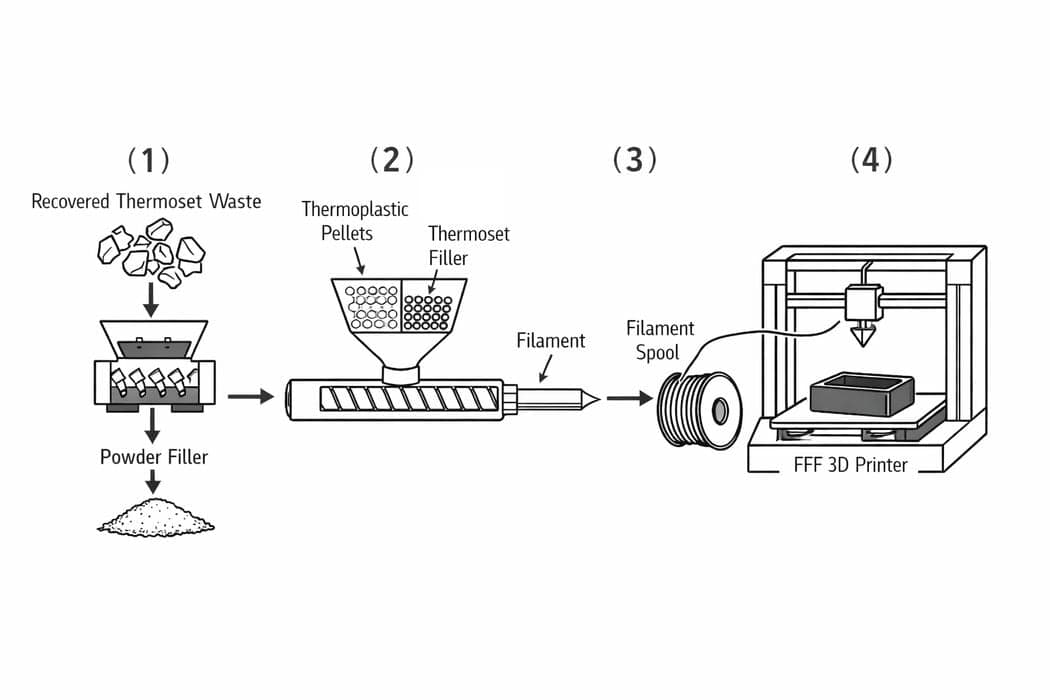
Thermoset resin waste is one of polymer chemistry's most stubborn recycling problems. Once cured, those crosslinked networks won't remelt. You can't toss a failed resin print or an epoxy scrap back into an extruder the way you would a broken PLA part. Proterial, a Tokyo-based specialty materials company established in 1910, filed a Japanese patent in late March that proposes a more pragmatic fix: grind the cured waste into particulates and use them as filler in thermoplastic filament.
The patent, JP-2026054806-A, published March 30, 2026 and titled "Method for manufacturing filaments and resin molded products, and method for material recycling thermosetting polymers," sidesteps the chemistry problem entirely. Instead of trying to break the crosslinked bonds that make thermosets unremeltable, Proterial's approach treats the cured material as a functional additive. Grind it fine enough, blend it with a thermoplastic carrier, extrude the composite, and you have filament that can run on a standard FFF printer.
The proposed composition allows up to 50% thermoset filler by mass, with at least 50% thermoplastic making up the remainder. That split is worth sitting with for a moment: half a spool could, in principle, be material that would otherwise go to landfill. The cost implications are real too. Thermoset scrap is essentially free feedstock, and high filler loadings reduce the thermoplastic content that actually drives material cost in a typical filament formulation.
The tradeoffs are predictable but worth spelling out. High filler loading typically reduces ductility, and ground thermoset particulates don't flow the same way a clean thermoplastic melt does. Melt viscosity shifts, extrusion behavior becomes harder to dial in, and layer adhesion can suffer. This probably isn't the material you'd reach for on a cosmetic enclosure or a bracket that needs to flex under load. Where it could work well is jigs, fixtures, functional prototypes, and non-cosmetic parts where the sustainability angle matters more than pristine surface finish.
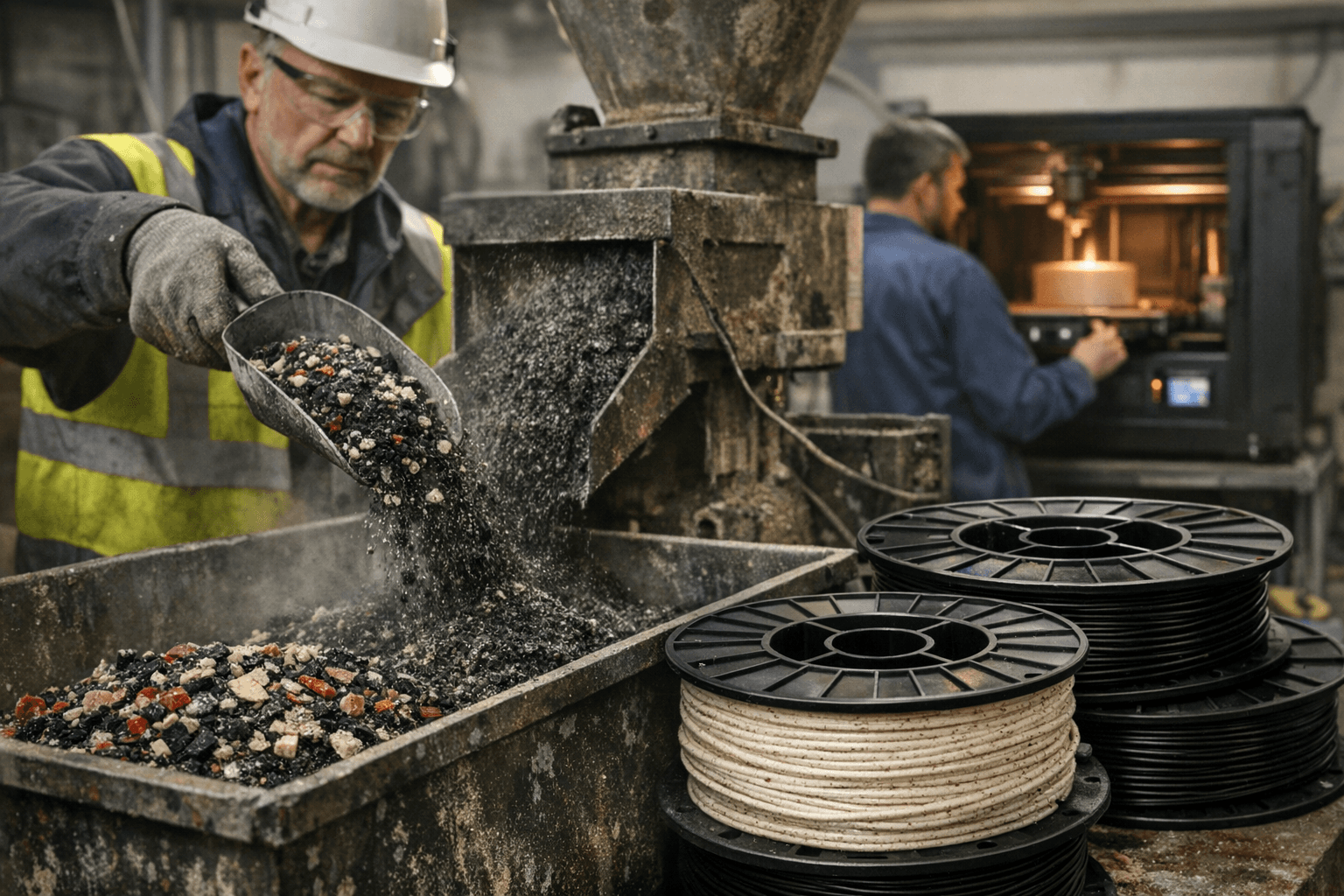
What distinguishes the Proterial approach is that it doesn't require the expensive chemical recycling routes sometimes proposed for thermoset recovery. Processes that solvolytically break crosslinks in cured thermosets are real but energy-intensive, requiring controlled industrial chemistry that's nowhere near accessible at the filament-manufacturer scale. Grinding and compounding, by contrast, maps onto existing extrusion infrastructure.
Proterial's core business spans specialty steel, magnetic materials, wire and cable, and advanced components, so thermoset-filled filament is far from the company's main lane. Whether JP-2026054806-A ever transitions from application to commercial product, and whether a filament manufacturer builds on or licenses the IP, remains an open question. But as a technically grounded approach to a genuinely difficult recycling challenge, it points toward a category of filament that doesn't just claim sustainability on its label.
This article was produced by Prism’s automated news system from verified source data, official records, and press releases, then run through automated quality and moderation checks before publishing. The system is built and supervised by the people who set the standards it runs under. Read our full AI policy.
Did this article answer your question?