Prusa's CORE One L brings larger heated build and security readiness
Prusa’s CORE One L stretches the Core One into a 300 x 300 x 330 mm heated workhorse, aimed at bigger parts, harder materials, and shared-network use.
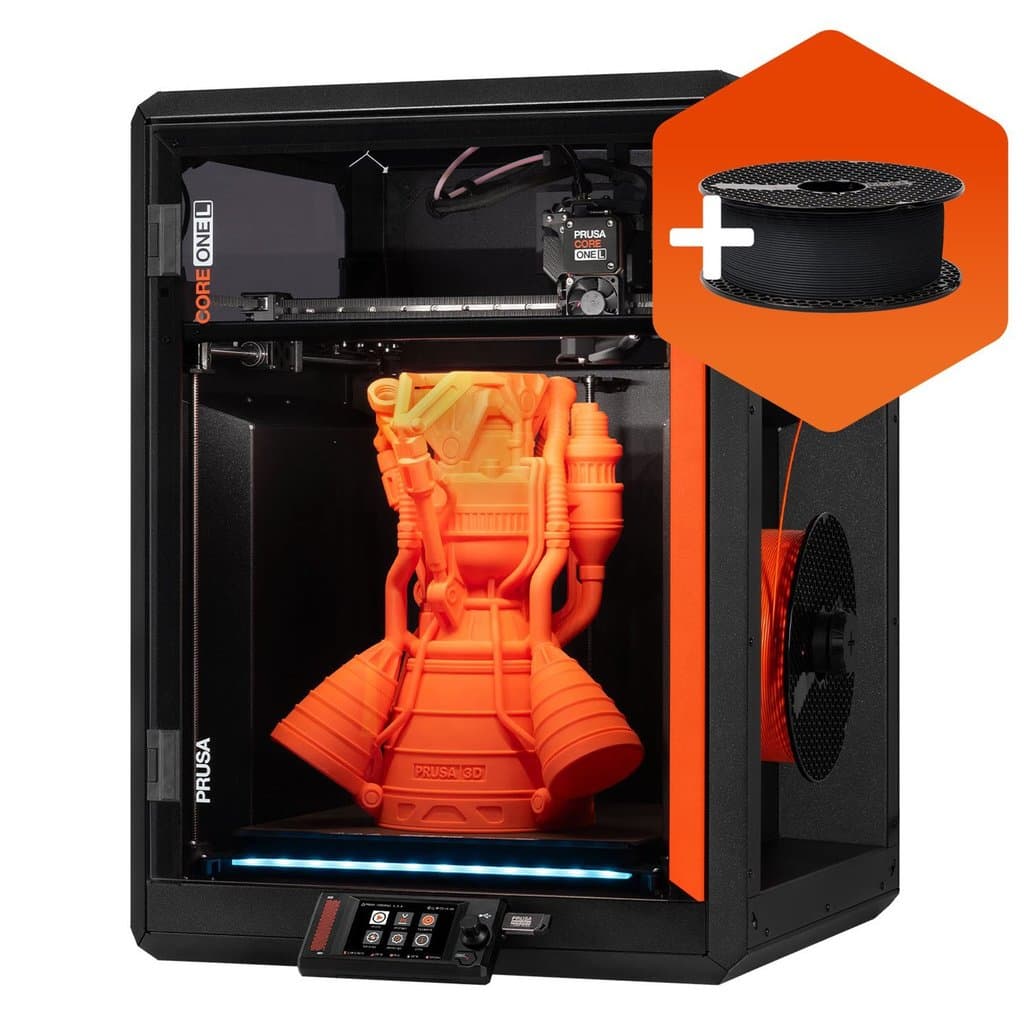
Prusa’s CORE One L is the kind of upgrade that changes what you can actually finish on a desktop machine. The jump to a 300 x 300 x 330 mm build area, a 60°C actively heated chamber, and a price of $1,999 puts this squarely in the “print bigger, print cleaner, waste less time splitting models” category. For anyone who has already hit the wall with smaller CoreXY machines, that larger heated build is the real story.
Bigger prints without the usual compromises
Prusa’s own product page makes the pitch plainly: “Think BIG. Print BIGGER.” The CORE One L is listed as a Made in EU machine with a 300 x 300 x 330 mm build area, and Prusa says it delivers 2× the CORE One+ volume. In the launch video, the company goes further, saying the printer gives you 200% more print volume while the footprint is only 10% larger than the original CORE One.
That matters because build volume is not just a spec-sheet trophy. Once you start printing props, enclosures, jigs, fixtures, or large functional parts, the old workaround is usually to split the model, glue it later, and hope the seams behave. Prusa’s launch material explicitly calls out “No model cutting” and “No sticky gluing,” which is exactly the kind of practical promise that saves time in a real shop.
Josef Průša framed the machine in similarly plain terms on LinkedIn, saying it has around 30 liters, or 1 cubic foot, of print volume and runs on standard power. That makes the CORE One L feel less like an oversized specialty printer and more like a table-friendly machine that finally crosses the line into useful large-format territory.
The heated chamber is the part that makes the size worth buying
A bigger box alone is nice. A bigger box with thermal control is what makes it useful for more demanding work. VoxelMatters’ launch coverage notes a 60°C actively heated chamber and an AC convection heatbed designed for edge-to-edge heat distribution, and that combination points straight at better behavior with engineering filaments and taller prints.
That is the difference between “it fits” and “it prints well.” Larger ABS, ASA, and other temperature-sensitive parts are where a heated chamber starts paying for itself, especially if you have ever watched a tall print warp at the corners or layer-separate halfway through a long job. Prusa’s social posts also emphasize uniform heat distribution, which lines up with the practical goal here: keep the whole chamber stable enough that large parts do not turn into a warping experiment.
VoxelMatters said it spent two months testing the machine and described it as a high-precision workhorse built for reliable, repeatable printing. That is the language you want to hear when a printer moves from hobby convenience into something you trust for production-style batches or repeat jobs.
Who this is really for
Prusa says the CORE One L is built for engineers, prop makers, and creators, and that target list tells you a lot about the machine’s purpose. Engineers care about dimensional reliability and material choice. Prop makers care about size, surface quality, and fewer glued seams. Creators care about getting a part off the machine in one piece instead of spending an evening splitting geometry just to make it fit.
The security-ready angle lands differently depending on how you use your printer. If you are running a single machine on a bench, it is not the headline. The bigger buying decision is still whether the machine gives you enough room, enough heat, and enough repeatability to replace two smaller prints with one larger one.
If you are running printers in a shared workshop, classroom, office, or other networked space, the story changes. Security-ready messaging suggests Prusa is thinking about device management, access control, and broader digital workflows, which is increasingly part of how printers live in professional environments. In plain terms: the machine is being positioned not just as a bigger printer, but as a printer that can fit into a more controlled setup without feeling like a hobbyist toy.
Why the original CORE One needed this
Hackster’s coverage of the original CORE One makes the upgrade logic easy to understand. The printer had been available for about 10 months, owners generally liked it, but its smaller build volume limited adoption. That is a familiar failure mode in desktop 3D printing: a machine can be well regarded and still lose buyers the moment the part no longer fits.
The CORE One L looks like Prusa answering that complaint directly instead of redesigning the whole platform from scratch. You keep the appeal of the Core One family and remove the one practical constraint that kept some users from moving in. That is a much smarter move than chasing novelty for its own sake.
Part of a bigger Prusa push
The CORE One L was not the only thing Prusa put on the stage at Prusa Day 2025 in Prague. CNC Kitchen’s launch-day coverage also highlighted an open-source RFID tag for filaments, a Signature Oak printer, PrusaSlicer 3.0, and a system for printing silicone with Liquid Filament, including a silicone-printing toolhead for the Original Prusa XL. That matters because it shows the CORE One L as part of a broader platform push, not an isolated box-checking release.
Taken together, the lineup says Prusa is still leaning on the strengths that built its reputation: open, engineering-minded hardware, but with more serious production and workflow features layered on top. The CORE One L fits that pattern cleanly. It is still recognizably a Prusa, but the larger heated build makes it much easier to treat like a tool instead of a project.
That is why the CORE One L matters. The bigger enclosure is not the point by itself. The point is what the larger heated build unlocks: larger engineering parts, fewer seams, more forgiving material handling, and a printer that makes sense when you want one machine to do the jobs that used to require two.
This article was produced by Prism’s automated news system from verified source data, official records, and press releases, then run through automated quality and moderation checks before publishing. The system is built and supervised by the people who set the standards it runs under. Read our full AI policy.
Did this article answer your question?