Purdue and Nebraska Researchers Study Metal Powder Behavior for Space-Based 3D Printing
Sending a kilogram of material to space cost $12,682 on a Falcon 9 in 2024 — so Purdue and Nebraska researchers mapped how moon dust could feed a 3D printer instead.
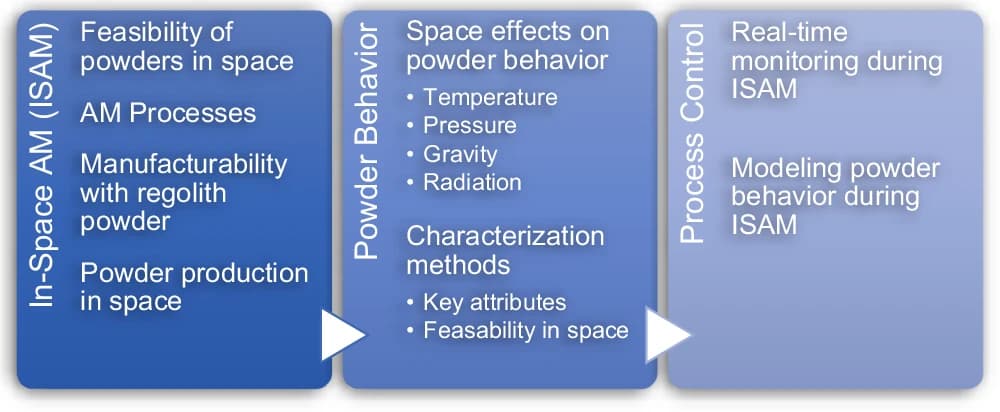
Shipping materials to orbit costs roughly $12,682 per kilogram on a Falcon 9, and that number sits at the center of a new peer-reviewed study arguing that powder-based additive manufacturing, fed by lunar regolith and recycled orbital debris, could rewrite how humanity builds things in space.
The review, titled "Powder characterization for in-space additive manufacturing" and published in npj Advanced Manufacturing, was authored by D. Scott Fernander, Rakeshkumar Karunakaran, Paul R. Mort, and Michael P. Sealy from Purdue University and the University of Nebraska–Lincoln. The team mapped what it would actually take to run powder-bed and powder-fed AM processes in environments no Earth-based printer has ever encountered: microgravity, hard vacuum, and lunar surface temperatures that swing from -250°C to 250°C.
The feedstock problem is where the study gets granular. Lunar regolith checks some encouraging boxes: 90% of its particles fall below 1,000 micrometers, putting it within a workable size range for powder-based processes. But the particles are jagged and irregular, shaped over billions of years by meteorite impacts in an atmosphere-free environment. That morphology complicates the two properties any SLS or binder-jetting operator knows matter most: flowability and packing density. The spherical, carefully atomized powders that run smoothly through Earth-based systems have no analogue on the lunar surface.
Recycled orbital debris was identified alongside regolith as the other primary feedstock candidate, though the two present very different processing challenges. The study also noted that Martian regolith carries its own distinct hazards: toxic perchlorate compounds and hydrated minerals that could compromise both manufacturing safety and the structural integrity of finished parts.
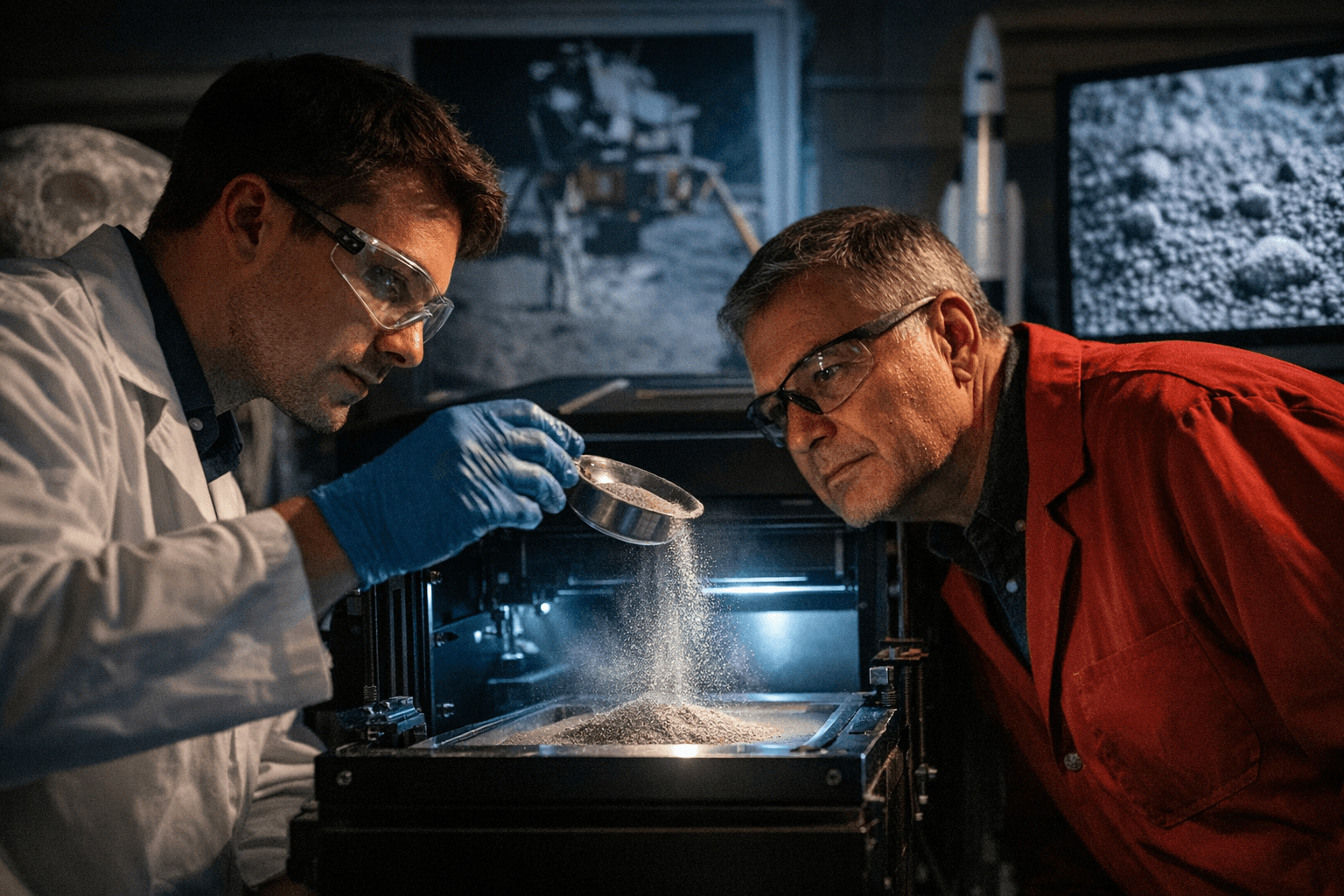
On the question of how to actually produce usable powder in space, the team evaluated multiple methods and landed on electrolysis as the most viable option. The rationale is practical: electrolysis runs on electricity, which solar panels can supply, and it does not depend on gravity to function. That combination makes it uniquely suited to the orbital and lunar environment in a way that conventional atomization methods are not.
Characterizing powder behavior in microgravity presents its own layer of difficulty. Standard lab techniques assume gravity-driven particle settling and flow behavior that simply does not apply off-Earth. The researchers pointed to dynamic image analysis and electrical sensing zone measurement as the most promising approaches for getting reliable feedstock data under microgravity conditions.
The study frames these as interlinked challenges rather than sequential problems: feedstock sourcing, powder behavior under space environments, characterization strategies, and process control all affect one another. Powder-based AM is already mature technology on Earth, valued for its design flexibility and material efficiency. The question the Purdue and Nebraska team set out to answer is not whether the process works, but what specifically has to change for it to work 384,000 kilometers away, with NASA's Artemis program pushing the timeline for putting humans back on the lunar surface.
This article was produced by Prism’s automated news system from verified source data, official records, and press releases, then run through automated quality and moderation checks before publishing. The system is built and supervised by the people who set the standards it runs under. Read our full AI policy.
Did this article answer your question?