Robotic 3D printer produces 12-meter ship hull, slashes shipbuilding costs
CEAD's Faber Navalis printed a 12-meter hull in one piece, pointing to faster composite workflows that could reach smaller machines first.
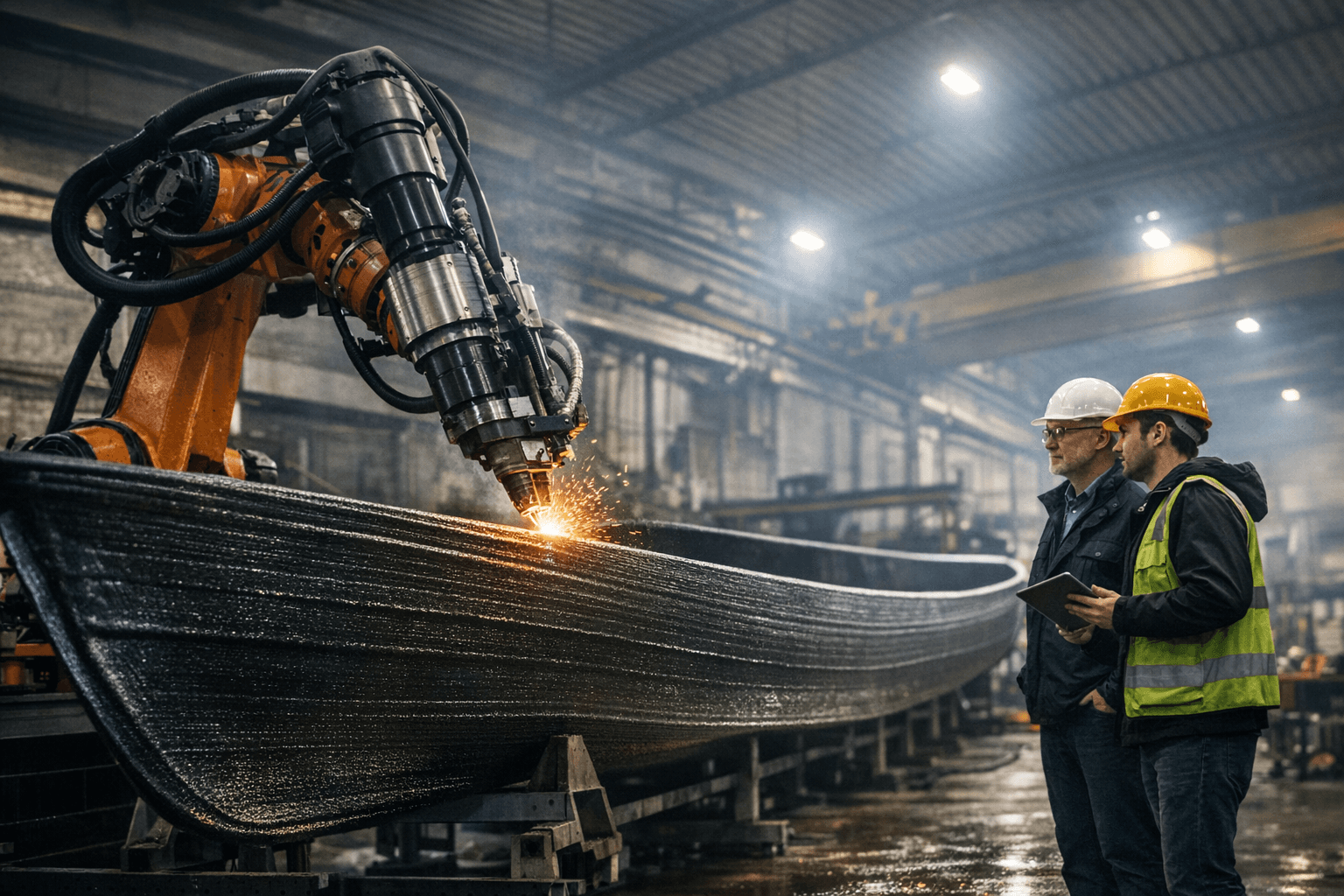
A 12-meter ship hull printed in one uninterrupted run is less about spectacle than about the parts of the process that might actually trickle down to smaller machines. CEAD Group says its Faber Navalis system can build one-piece hull structures up to 12 meters long and 4 meters wide, while cutting out the segmentation, assembly and alignment steps that usually slow marine production down.
That matters because the real innovation is not just size. CEAD says the system combines patented hardware, HDPro material, dedicated workflow software and quality control in a closed-loop, fully automated setup. For desktop and prosumer users, the most transferable lessons are the ones already visible in that stack: tighter toolpath control, more reliable material handling, better process monitoring and fewer manual handoffs between print and post-processing. The 12-meter footprint itself is irrelevant to home printers, but the automation logic behind it is not.
CEAD says the process can reduce production time by 60% to 80%, a claim that helps explain why maritime additive manufacturing is moving beyond one-off demos. In Delft, just around the corner from CEAD’s headquarters, the company has turned a 2,300-square-meter Maritime Application Center into what it calls the boat factory of the future. The center is set up as a test bed for boats up to 12 meters long, with industrial and defense uses that include patrol boats, workboats, supply vessels, fishing boats and unmanned surface vessels.
The company reported in January 2026 that it had already worked with more than 10 customers and shipped nearly 20 boats, which puts Faber Navalis in a broader production ramp rather than a lab-only phase. CEAD also showed a fully automated 5.7-meter fishing boat at Formnext 2025, then launched Faber Navalis in early 2026 as its first application-ready solution for heavy-duty 3D-printed hulls.
That progression is the part hobbyists and small shop operators will watch most closely. The likely spillover is not a 12-meter hull printer on a garage bench, but better composite extrusion, more repeatable continuous-path printing and production software that makes long, structural prints less dependent on constant operator intervention. CEAD’s earlier collaboration with Damen Shipyards Group on a 3D-printed HDPE workboat shows the same arc: marine-scale printing is becoming a workflow problem, not just a machine-size problem.
This article was produced by Prism’s automated news system from verified source data, official records, and press releases, then run through automated quality and moderation checks before publishing. The system is built and supervised by the people who set the standards it runs under. Read our full AI policy.
Did this article answer your question?