Rotational multimaterial 3D printing embeds pneumatic channels for programmable soft robots
A rotating single-nozzle printhead in Harvard’s MM3D process extrudes a polyurethane shell and poloxamer core in one pass, then drains the gel to leave programmable pneumatic channels for soft robots.
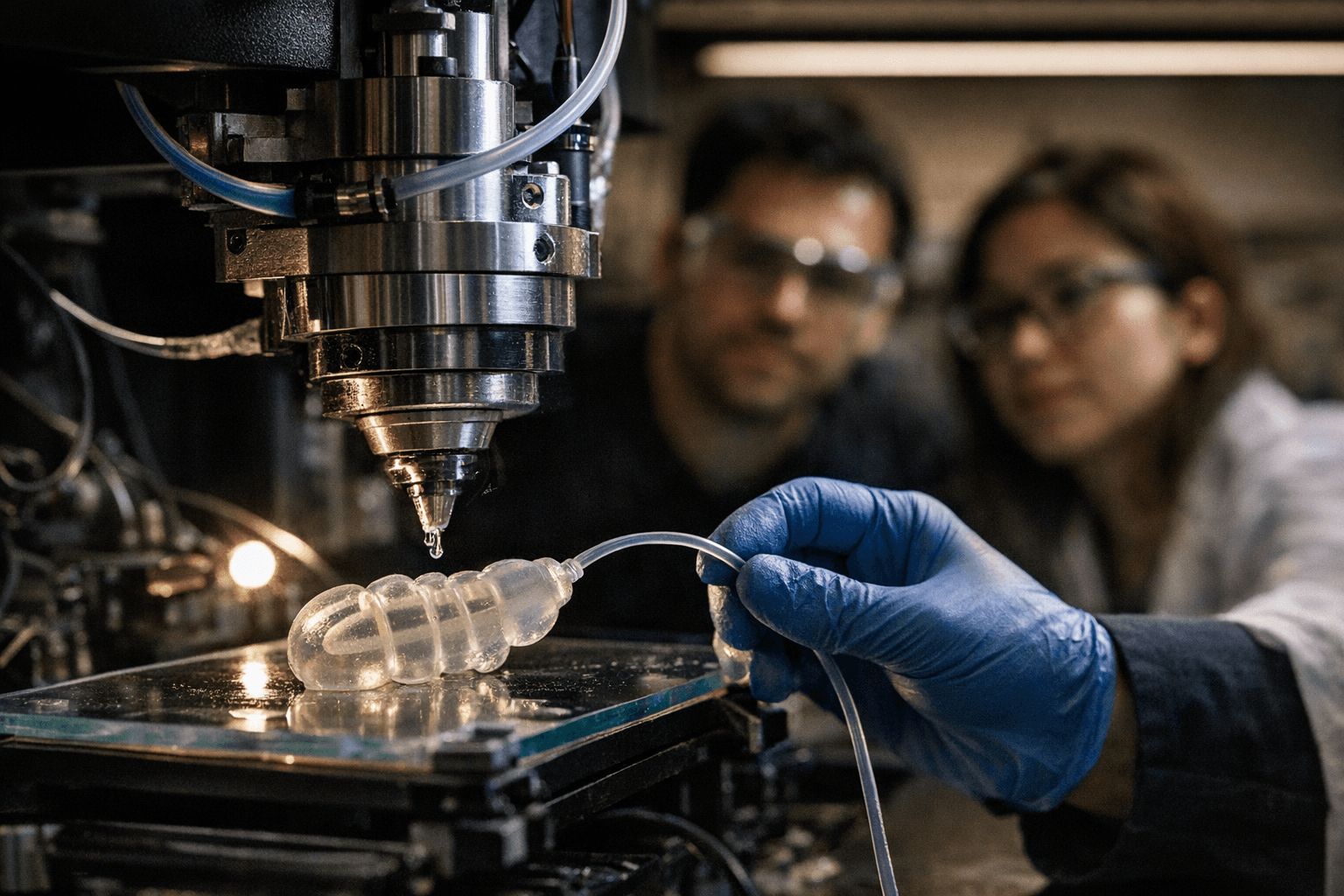
Harvard researchers have shown that a single rotating nozzle can deposit asymmetric core–shell filaments that print embedded pneumatic channels and actuation paths in one continuous pass, enabling soft devices like a spiral actuator that unfurls, a five-finger gripper, and origami-like walkers reported to carry several times their own weight. Coverage of the work appeared across outlets between Feb 9 and Feb 23, 2026, and Gizmodo reports the team describes the method in a paper published in Advanced Materials.
The hardware approach uses one nozzle that rotates continuously while extruding two materials at once: a flexible outer polymer shell and a gel-like poloxamer fugitive core. Engtechnica and other outlets describe control of nozzle orientation, rotation speed, and material flow as the programmatic knobs that determine where the fugitive material sits inside each filament cross-section. Mezha Ua’s account names Jennifer Lewis’s lab at Harvard John A. Paulson School of Engineering and Applied Sciences as the developer and specifies the outer layer as a durable polyurethane, while multiple outlets characterize the inner filler as a poloxamer gel, a material noted for consumer uses such as hair gels, that is removed after printing.
After the printed part hardens, the team drains or removes the poloxamer to leave hollow conduits that become pneumatic channels. Engtechnica reports designers can thus encode motion into the print path itself: by varying nozzle angle, rotation rate, and flow the process produces spirals and asymmetric channel layouts that deform predictably when inflated. Mezha Ua quoted the group’s practical pitch succinctly: “The process does not require any changes to the equipment – just adjusting the printing parameters.”
Demonstrations compiled across the coverage show distinct device classes enabled by the method. Engtechnica details a spiral actuator that unfurls on inflation and a five-finger gripper that bends to grasp. 3D Printing Industry highlights origami-style walkers produced with the MM3D approach and reports they can carry several times their own weight, while Gizmodo frames the technique as creating “artificial muscle” by embedding pneumatic channels directly into soft material. 3Dnatives supplied imagery credited to Harvard John A. Paulson SEAS and described the workflow as ready-to-use after printing.
Reporters and the authors framing the work emphasize manufacturing advantages over traditional mold-casting and multi-step assembly for pneumatic soft actuators. 3Dnatives put it plainly: “This multi-material printing method eliminates the need to create molds… the process produces a structure that is ready to use and program.” 3D Printing Industry links the capability to application areas such as surgical robotics and wearable assistive devices and places the work alongside design tools like CU Boulder’s OpenVCAD as part of a broader push in multimaterial additive manufacturing.
If the Advanced Materials report and lab attributions stand, rotational multimaterial 3D printing promises a practical route to faster iteration and greater design freedom by encoding predictable deformation into the print path and producing ready-to-actuate soft robots in a single fabrication step.
This article was produced by Prism’s automated news system from verified source data, official records, and press releases, then run through automated quality and moderation checks before publishing. The system is built and supervised by the people who set the standards it runs under. Read our full AI policy.
Did this article answer your question?