Royal3D Launches Interlayer Control System for Real-Time Thermal Monitoring
Royal3D's new Interlayer Control System uses a 160x140 thermal camera to catch layer adhesion failures in real time before they ruin a large-format print.
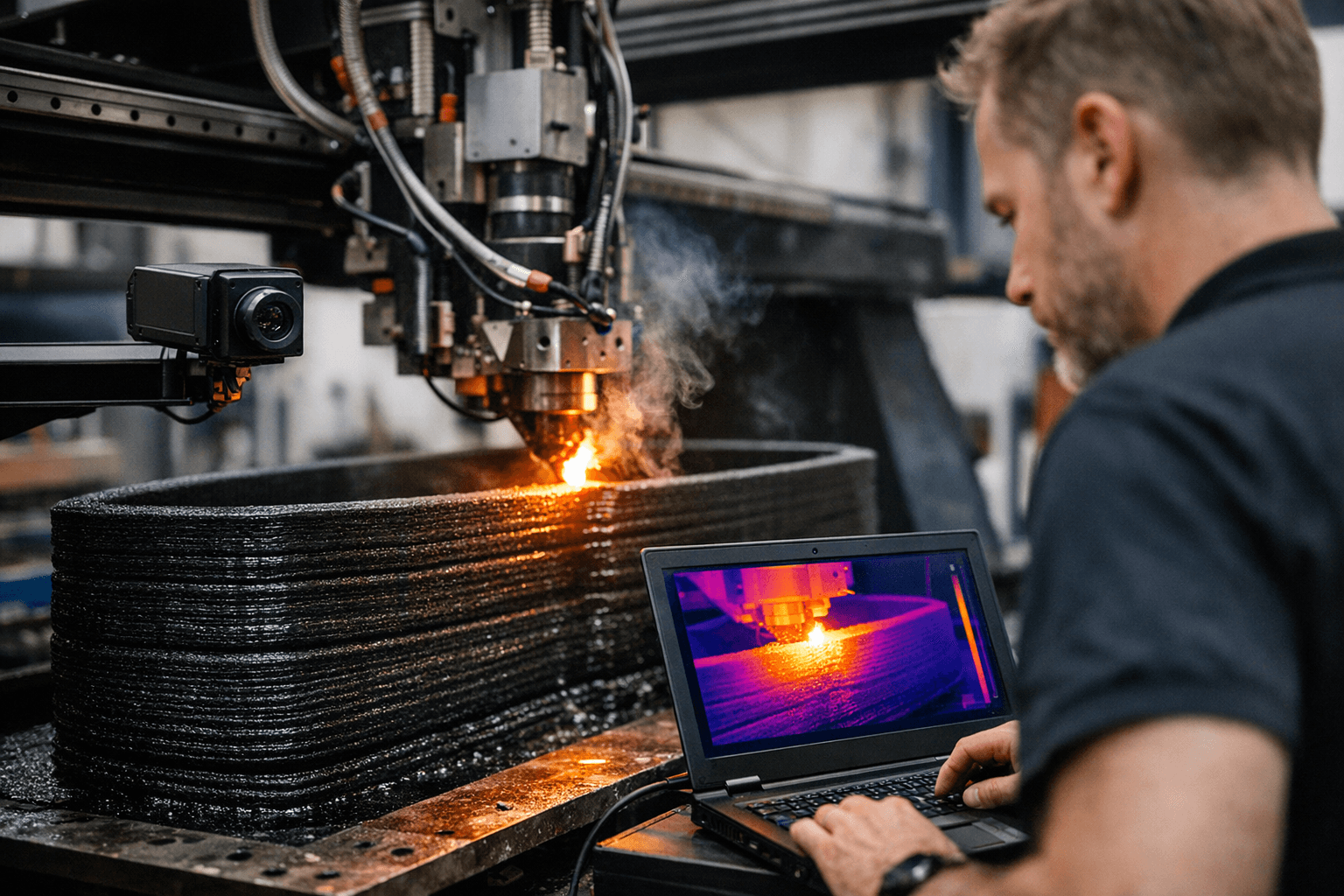
Rotterdam-based Royal3D launched the Interlayer Control System (ICS) this week, a thermal-imaging tool that maps nozzle temperatures to XYZ coordinates in real time across large-format and robotic 3D printing installations, targeting one of the most stubborn failure points in industrial additive manufacturing: the gap between layers that nobody sees until the print is ruined.
The problem is familiar to anyone running industrial-scale jobs. Temperature inconsistencies between layers cause poor layer adhesion, internal stresses, warping, and misprints, and these issues typically go undetected until after a job is completed, at which point the material is already wasted and production timelines have taken a hit. The ICS addresses this by pulling live thermal data from every layer as it deposits, giving operators visibility before problems have a chance to compound.
At the hardware level, the system uses a 160 by 140 pixel thermal camera that continuously tracks nozzle position across X, Y, and Z axes. The camera feed is correlated to nozzle location through the printer's PLC, which must be capable of returning XYZ-coordinated nozzle data, making ICS a fit for PLC-equipped robotic and large-format installations rather than desktop machines. The system runs on a dedicated computer to guarantee stability and performance, and installation follows a four-step process: three steps covering hardware and software integration into the existing printing setup, and a fourth dedicated to calibration.
For composites fabricators specifically, the system's measurement range is worth noting. It can measure the temperature of any type of material up to 280°C with any type of fiber reinforcement, a spec that positions it squarely in fiber-reinforced thermoplastic territory where interlayer consistency is critical to structural performance.
Beyond catching defects in the moment, the ICS builds a cumulative thermal record that operators can mine for material-specific tuning. Royal3D points out that a profile that works well for PETG may not produce the same results with PP, and that analyzing accumulated thermal data over time helps fine-tune parameters on a per-material basis. Maintenance is low, requiring only periodic calibration to maintain measurement accuracy.
Founder Fulko Roos framed the launch in explicitly data-driven terms. "Our goal is to empower manufacturers to take control of their quality processes, reduce material waste, and improve efficiency across the board," Roos said. "This is more than a tool but it's a pathway to smarter, data-driven manufacturing."
Royal3D showcased the ICS at JEC World 2026 alongside CompositesNL, marking what the company described as a significant step from development into active industry conversations. "Seeing this technology move from development into real conversations with the industry felt like a true milestone for our team," the company wrote following the event. Royal3D indicated the next phase is bringing ICS into live production environments, though the company has not yet disclosed pricing or a formal commercial availability date.
This article was produced by Prism’s automated news system from verified source data, official records, and press releases, then run through automated quality and moderation checks before publishing. The system is built and supervised by the people who set the standards it runs under. Read our full AI policy.
Did this article answer your question?