Single-exposure holographic printing produces million-voxel parts in seconds
Researchers demonstrated a single-exposure holographic 3D printing technique that fabricates millimeter-scale parts in a single 7.5 second shot, boosting volumetric throughput for resin printing.

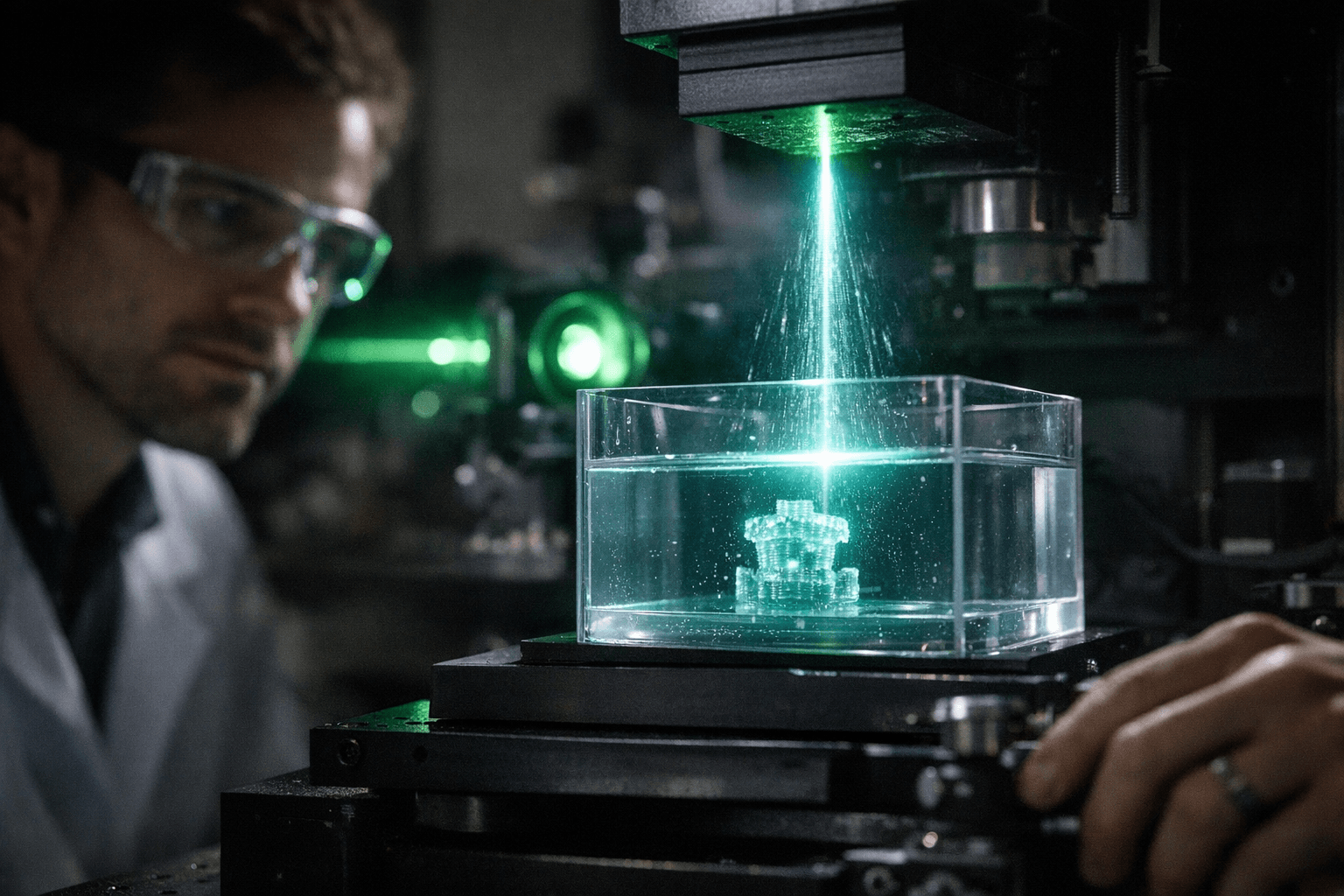
A new volumetric printing approach used inverse-designed microstructured phase masks and tuned photopolymer resins to polymerize entire 3D dose fields in one exposure, producing millimeter-scale architectures with more than 1,000,000 addressable voxels in a single 7.5 second shot. The team reported a volumetric throughput of about 1 mm^3 per second, equivalent to over 100,000 voxels per second, shifting the bottleneck from optical patterning to resin response and illumination geometry.
The method generates arbitrary three-dimensional light-intensity distributions inside the resin by tailoring the phase-mask topography. That control lets users encode intentional low-dose or dark regions to carve out hollow internal features without layer seams or support structures. At the same time, the resin chemistry is co-optimized for controlled optical absorption and sufficient local energy deposition so that polymerization fidelity is maintained throughout the volume rather than only at a surface or plane.
Optically, the volumetric information capacity of the process scales with the space-bandwidth product of the phase mask, meaning larger or higher-resolution masks can increase the number of independently addressable voxels. In practice, the demonstrated limits came from resin kinetics and the illumination geometry used in the experiments, not from the phase-mask design framework itself. That separation is important for practitioners: improving photoinitiator kinetics and dose-response curves, or revising the illumination optics, could yield immediate gains without reworking the inverse design pipeline.
For the maker and lab communities this is more than a laboratory curiosity. The ability to create complex internal topology, micro-optical elements, and biomedical scaffold geometries in a single exposure removes many of the mechanical artifacts and slow point-by-point constraints of traditional stereolithography and two-photon techniques. Achieving these throughput gains in a workshop or small lab requires attention to resin formulation, light penetration control, and access to phase-mask inverse-design tools or collaborators who can fabricate microstructured optics.
The tradeoffs are practical: single-shot volumetric printing demands resins with balanced absorption and rapid, local polymerization; it also favors illumination systems designed to deliver the computed dose field uniformly across the build volume. The path forward is clear, scale the mask space-bandwidth product, accelerate resin kinetics, and refine illumination geometry, and the payoff is orders-of-magnitude speedups for suitable resin-based applications.
Expect rapid follow-up on resin recipes and optical hardware as groups adapt the phase-mask framework to larger build volumes and different wavelength regimes. If you plan to experiment, test compatible resins and illumination setups first, and consider teaming up with optical designers; this technique turns light patterning into a production asset rather than a limiting step.
This article was produced by Prism’s automated news system from verified source data, official records, and press releases, then run through automated quality and moderation checks before publishing. The system is built and supervised by the people who set the standards it runs under. Read our full AI policy.
Did this article answer your question?