Single-View Holographic Volumetric Printing Enables Fast 10-Micron Features via Photochemistry-Aware Optimization
Researchers developed a single-view holographic volumetric printer that uses photochemistry-aware optimization to produce ~10 µm features inside millimeter-scale volumes in seconds.
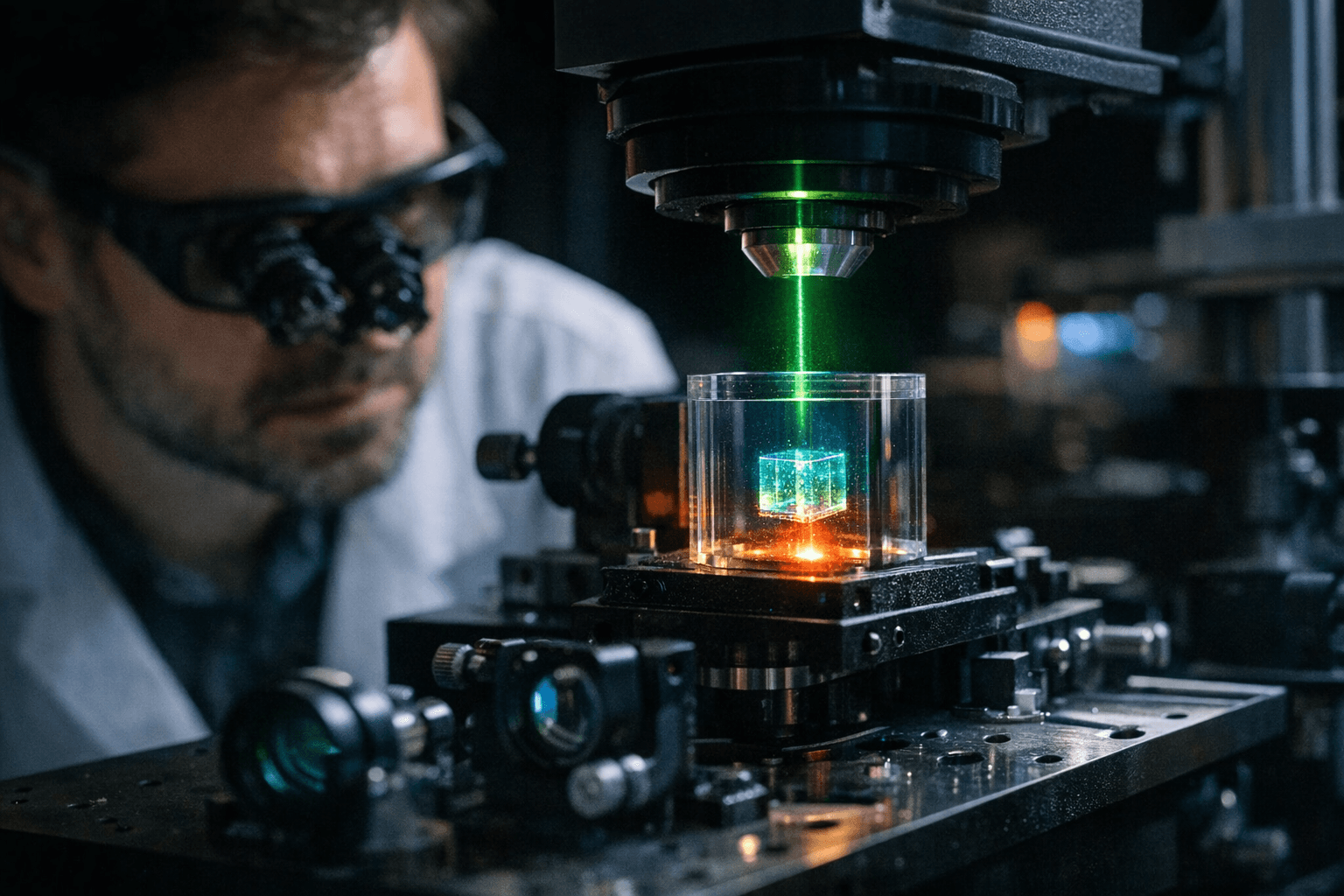
Felix Wechsler, Riccardo Rizzo, and Christophe Moser presented a mechanically static single-view holographic volumetric additive manufacturing method that stitches time-multiplexed phase-only holograms to synthesize 3D dose distributions while accounting for resin chemistry. By coupling a differentiable wave-optical forward model with a simplified photochemical model that includes inhibitor diffusion and nonlinear dose response, the team treated hologram synthesis as a single inverse problem combining optics and photochemistry. The result is compensation for chemical blur and markedly higher printing fidelity than optics-only hologram design.
The approach, posted to arXiv on January 22, 2026, projects sequences of phase-only holograms from one optical axis, rather than scanning a beam or rotating the build. Demonstrations include printed 2D and 3D structures with lateral feature sizes near 10 micrometers inside volumes of roughly 0.8 x 0.8 x 3 mm, produced in on the order of seconds. Those numbers matter because they pair microfeature resolution with volumetric, nonlayered printing speed, opening a shortcut to rapid prototyping of micro-optics, biomedical scaffolds, and mesoscale assemblies that demand internal structure.
For makers and lab groups, the practical value is twofold. First, a static, single-axis optical setup reduces mechanical complexity compared with multi-view holography or tomographic projection systems. Second, embedding photochemistry into the optimization loop directly addresses the resin-level limits that often blur designed features: inhibitor diffusion and nonlinear dose thresholds are not just lab nuisances but predictable physics that the optimization can counteract. That means users who can control resin formulation, photoinitiator and inhibitor concentrations, and exposure timing can expect better fidelity without brute-force hardware upgrades.
Limitations and caveats remain. The demonstrated build volume is millimeter-scale, so this technique is not yet a replacement for large-format printers. The method relies on phase-only spatial light modulators or equivalent hardware capable of fast, repeatable hologram playback, and on resins whose reaction-diffusion behavior can be modeled. Scaling depth, increasing lateral field, and validating across a broader set of chemistries will be key engineering steps before community labs can routinely reproduce these results.
For the 3D printing community, the study points to a clear design path: optimize light patterns and chemistry together rather than treating optics and resin as separate problems. Expect follow-up work on expanding volumes, tuning resins for faster inhibitor dynamics, and integrating differentiable models into hologram design toolchains. Those advances could bring true volumetric microfabrication from demo rigs to shared lab benches, cutting print times and unlocking compact micro-optic and scaffold designs that were previously expensive or impractical.
Know something we missed? Have a correction or additional information?
Submit a Tip