Texas Tech Library Makerspace Upgrades to Ultimaker Printers for Student Makers
Texas Tech's Makerspace swapped worn-out printers for Ultimaker S7s in March; the $11K decision reveals where institution-grade hardware outperforms a Bambu fleet, and where it doesn't.
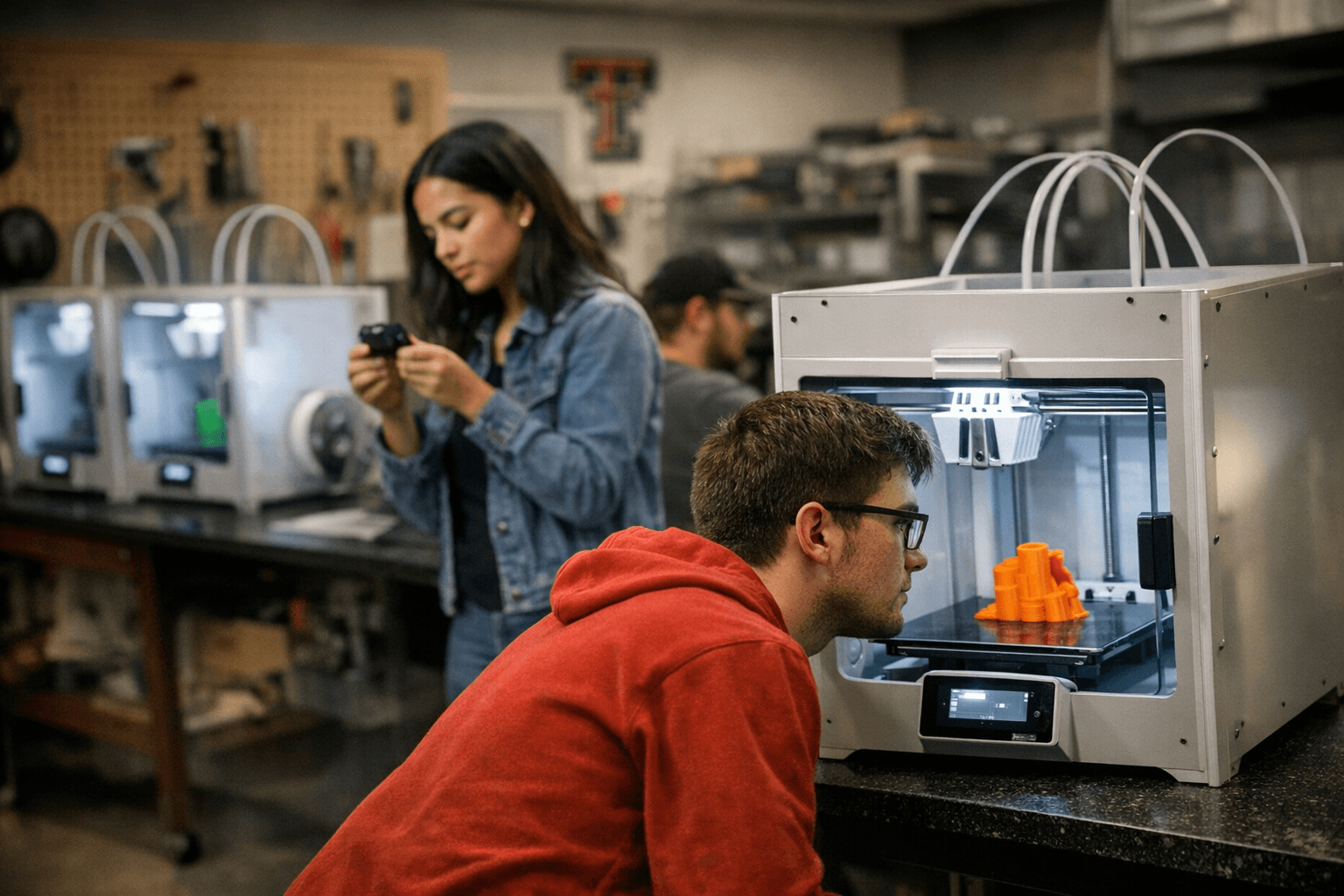
The Texas Tech University Library Makerspace replaced its aging 3D printer fleet with Ultimaker S7 and Ultimaker 3 machines in March, ending a cycle of recurring repairs that Makerspace lead administrator Sean Scully identified as a growing maintenance burden after years of heavy student traffic. The machines are live on the library's second floor in room 210, and the specific hardware choices tell a useful story for anyone managing shared print infrastructure or debating whether institution-grade equipment belongs in a home shop.
The S7 is Ultimaker's current flagship and its feature set is built around first-layer certainty rather than raw speed. An inductive print head sensor probes the build plate at multiple points, applying automatic tilt compensation without manual thumbscrew calibration. In a shared environment where student workers cycle through between classes and nobody personally owns the machine, that level of repeatable first-layer reliability eliminates one of the most common failure modes: a slightly unlevel bed compounding into an abandoned print 45 minutes in. Scully's maintenance-burden rationale maps directly here; the older machines likely required constant releveling and nozzle intervention that the S7's active leveling approach largely removes.
Dual extrusion with PVA soluble support changes the material game more substantially. Quest-Dion Carlos, a third-year mechanical engineering student and Makerspace assistant, noted the new printers "allow for higher forms of creativity" across architecture, art, and engineering, specifically calling out support strategy and structural integrity testing as areas of real improvement. PVA dissolves in water, leaves no surface scarring, and opens up overhanging geometries that would have required hours of post-processing on the prior machines. Kaeden Mailands, a third-year creative media major, described the capability shift as allowing "a little more sophisticated" work, which understates the visible gap between single-material output and clean dual-extrusion parts.
The S7's Air Manager accessory adds an EPA-rated filter, independently tested to the UL2904 emissions standard, that captures particulate and chemical output from the print environment. In an enclosed library where students sit nearby for extended sessions, that is not a minor spec note. Open-frame machines like the Prusa MK4 leave the enclosure and air quality question unaddressed by design. Ultimaker's Digital Factory platform layers remote queue management on top, allowing Makerspace staff to monitor jobs and machine status across multiple printers without a dedicated physical presence, a capability that justifies its operational overhead once you are running three or more machines concurrently.
That is precisely where the home hobbyist calculation forks. The Ultimaker S7 bundle runs close to $11,000. Community consensus holds that you could buy a small fleet of Bambu X1C machines for the same budget, and they would outprint the S7 on raw throughput: the X1C is capable of roughly 300mm/s compared to the S7's more conservative standard profiles. For single-material PLA and PETG, the Bambu's CoreXY motion system and multi-color AMS ecosystem deliver faster cycle times and a lower cost per successful print. Prusa's MK4 sits between the two: open-source material profiles, a deeply documented community, and a price point that makes personal ownership sensible. Neither Bambu nor Prusa matches Ultimaker's depth of validated third-party material profiles, which cover engineering-grade filaments and have been tested for thousands of hours through manufacturer partnerships.
Mailands put the ownership question plainly: if you are not printing often enough to justify the cost and commitment, a well-equipped shared makerspace is the right answer. For students working with TPU, short-run composite parts, or complex geometries that require soluble support, access to an S7 through a campus library beats owning a mid-range machine. For everyone running standard profiles on a deadline, the Bambu is the faster answer at home.
This article was produced by Prism’s automated news system from verified source data, official records, and press releases, then run through automated quality and moderation checks before publishing. The system is built and supervised by the people who set the standards it runs under. Read our full AI policy.
Did this article answer your question?