Ukrainian FPV Drone Features 3D-Printed Warhead With Shaped-Charge Copper Liner
A Ukrainian FPV warhead with a 3D-printed casing uses a copper cone liner to generate an explosively formed jet, similar in principle to an RPG-7 warhead, per OSINT analyst GrandpaRoy2.

A Ukrainian FPV drone warhead documented by Canadian OSINT analyst GrandpaRoy2 puts 3D printing squarely inside the warhead itself, not just in the airframe around it. The munition pairs a fully printed polymer casing with a shaped-charge copper cone liner designed to generate an explosively formed jet on impact, a penetration mechanism more commonly associated with an RPG-7 round than a drone built from hobby parts.
The physics behind it will be familiar if you've spent any time studying shaped-charge design. A conical copper liner, when driven by the detonation wave from the main explosive charge, collapses inward and forward at extraordinary speed, forming a coherent high-velocity jet of superplastic copper that punches through armor well beyond what the charge diameter alone would suggest. GrandpaRoy2 has noted that the "Thermos 75 S2," a Ukrainian printed-casing drone munition operating on exactly this principle, performs similarly to the standard PG-7M warhead in penetration terms, with test footage showing it pierce multiple layers of steel. The standoff distance is critical: a rod fuze extending ahead of the warhead ensures the jet has room to fully form before it meets the target, a detail Ukrainian designers have incorporated deliberately.
What makes GrandpaRoy2's documentation particularly valuable for anyone tracking this space is the breadth of what Ukraine is fielding. The "SAB-FPV-1.3K" warhead he shared earlier packs a copper-liner EFP (Explosively Formed Penetrator, a dish-based variant of the same principle) alongside 1,700 steel ball fragmentation elements that carry a lethal radius of four meters, all detonated by a C4 main charge. That is an anti-armor and anti-personnel dual-purpose round, factory-branded and produced in volume. Separately, the "Toro" fragmentation warhead, recovered by Russian forces and also documented by GrandpaRoy2, weighs 1.3 kg loaded and carries approximately 1,100 steel shot elements. These are not improvised grenades zip-tied to a racing quad. They are engineered munitions with specific lethality profiles, and the 3D-printed casing on the copper-liner warhead is the same manufacturing logic applied to a more demanding penetration role.
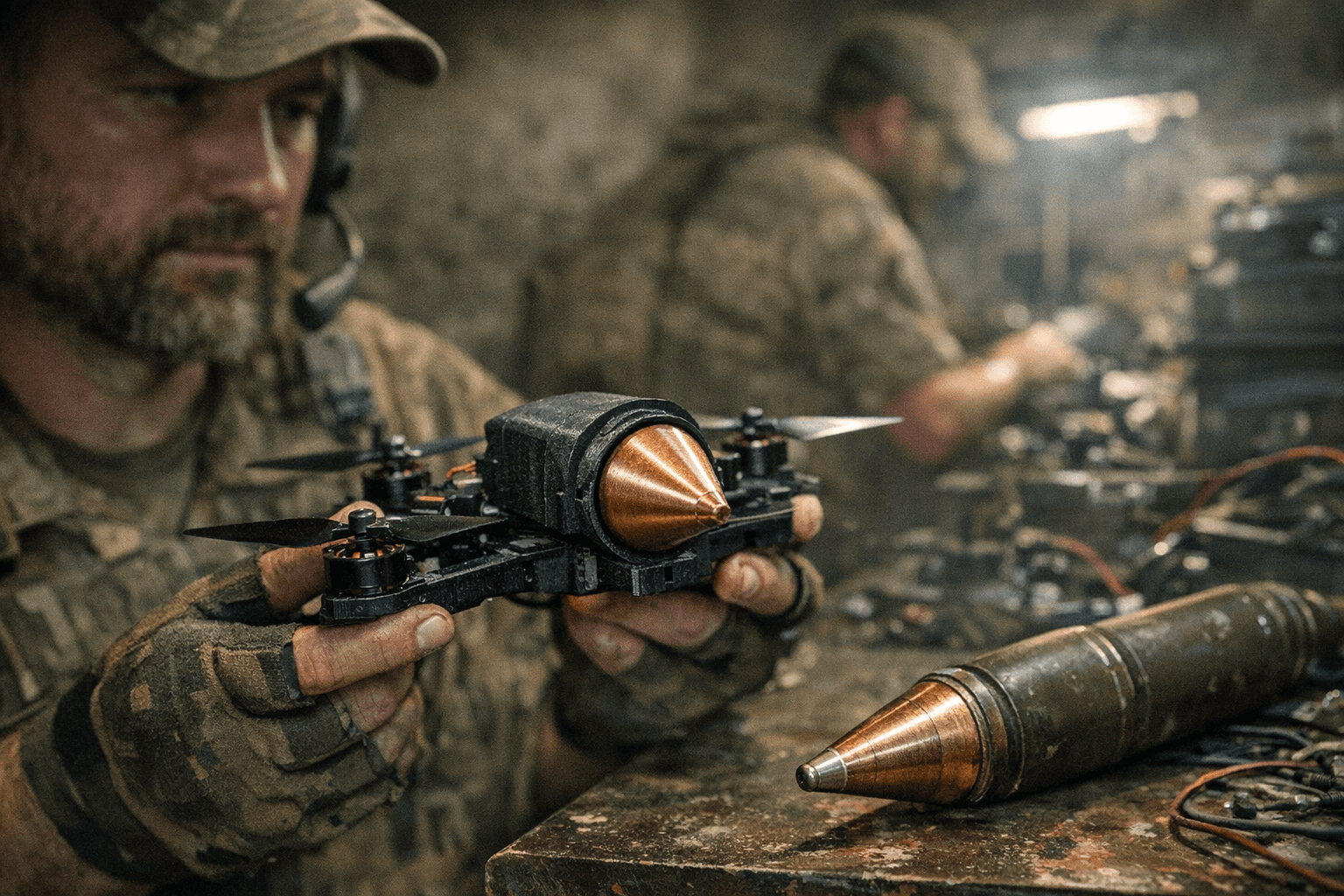
The preference for copper over steel in the liner is well established in munitions engineering and shows up directly in GrandpaRoy2's own commentary on a test of an improvised EFP warhead, where he noted that the 3mm steel liner used in that particular example "will not be quite as effective as the usual copper." Choosing copper for a conical EFJ liner is not a shortcut; it is the correct material choice for maximizing jet coherence and penetration depth. That a Ukrainian manufacturer is sourcing and forming copper cones and integrating them into 3D-printed casings at scale reflects a level of technical maturity that goes well beyond the early zip-tie-and-RPG-warhead configurations that defined FPV munitions two years ago.
GrandpaRoy2 has built one of the most detailed open-source catalogs of Ukrainian and Russian drone munitions currently available, with detailed cross-section imagery, weight figures, and penetration test footage that rarely surfaces elsewhere. The copper-liner warhead is the latest addition to a Ukrainian FPV arsenal that is iterating faster than most conventional procurement cycles could track.
Know something we missed? Have a correction or additional information?
Submit a Tip