NASA Chief Isaacman Envisions Moon Economy Built on 3D Printing and Helium-3 Mining
Jared Isaacman described a lunar economy where 3D printers build from regolith and Helium-3 fuels fusion reactors - and said that economy is inevitable.
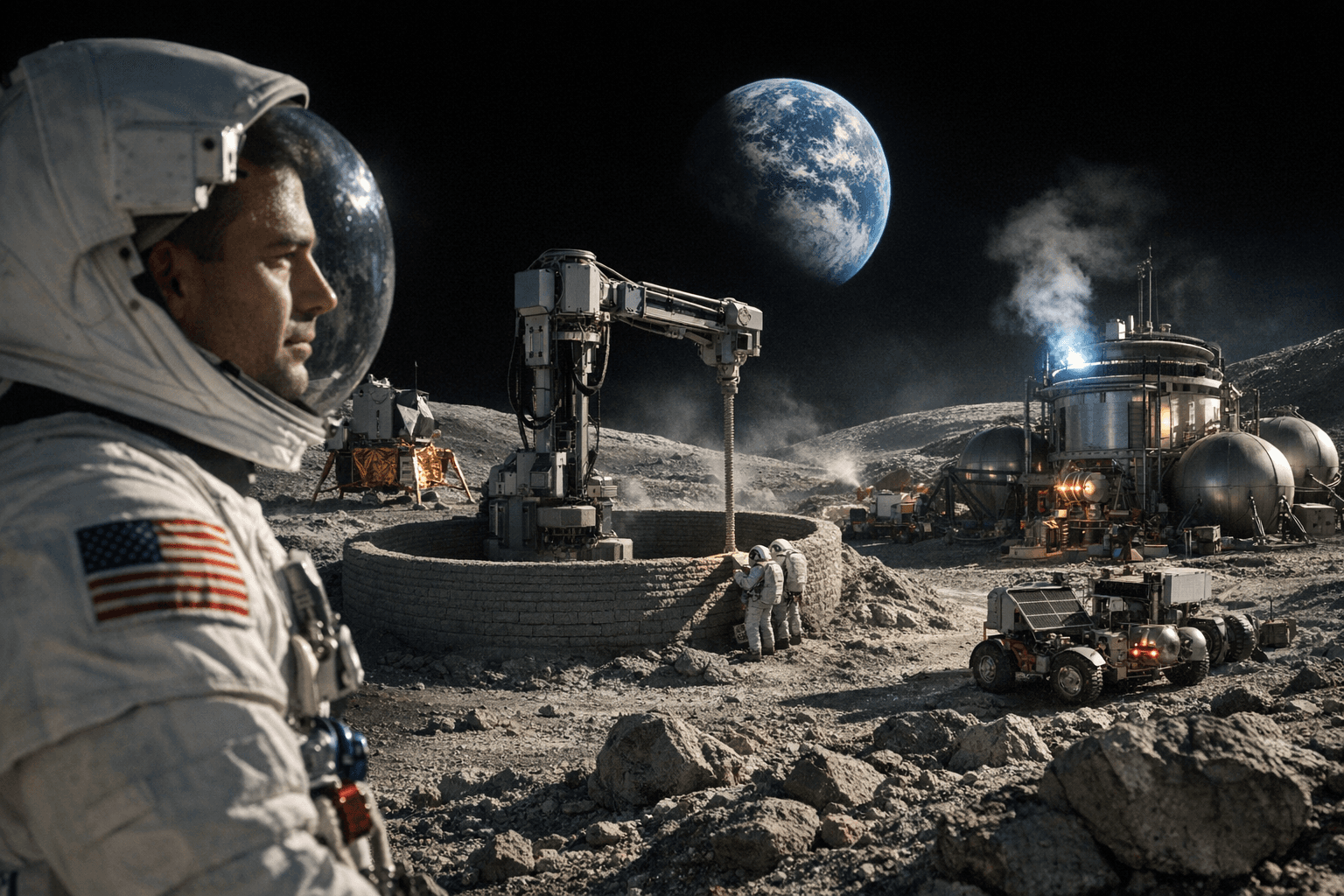
NASA Administrator Jared Isaacman laid out a sweeping vision of the moon as an industrial frontier in a conversation with Glenn Beck, describing a future where additive manufacturing machinery works the lunar surface and Helium-3 mining supplies what could become the most transformative energy source in human history.
The 3D printing component is exactly what it sounds like to anyone in this community: using the moon's regolith, the loose, meteorite-pulverized soil blanketing the entire surface, as feedstock to fabricate structures in place. Rather than launching building materials from Earth at punishing cost per kilogram, the logic of in-situ resource utilization means printing landing pads, shelters, and industrial infrastructure directly from what is already there. Isaacman framed this not as a distant concept but as the practical engineering precondition for any serious, sustained human presence on the moon.
Helium-3 is the other pillar of the vision he presented to Beck. The isotope accumulates in lunar regolith over billions of years because the moon, lacking Earth's magnetic field and atmosphere, receives the solar wind directly. Isaacman has described the element as something that barely exists on Earth and as "predicted to be a more efficient source of fusion power." The economics carry real weight: even modest quantities of Helium-3 could be worth trillions of dollars if fusion energy reaches commercial scale, a milestone that moved a significant step closer in 2022 when a U.S. government lab achieved fusion ignition for the first time in history.
Isaacman is driving this agenda from the top of an agency undergoing significant change. Confirmed as NASA's 15th administrator in a 67-30 Senate vote on December 17, 2025, he is operating under a presidential directive to land Americans on the moon by 2028 and establish a permanent lunar base by 2030. That compressed timeline frames every decision he is making, including recent changes to the Artemis program's architecture and a push to increase uncrewed landing frequency before committing crew. Artemis II, the first crewed lunar mission since 1972, launched from Kennedy Space Center this week.
The national security angle is never far from Isaacman's public statements. Both the United States and China are targeting lunar resources, and the lunar south pole, with its deposits of water ice convertible into rocket propellant, sits at the center of that competition. Isaacman has been explicit that getting to the moon first and staying is a strategic imperative, not just a scientific one.
For the 3D printing community, the lunar economy is not an abstraction. Research groups including a team at Ohio State University have already demonstrated laser-based techniques that process regolith simulants into hardened structural material capable of withstanding radiation and the moon's extreme thermal swings. The gap between lab-proven and surface-deployed is closing. With Isaacman publicly naming regolith printing as a foundation of the moon's industrial future, that technology now has the most powerful institutional advocate it has ever had.
Know something we missed? Have a correction or additional information?
Submit a Tip