Tsinghua Researchers Unveil Under-a-Second Holographic 3D Printing Breakthrough
Tsinghua's DISH printed millimetre-scale objects in 0.6 seconds without layers, a speed jump that could reshape resin printing if it ever leaves the lab.
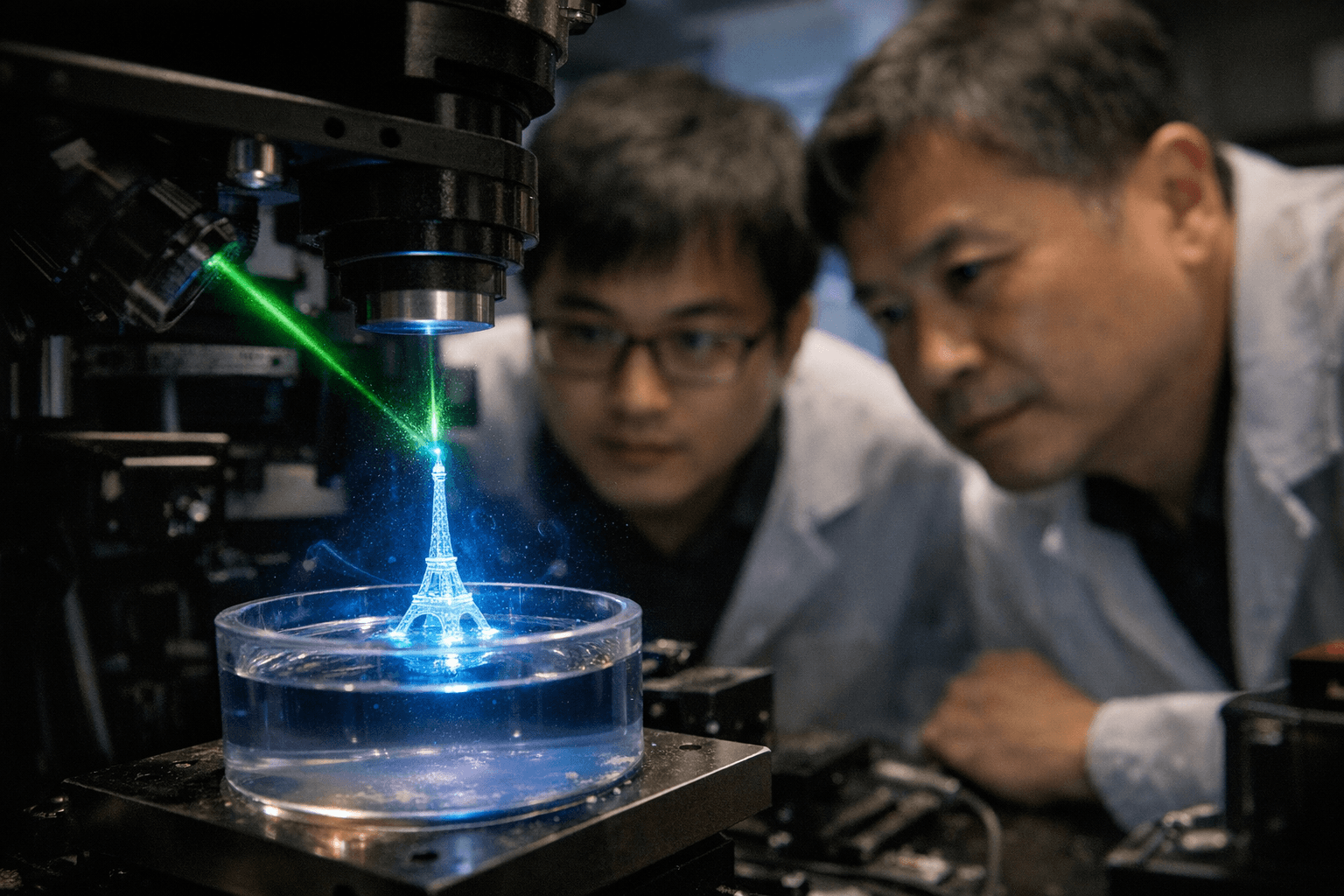
Tsinghua University just showed what happens when holography stops being a display trick and starts acting like a printer: millimetre-scale objects came out in 0.6 seconds, with no layers at all. If even a sliver of that speed made its way into desktop resin machines, the bottleneck in SLA and MSLA would look very different overnight.
The system, called DISH, short for Digital Incoherent Synthesis of Holographic light fields, was described in a Nature paper published on 11 February 2026. Led by Qionghai Dai, the team used continuous multi-angle projections and a high-speed rotating periscope to build 3D light distributions without rotating the sample itself. That stationary setup matters. Traditional volumetric methods have chased speed for years, but once the resin container starts moving, vibration and flow distortions can wreck the fine details makers actually care about.
The headline number is not just the speed. The paper says DISH held 19-micrometre printing resolution across a 1-centimetre range, which is far beyond the depth of field of the objective. Tsinghua also said the process reached a minimum printable structure size of 12 micrometres and a volumetric printing rate of 333 cubic millimetres per second. That is the kind of throughput that turns a lab demo into a genuine manufacturing flex.
The catch, and it is a big one for anyone used to the clean workflow of today’s SLA printers, is that this is still a research system built around a very different material and optics stack. Nature reports that the team demonstrated the method with acrylate materials across a range of viscosities, and it also showed that integrating DISH with a fluid channel enabled batch and successive printing of complex structures in low-viscosity materials. That is promising, but it is not the same as dropping a new resin into an Elegoo or Formlabs machine and calling it a day.
The broader context is where this gets interesting. Computed axial lithography and other volumetric approaches already proved that you can beat layer-by-layer speed, but they brought their own compromises, especially around rotating containers, out-of-focus precision loss, and resin constraints that tended to favor high-viscosity materials. DISH pushes past that trade-off by bringing computational optics, a field built for imaging, into direct manufacturing.
Tsinghua said the project took five years and could feed into biomedicine, engineering, photonics, flexible electronics, drug screening, and micro-robots. That is a wide target list, and it reads like a roadmap for where this kind of printing has a real shot: tiny, complex parts where speed and precision both matter. For desktop resin printing, though, the message is simpler and sharper. The future is not another faster layer. It is light doing the whole job at once.
Know something we missed? Have a correction or additional information?
Submit a Tip