Virtuals Protocol Demos First On-Chain Robot-to-Robot Commerce with 3D-Printed Model
A Unitree humanoid robot 3D-printed a model, paid a rover and a drone for autonomous delivery via on-chain USDC settlement on Base, with zero human involvement.

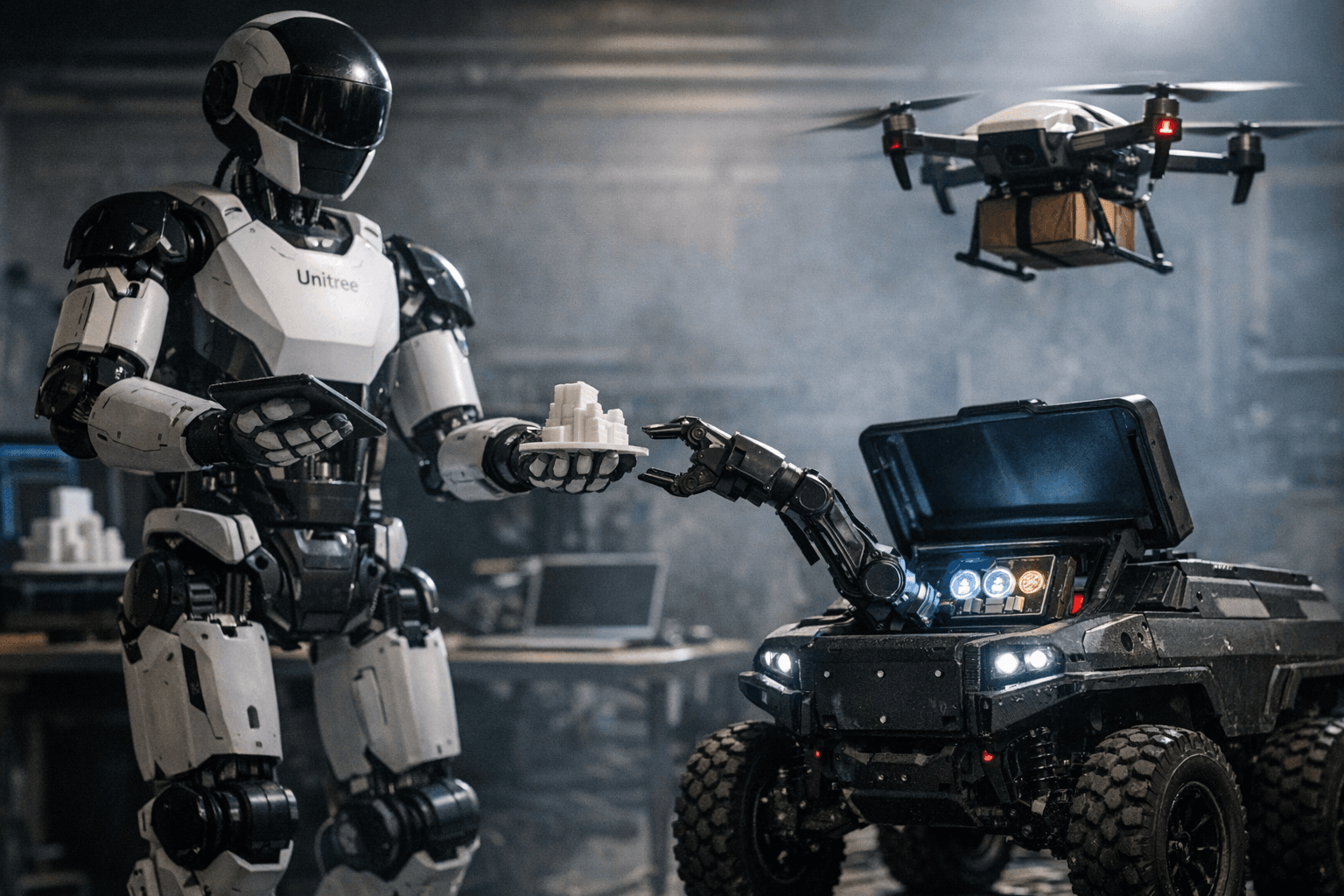
The order went out the moment the print finished. A Unitree humanoid robot filed a delivery request through Virtuals Protocol's Agent Commerce Protocol, an autonomous RiceAI rover collected the package and moved it to the shipping point, and a FlybyRobotics drone handled the final mile. Every leg of that chain settled in USDC on Base via Coinbase's x402 payment protocol. Zero humans coordinated anything.
That is what Virtuals Protocol demonstrated on April 6, and the reason it matters to anyone running a print shop is the end-to-end chain it sketched out: print triggers order, order triggers payment, payment triggers fulfillment, fulfillment closes on-chain. Right now that chain requires a human at nearly every handoff. The demo showed machines negotiating those handoffs between themselves.
ACP, the open standard at the core of the demo, handles the commercial logic between autonomous agents: job creation, on-chain escrow, delivery verification, and settlement. It is designed so any agent, robotic or software, can register a service, post a fee, and receive payment without a human approving each transaction. An earlier Virtuals experiment chained five specialised software agents together to run a simulated lemonade stand business entirely on-chain. The Unitree demo moved that same framework into physical hardware.
x402, the payment rail underneath, is Coinbase's open HTTP-402 implementation that enables gasless micropayments settling in roughly two seconds using USDC on Base. The protocol had processed $600 million in cumulative payment volume by November 2025, with Google Cloud, AWS, and Anthropic already integrating it for machine-centric workflows.
The hobbyist parallel is closer than it looks. You can connect OctoPrint or a Klipper-based setup to Shopify or Etsy order triggers using webhooks today, and services like Printago offer native integrations that pull orders directly into a print queue. That covers the order-to-print leg. What Virtuals added is the payment-to-fulfillment leg: once the print is done, an agent autonomously hires another agent or robot to pick it up and deliver it. The gap between those two worlds is narrowing, but the on-chain robot-to-robot settlement piece remains early-adopter territory that most small-shop operators are not close to running themselves.
Two failure points deserve honest attention before anyone mentally wires their Ender 3 into an autonomous fulfillment loop. Quality control is the first: ACP's SLA framework gives agents a defined window to complete a job before escrow auto-refunds, but there is no mechanism yet for a drone to inspect a print for layer shifts or delamination before payment clears. The second is liability. When a humanoid robot ships a part that breaks in service and every hand in the chain was autonomous, the question of who bears legal responsibility has no settled answer under current law in any major jurisdiction.
Virtuals Protocol operates Eastworld Labs with a fleet of more than 30 full-sized Unitree G1 platforms, giving the company real hardware to iterate against rather than simulated proofs. The April 6 demo was a proof of concept, not a shipping product. But the workflow it described, a print shop as an autonomous agent that earns, hires, and fulfills without a human clicking approve at each step, is the most concrete sketch yet of where small-batch physical manufacturing is headed.
Know something we missed? Have a correction or additional information?
Submit a Tip