Voron 0 Calibration Breakthrough Uses Camera and Timing Precision
A maker known as Dennis on December 24 systematically recalibrated a Voron 0 FFF printer to target better than 100 micrometers accuracy across 100 mm, using a camera on the toolhead and microsecond level timing to build a correction map. The experiment demonstrates practical methods for compensating geometric errors and bed contact uncertainty, giving the community a replicable pathway to improve positional accuracy on consumer machines.
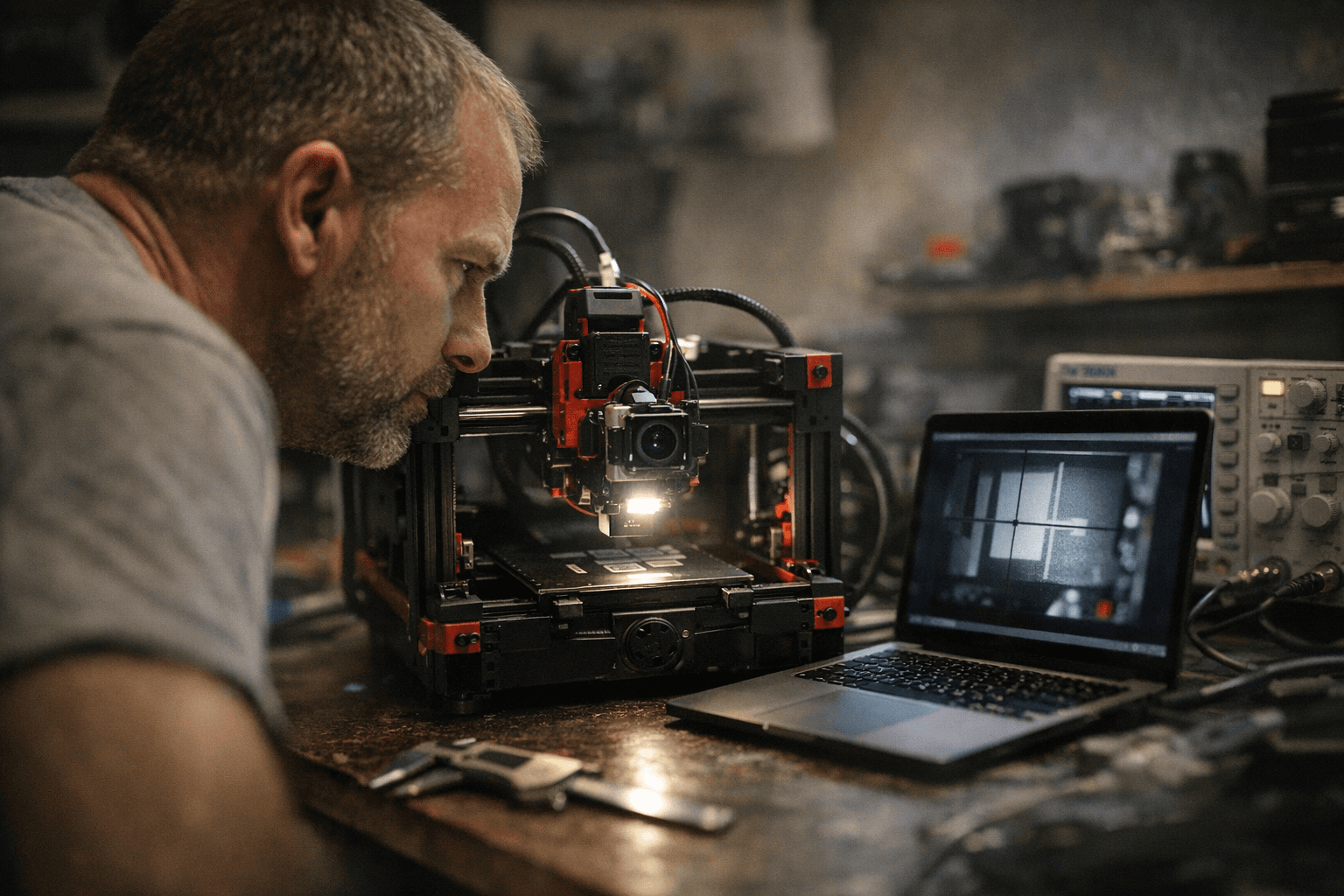
Dennis from Made by Dennis spent a focused session on December 24 pushing a Voron 0 beyond typical consumer grade calibration. The project combined computer vision, precise time measurement, and linear algebra to derive a position correction matrix that maps the printer reported coordinates to actual physical coordinates. The aim was clear, to achieve positional accuracy better than 100 micrometers across a 100 mm span.
The core of the approach was straightforward and adaptable. A camera mounted to the toolhead imaged a ChArUco calibration board placed on the print bed. Image recognition identified tile corners and, with a known camera focal length, allowed the system to derive the camera position in space. Dennis captured images across the working area to build the spatial data set. That data was then processed with linear algebra methods to compensate for axis non perpendicularity and other geometric distortions that cause systematic coordinate errors.
Bed contact and tiny deviations around z probing were handled with a piezo probe that logged contact events. To separate true contact positions from noise introduced by bed deformation or nozzle residue, Dennis synchronized microcontroller logs at the microsecond level. Synchronization relied on USB start of frame packets and a Raspberry Pi used for timestamping, producing tightly correlated time stamps for contact events that could be mapped back to position.
The result was a retrospective determination of true contact positions and a fine grained correction map that can be applied to improve positional accuracy. For the community this matters because it shows how accessible instrumentation and careful measurement can push FFF printers into precision territory without replacing mechanical components. The method yields practical takeaways, verify camera focal length when using vision based calibration, capture a dense sample of points across the bed, and log probe events with as fine timing as possible. Makers who want higher accuracy can adapt elements of this workflow to their own printers and toolchains to reduce geometric error and improve first layer consistency.
This article was produced by Prism’s automated news system from verified source data, official records, and press releases, then run through automated quality and moderation checks before publishing. The system is built and supervised by the people who set the standards it runs under. Read our full AI policy.
Did this article answer your question?