Waste Sulfur Becomes 4D-Printing Feedstock for Tiny Self-Actuating Soft Robots
A South Korean team built a self-moving soft robot smaller than 1 cm using 4D-printed sulfur waste mixed with 20% iron powder, and the whole thing melts down for 100% reuse.

A joint research team from the Korea Research Institute of Chemical Technology (KRICT), Hanyang University, and Sejong University has turned petroleum refining's most overlooked byproduct into the feedstock for self-actuating soft robots no bigger than a fingernail, with their findings landing as the cover story of the November 2025 issue of Advanced Materials.
Led by Dr. Dong-Gyun Kim of KRICT, alongside Professor Jeong Jae Wie of Hanyang University and Professor Yong Seok Kim of Sejong University, the team developed what they describe as the world's first 4D printing technology based on sulfur-rich polymers. The material responds to three distinct stimuli: heat, light, and magnetic fields, giving printed structures the ability to change shape and move autonomously depending on their environment.
The most immediately striking demonstration involved embedding the sulfur plastic with 20% iron powder to produce a soft robot measuring less than 1 cm across. That robot could follow the movement of an external magnet and execute complex motions without any internal power source. The magnetic particles handled actuation entirely, with no battery, no tether, and no motor required.
Every year, millions of tons of sulfur accumulate as waste from petroleum refining, with fertilizer remaining the dominant destination for the material. This research represents a different path. "This is the first case of upcycling the industrial byproduct sulfur into an advanced robotics material," said Principal Researcher Kim Dong-kyun. "This smart material, which can move on its own and be recycled, will become a key driver for the future soft robotics and automation industries."
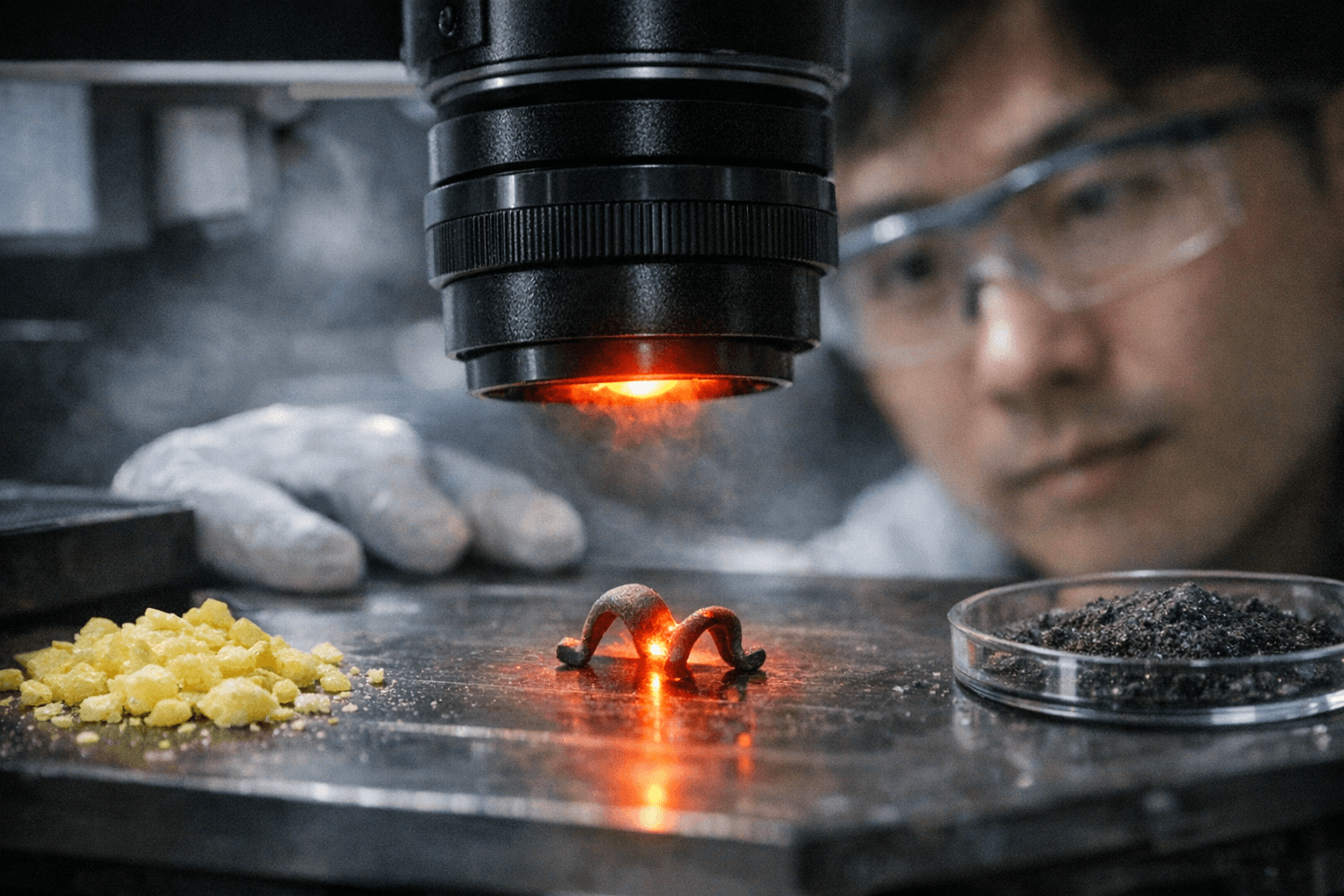
Recyclability is the other headline claim. After a printed structure has served its purpose, it can be melted down and reused in full as printing feedstock, creating what the team calls a closed-loop 4D printing system. No secondary processing step is required beyond melting, and the researchers report 100% material reuse. The implication for soft robotics manufacturing is significant: the same sulfur that refineries treat as a disposal problem becomes both the build material and the reclaim material in a single cycle.
The study was published under DOI 10.1002/adma.202507057. Postdoctoral Researcher Jae Hyuk Hwang also contributed to the work alongside the three lead investigators from KRICT, Hanyang, and Sejong. The cover art for the Advanced Materials issue was created by GaHyeon Jo.
For the 3D printing community, the more immediately relevant question is what printing parameters and resolution the process supports at scale, details the research notes leave to the full paper. What the published demonstrations confirm is a sub-centimeter, magnetically actuated structure that costs nothing in raw material and nothing to reclaim.
This article was produced by Prism’s automated news system from verified source data, official records, and press releases, then run through automated quality and moderation checks before publishing. The system is built and supervised by the people who set the standards it runs under. Read our full AI policy.
Did this article answer your question?