Yokohama National researchers unveil recyclable resin for 3D printing
Yokohama National's anthracene resin hardens under blue light, then liquefies at about 150°C, and it stayed usable for 10-plus reuse cycles.

Resin printing’s dirty secret has always been the same: once a photopolymer part is cured, it usually lives one life and dies as waste. Researchers at Yokohama National University just pushed hard against that rule with a recyclable resin that can be printed, heated back into a liquid at about 150 to 180 degrees Celsius, and run through the process again without the usual extra additives or cleanup chemistry.
The material, developed by Masaru Mukai, Wakana Miyadai, Seina Matsubara, Tomomi Aoki and Shoji Maruo, uses reversible photodimerization of anthracene. Blue light drives the anthracene molecules into a rigid cross-linked network, and heat breaks those bonds apart so the resin can flow again. The team published the work in ACS Omega on February 21, 2026, and the journal selected it as an ACS Editors’ Choice article.
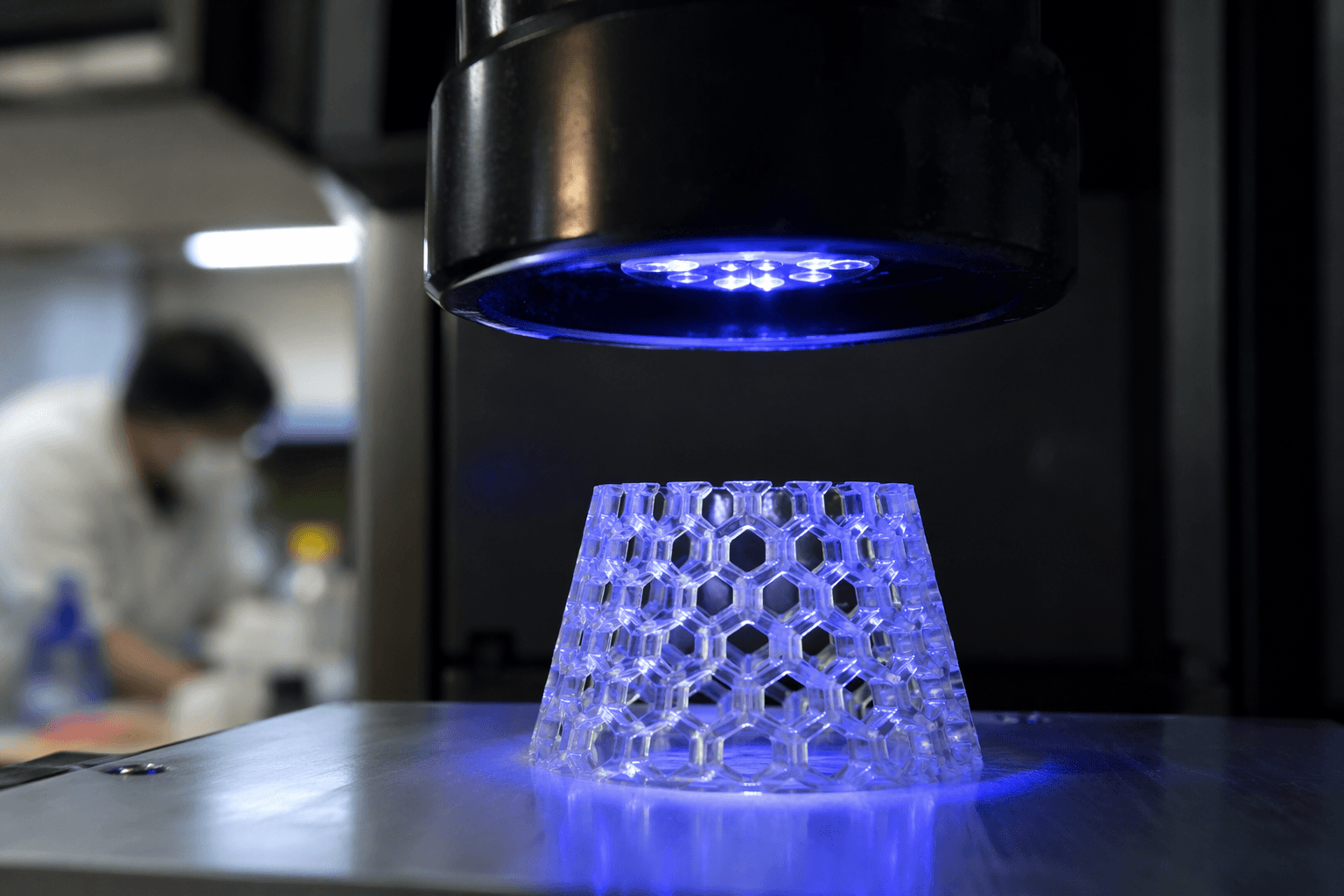
That matters because the chemistry worked in both single-photon microstereolithography and two-photon lithography, two methods that sit at very different points on the precision spectrum. In the university’s two-photon setup, a femtosecond laser at 780 nm printed intricate microstructures, including microneedle arrays and a miniature bunny model. The university said the process reached submicron resolution of about 0.6 µm, which puts this well beyond a curiosity-piece resin that only behaves in a beaker.
The bigger proof is reuse. The paper reported more than ten successful reprocessing cycles with minimal degradation, a sharp step up from earlier recyclable resins that often managed only one to three loops before falling apart or needing added recycling chemistry. The university also said the resin was initiator-free and compatible with common 405 nm blue-light stereolithography, which is the kind of detail that matters if this ever leaves a lab bench and has to survive real print workflows.
For resin users, the appeal is obvious. SLA and DLP can deliver beautiful surface finish and fine detail, but they also leave behind support goo, failed prints, rinse waste and a stack of cured parts that do not go back into the vat. Yokohama National’s material does not erase those headaches yet, but it points toward a different economics for high-resolution additive manufacturing, one where precision parts and medical devices could be made with a lot less throwaway material. The real test now is whether this reversible chemistry can keep its print quality, scale beyond the lab and stay practical for makers who want sustainability without giving up the sharp detail that drew them to resin printing in the first place.
This article was produced by Prism’s automated news system from verified source data, official records, and press releases, then run through automated quality and moderation checks before publishing. The system is built and supervised by the people who set the standards it runs under. Read our full AI policy.
Did this article answer your question?