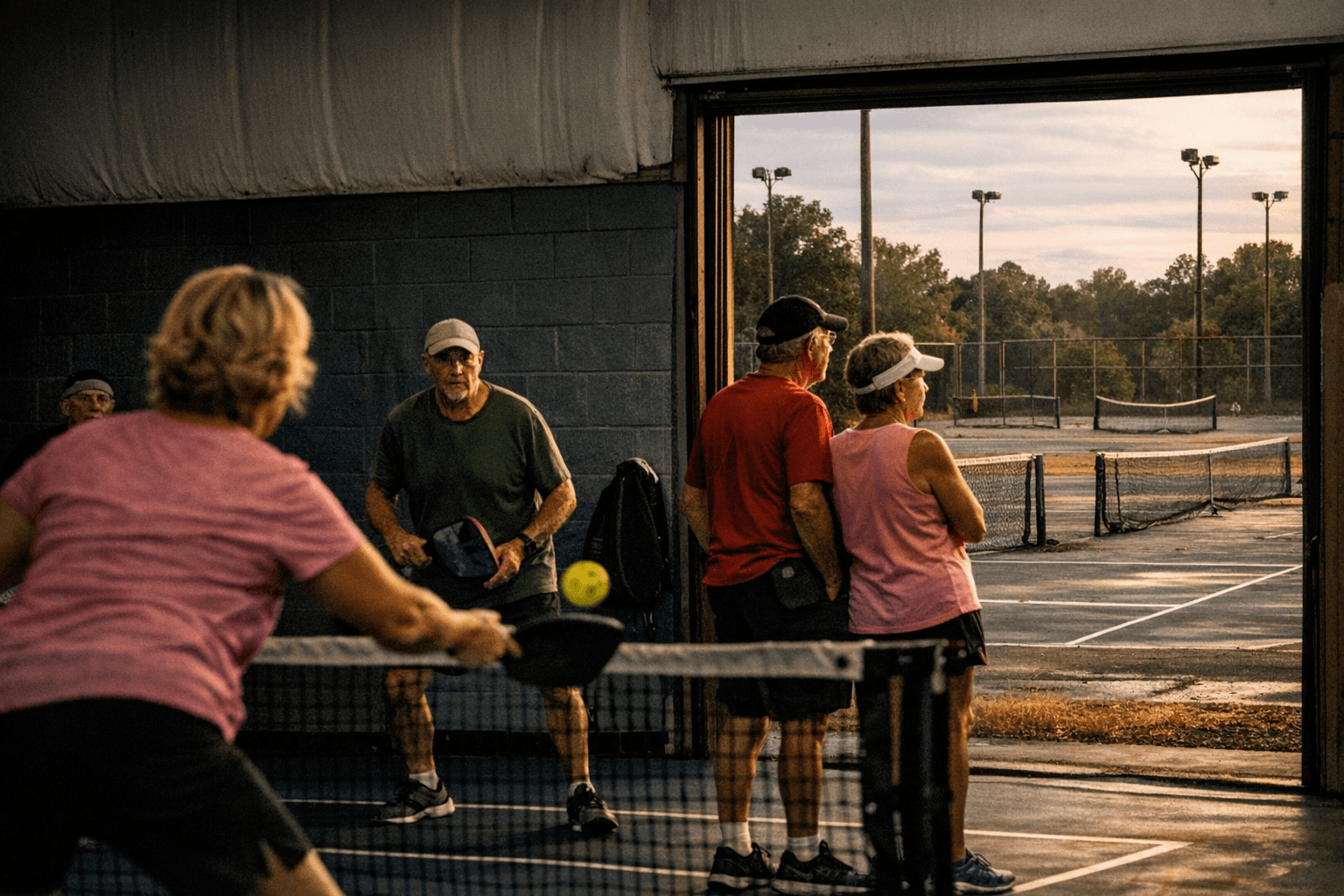
Villages Residents Petition for Noise Controls Near Busy Pickleball Courts
Hundreds of Villages residents petitioned for noise controls near Saluki Recreation Center; Sumter County says a development agreement may block any enforcement action.

When neighbors in The Villages began comparing pickleball's sharp pop to firecrackers going off outside their windows, the complaint moved fast. By late March 2026, hundreds of residents had signed a petition asking for noise mitigation near the Saluki Recreation Center, where multiple courts sit close to residential homes. Then came the complication that nobody had fully anticipated.
The issue was brought to Sumter County leaders in an effort to pursue a noise ordinance, but county officials responded that they cannot enforce one due to a development agreement tied to The Villages, stripping away the most direct regulatory tool available and placing the entire weight of resolution on recreation managers and residents negotiating without enforceable rules behind them.
The petition does not call for the sport to be shut down; it asks for solutions to reduce the impact of the sound, because residents say the repetitive noise carries into nearby homes, affecting their quality of life. The specific requests are practical: acoustic barriers along the court perimeter, adjusted operating hours, changes to court orientation designed to redirect noise, and the relocation of peak-hour programming away from early mornings and late evenings.
Each of those requests maps to a documented solution. USA Pickleball maintains a certified catalog of paddles and balls recognized as Quiet or Noise Reducing, products that significantly reduce noise levels while delivering the same fast-paced performance. Acoustic fencing, of the kind Arlington County planned for the Walter Reed Community Center's courts, is designed to absorb and reduce the sound of pickleball play, offering a proactive approach to balancing the sport's popularity with the community's need for quiet. Court orientation is a design variable that costs nothing to address in future buildouts: positioning nets so they run parallel to the nearest residential boundary directs the loudest angles of play away from adjacent properties before a single barrier goes up.
The process question is harder than the technical one. Because a noise ordinance appears unavailable in Sumter County, the path forward runs through direct negotiation rather than regulation. That format rewards organized, specific, and early engagement. Clubs that approach parks departments before complaints escalate, armed with documented play schedules, proposed quiet hours, and a willingness to pilot quieter equipment, tend to retain far more goodwill than groups that arrive at a county hearing on the defensive. Supporters of pickleball at The Villages made the community benefit case in public during this dispute; the next step is pairing that argument with concrete operational adjustments that give skeptical neighbors something tangible to accept.
The Villages, with its active petition networks and well-attended governance forums, will almost certainly work this out on the record. Whatever arrangement Saluki Recreation Center ultimately reaches may become the working model that comparable communities, without the same organizational infrastructure, look to replicate first.
Know something we missed? Have a correction or additional information?
Submit a Tip