Bath Bomb Troubleshooting Guide Tackles Crumbling, Cracking, and Pre-Fizzing Failures
One bad variable ruins an entire batch: here's the exact symptom-to-fix playbook every small-batch maker needs, with humidity targets, spritz counts, and rescue methods.
The Foundation That Makes Every Other Fix Work: Get Your Ratio Right First
Before diagnosing anything that goes wrong, you need a baseline worth defending. The starting point that experienced small-batch makers return to repeatedly is a 2:1 ratio by weight: two parts baking soda (sodium bicarbonate) to one part citric acid. From there, smaller additions of cornstarch and Epsom salt adjust texture and fizz duration. Cornstarch slows the reaction slightly for a longer, more luxurious fizz; Epsom salt adds density and a silkier feel in the water. These are not rough guidelines, they are the chemical scaffolding your entire batch rests on.
The single most important habit you can build is weighing every ingredient in grams rather than scooping by volume. Citric acid and baking soda from different suppliers have meaningfully different bulk densities, which means a cup of one brand is not stoichiometrically equivalent to a cup from another. When the acid-to-base ratio drifts off, you get either an under-fizzing bomb (excess baking soda) or a bomb that starts reacting in the mold before you've even pressed the halves together (excess citric acid). A kitchen scale with 1-gram resolution costs less than a failed batch.
The Hidden Variable That Ruins More Batches Than Bad Recipes: Humidity
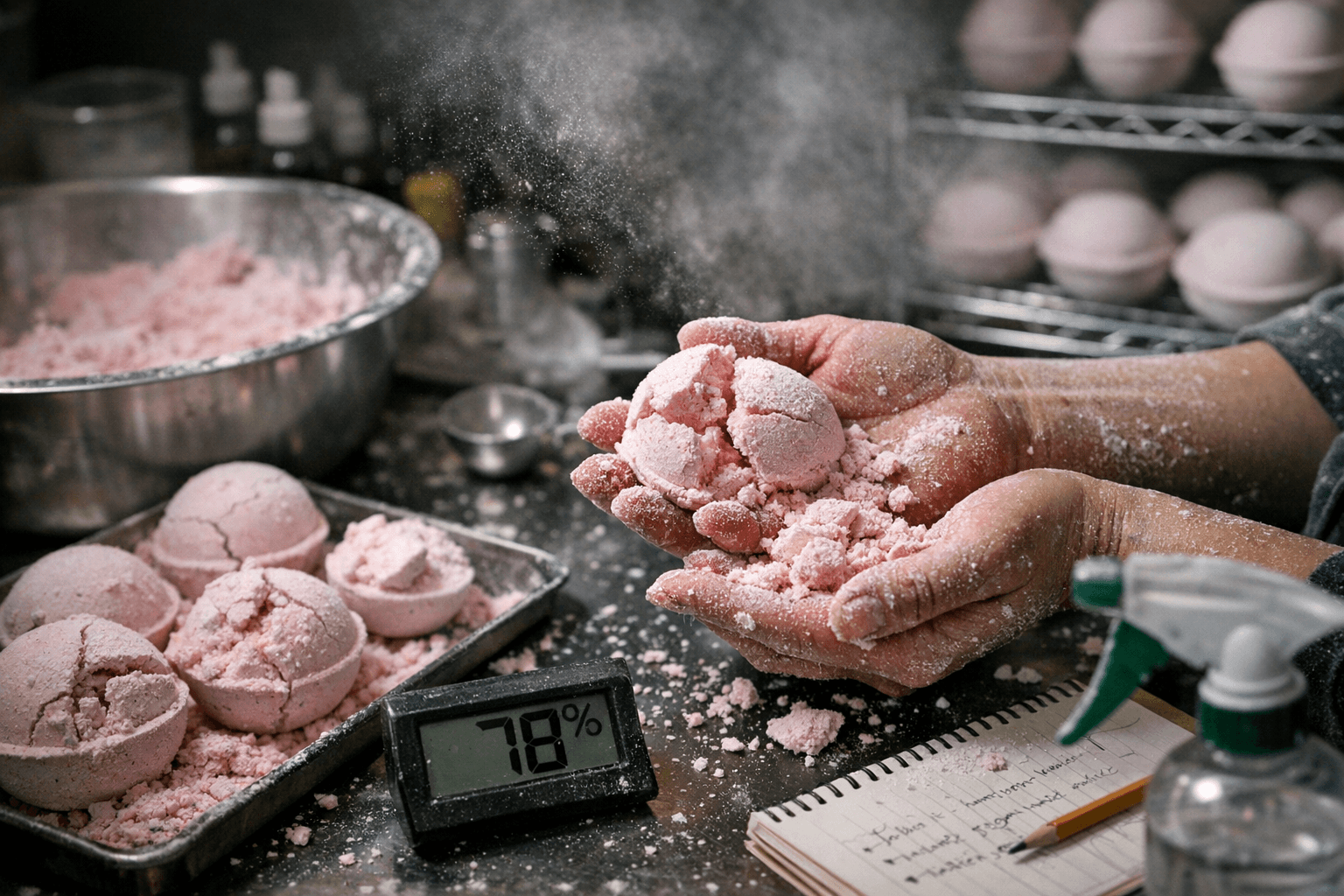
Most makers blame their recipe when the real culprit is the room they're working in. Humidity above approximately 50% relative humidity gives airborne moisture enough contact with your citric acid to begin a slow, premature acid-base reaction, and hygroscopic clumping of dry ingredients means your mix won't pack evenly. The fix is environmental before it's chemical.
Ideal conditions for mixing are a relative humidity below 40% and a room temperature of 18-22°C (64-72°F). On muggy summer days or in unventilated bathrooms, neither of those is a given. Run a dehumidifier or air conditioning during your mixing session, work in smaller batches so your dry mix has less exposure time, and store dry ingredients in airtight containers with desiccant packs between sessions. A cheap hygrometer on your workbench is one of the better investments you can make, as it turns an invisible problem into a number you can act on.
Symptom: Premature Fizzing in the Mold
Cause: Moisture is activating the acid-base reaction before compression is complete. This happens from over-wet binding liquid, high ambient humidity, or a combination of both.
Fix: Switch to a fine-mist spray of witch hazel or 70% isopropyl alcohol rather than pouring any liquid into the bowl. Both carry far less free water than even a light pour of distilled water, which dramatically reduces the risk of triggering an early reaction. Spray slowly while whisking continuously and stop the moment the mixture just holds a clump when squeezed in your palm. That's the target: barely-there cohesion, not a visibly moist mix.
Rescue: If the mix starts fizzing lightly during spraying, stop immediately and work faster into the molds. The batch is not necessarily lost; press both halves firmly together right away and get the bomb into a cool, dry space. A bomb that pre-fizzed slightly in the mold will have reduced fizz in the bath, but it will still function. Label those as test bombs rather than discarding them.
Symptom: Crumbling After Unmolding
Cause: Insufficient binder, under-compression, or a cure environment that's too dry and didn't allow the mix to fully set.
Fix: Add a teaspoon of kaolin clay or fine cornstarch per batch. Both improve structure without significantly affecting fizz. When pressing the mold halves together, apply firm, even pressure and hold for a few seconds; a common mistake is tapping the halves together rather than pressing. After unmolding, place bombs in a dry space for a cure window of 12 to 48 hours before handling them further.
Rescue: Crumbled pieces are not wasted material. Break them down fully, run the powder through a sieve to remove any lumps, remoisten carefully with a single additional spritz of witch hazel, and re-press into the mold. The second press usually holds better because the mixture has already been worked to a consistent texture.
Symptom: Cracking After Unmolding
Cause: Cracking is the opposite problem from crumbling, and the causes are often opposite too. Over-drying in excessive heat, low humidity environments that pull moisture out of the bomb too fast, or too much hardener (kaolin clay, cornstarch, or cream of tartar) can cause surface tension to break as the bomb contracts unevenly.
Fix: Reduce ambient heat during curing; a cool, stable room is better than a warm one. If you've been heavy-handed with clay or cornstarch, dial both back by 25% in your next batch. Avoid placing freshly unmolded bombs near heat sources, sunny windowsills, or in front of fans.
Rescue: Minor cracks can be sealed. Lightly mist the crack lines with witch hazel, press the pieces back together firmly with your fingers, and allow the repair to set for several hours in a dry space. This works well for cosmetic cracks; structural breaks through the center are harder to recover but the pieces can still be used as crumbles in a mesh bath sachet.
Symptom: Sinking Instead of Floating
Cause: The density of the bomb is higher than the bath water, usually because the baking soda proportion is too low or the overall mix is packed too densely.
Fix: Increase the baking soda proportion slightly relative to citric acid. You can also incorporate lightweight embeds such as foam beads to reduce overall density without changing the chemistry. Before committing to a full production run, test a single bomb in a shallow bowl of water. Floating behavior is much easier to troubleshoot at small scale than after you've pressed two dozen bombs.
Rescue: Sinking bombs still fizz and still release fragrance and oils effectively; the sinking itself is an aesthetic issue rather than a functional one. If you're selling or gifting these, pair them in a set labeled as "fizzers" rather than "floaters" and adjust your next batch.
Symptom: Oily Bathtub Ring or Dye Bleeding
Cause: High oil loads without an emulsifier, or colorants that aren't formulated to disperse in water, leave residue on tub surfaces and waterline rings.
Fix: Add polysorbate 80, cosmetic grade, whenever your formula includes more than a light touch of carrier oil or fragrance oils with heavy bases. Polysorbate 80 acts as a surfactant that helps oils disperse throughout the bath water rather than pooling on the surface and coating the tub. For color, use cosmetic-grade micas or water-soluble dyes; oil-based colorants are the most likely culprits for waterline staining.
Before producing a full batch with a new colorant, run a single tub test: dissolve one bomb in a bowl of diluted water and inspect the bowl and waterline for color transfer. This takes about 10 minutes and saves you from discovering a staining problem after handing out gifts or fulfilling orders.
Rescue: If you've already pressed a batch with an incompatible colorant, melt the bombs down in a warm water bath, strain the liquid, and re-examine your dye choice before reformulating. The baking soda and citric acid are spent in this case, but recovered fragrance or essential oils can often be repurposed.
Putting It Together: Your Pre-Batch Checklist
Every consistent maker, whether producing 10 bombs at home or 100 for a craft market, runs through the same environmental and formula checks before mixing:
- Room humidity below 40%, temperature 18-22°C (64-72°F)
- Ingredients weighed by gram, not scooped by volume
- Witch hazel or 70% isopropyl alcohol in a fine-mist spray bottle
- Polysorbate 80 on hand if any oils are in the formula
- Airtight storage for unused dry ingredients, with desiccant
The chemistry of bath bombs is genuinely forgiving once you stop fighting your environment. Humidity is the variable most makers discover last and fix first once they know it's there. Get the room right, weigh your ingredients, mist instead of pour, and the ratio does the rest.
This article was produced by Prism’s automated news system from verified source data, official records, and press releases, then run through automated quality and moderation checks before publishing. The system is built and supervised by the people who set the standards it runs under. Read our full AI policy.
Did this article answer your question?