Best Oils for Bath Bombs: A 2026 Guide to Scent and Skin Performance
Not all oils survive the fizz: Bramble Berry's Cashmere Fragrance Oil tops this 2026 guide for makers prioritizing scent that lasts and skin that benefits.

The bath bomb was born in a garden shed in Dorset, England. In 1989, Mo Constantine, co-founder of Lush Cosmetics, pressed together citric acid, sodium bicarbonate, and a blend of essential oils to create what would become a global product category worth approximately USD 1.99 billion in 2024 and projected to reach USD 3.34 billion by 2033. Lush now presses over 40.5 million bath bombs per year across seven factories in six countries. Every DIY maker working from that same citric acid and baking soda base is competing, at least in the eyes of the person receiving a gift or buying a batch, with that commercial standard.
The oil you choose is where that gap gets closed or widened. Scent needs to survive the dry-mix phase, the fizz, and the soak before it can linger on skin. Carrier oils have to moisturize without leaving a slick ring around the tub. Some fragrance oils accelerate effervescence the moment they hit the dry mix; others separate at higher concentrations and ruin the texture. The ten picks below are ranked by overall performance across scent longevity, skin compatibility, and batch reliability for makers working toward gift- or sale-quality results.
1. Bramble Berry Cashmere Fragrance Oil
The top-performing fragrance oil for bath bomb applications, Bramble Berry's Cashmere is warm, long-lasting, and explicitly tested not to accelerate premature fizzing in dry formulations. Bramble Berry was founded in 1999 by Anne-Marie Faiola in Bellingham, Washington, built from a $15,000 credit card investment into a business generating roughly $5 million in annual sales and offering more than 2,500 products; their formulations are calibrated specifically for craft soap and bath-bomb chemistry. As the testing verdict goes: "For crafting luxurious, skin-safe bath bombs with a scent that lasts, this is the gold standard."
2. Lavender 40/42 Essential Oil
Lavender 40/42 is a standardized blend of lavender varieties rather than a single-source extract, which is precisely why it earns the second spot: it delivers a reliably consistent scent profile from one batch to the next, something pure lavender cannot always guarantee. Its fresh, floral character with balsamic undertones is widely documented for reducing stress and promoting relaxation, and it pairs naturally with cool color palettes in bath bomb design. It is the logical starting point for any maker building their first essential oil shelf.
3. Sweet Almond Oil (Carrier)
On the skin-performance side of the equation, sweet almond oil is the carrier most consistently recommended for bath bomb formulas. It is rich in Vitamin E, Vitamin A, essential fatty acids, potassium, and proteins, and is suitable for skin prone to eczema and psoriasis. It absorbs well without leaving a heavy residue, which is the practical test any carrier oil has to pass before it earns a place in a dry-mix formula.
4. Eucalyptus Essential Oil
Fresh, woody, and slightly sweet, eucalyptus is one of the strongest essential oils available for bath bomb use, and that potency is both its advantage and its main handling note: starting with just one or two drops per recipe prevents the scent from overwhelming the finished product. It pairs naturally with lavender and tea tree for layered blends and delivers the invigorating, head-clearing quality that makes it the obvious pick for a morning bath bomb. Its wild-harvested character also holds well in hot water.
5. Jojoba Oil (Carrier)
Technically a wax ester rather than a true oil, jojoba has an unusually long shelf life and a non-greasy skin feel that sets it apart from heavier carrier options. It closely mimics the skin's natural sebum, which means it absorbs quickly and is unlikely to leave the slick tub residue that over-oiled bath bombs are notorious for producing. For makers formulating across skin types, including combination and oily skin, jojoba is the most universally compatible carrier choice.
6. Ylang Ylang III Essential Oil
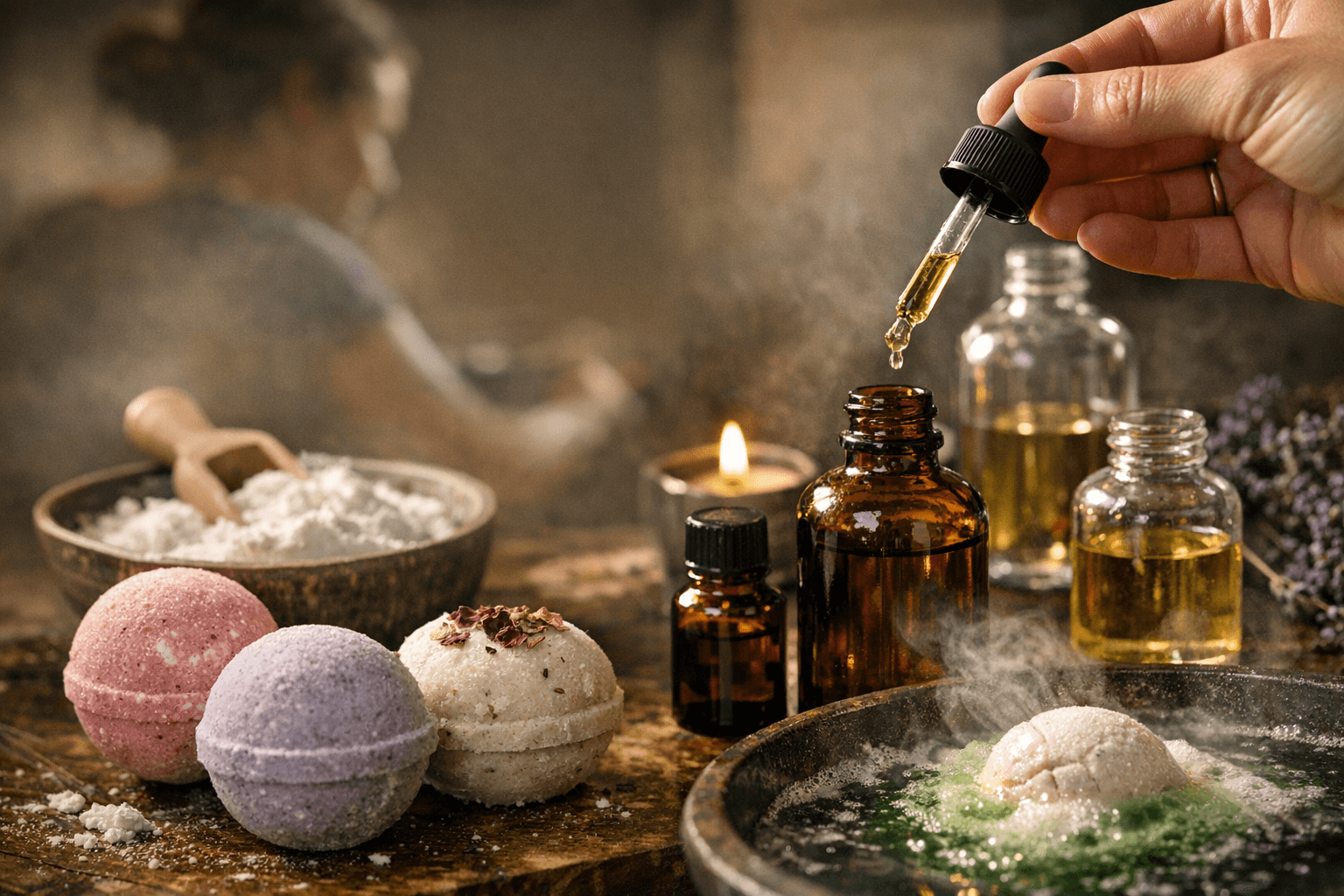
Sweet, floral, and exotic without being polarizing, ylang ylang works across a wide range of color palettes and additive combinations. Bramble Berry's Ylang Ylang III is specifically blended with 20% nature-identical oils to boost scent retention and ensure batch-to-batch consistency, addressing a known weakness of single-origin ylang ylang, which can vary significantly by harvest year. It releases tension and has a well-established romantic association that makes it a strong seller in gift-oriented collections.
7. Sweet Orange Essential Oil
Citrus is the scent category most directly associated with the visual drama that made bath bombs a social media phenomenon, and sweet orange is the most affordable and beginner-friendly entry point in that group. It delivers an uplifting, bright character that pairs easily with lavender, vanilla, or floral base notes. The main technical consideration: citrus oils are more volatile than resinous or woody options and can fade more quickly through the fizz, so slightly higher usage rates or pairing with a longer-lasting base note is often the practical fix.
8. Sandalwood Essential Oil
Creamy, woody, and almost universally appealing, sandalwood performs exceptionally well in bath bomb applications, holding its character in hot water in a way that lighter florals and citruses sometimes cannot. It also functions as a natural fixative in blends, helping top notes, including citrus and floral accords, linger longer in the finished soak. For makers positioning their products at the premium end of the gift market, sandalwood signals luxury in a way few other single ingredients can match.
9. Roman Chamomile Essential Oil
The gentlest option on this list, Roman chamomile is the right choice when the target audience is sensitive skin, young children, or specifically a pre-bedtime relaxation product. It has a soft, apple-tinged floral scent and well-documented calming properties. Its quieter character means it works best as part of a blend rather than a standalone fragrance, and it pairs particularly naturally with lavender for a sleep-focused formula.
10. Phthalate-free Multi-Fragrance Essential Oil Sets
For makers building a scent library before committing to individual bottles, curated multi-oil sets offer the most cost-efficient path to experimentation. Fragrance oils generally cost between $3 and $15 per ounce versus $15 to $50 for essential oils, making sets a practical way to test scent combinations across batches. The filter that matters most when evaluating any set: explicit phthalate-free certification. Under current U.S. law, "Fragrance" on a cosmetic label is a legally protected trade secret, meaning manufacturers are not required to disclose individual chemical components. The FDA's official position is that diethyl phthalate (DEP) does not raise safety concerns in cosmetics, but Melanie Benesh, attorney and VP for government affairs at the Environmental Working Group, has noted that a single "Fragrance" listing can represent hundreds of different chemicals that consumers and home makers cannot independently assess from a label. Researchers have also linked high phthalate exposure to preterm birth in pregnant women. For anyone gifting or selling their work, a phthalate-free label on the tin is the one check the current regulatory framework does not make for you.
Getting Concentration Right
The working range for fragrance oils is 1 to 2% of total batch weight, with 1.5% the mark that professional makers return to most often as the balance between noticeable scent and skin safety. Essential oils require more caution at the individual ingredient level: cinnamon and peppermint, for example, are generally not recommended for bath bomb use because of their irritation potential on skin. Test at the lower end of the range first, in small batches, and observe both the mix behavior and the post-fizz scent retention before scaling. Anne-Marie Faiola, who grew Bramble Berry from a $70,000 first-year operation into one of the craft community's primary supply sources, put the underlying principle clearly: "I believe our success has everything to do with being genuinely excited about the craft first and sales second." That sequencing, craft before scale, is exactly the discipline that separates a bath bomb people photograph from one that just fizzes and fades.
This article was produced by Prism’s automated news system from verified source data, official records, and press releases, then run through automated quality and moderation checks before publishing. The system is built and supervised by the people who set the standards it runs under. Read our full AI policy.
Did this article answer your question?