How a Central Powers invasion game cut naval rules from 5 pages to 1
Cutting five pages of naval rules to one is not a loss of realism, it is a design decision about where the real game lives. Clint Warren-Davey’s work shows how abstraction can sharpen the choices that matter.

In a Central Powers invasion design discussed on BoardGameGeek, the naval section shrank from five pages to one. That compression points to the core question every designer eventually faces: which details create decisions, and which only slow the table down?
Clint Warren-Davey has built a career around that question. A History teacher and wargame designer-developer from Australia, he has spent many years using wargames to teach high school students about military history, pushing large conflicts into formats that can be played in an hour or less. That classroom pressure, where attention is limited and momentum matters, has shaped a design philosophy built on essence over exhaustiveness: fewer rules, fewer components, less downtime, and a tighter loop between action and response.
Simplification is not surrender
The lesson in that one-page naval system is not that naval warfare is unimportant. A designer has to decide what the naval layer is doing for the rest of the game. If the fleet rules do not create new choices, change the tempo, or force players to adapt their plans, then five pages of procedures are just a tax on the experience.
The most revealing design question is not whether a system is detailed, but whether its detail produces meaningful friction at the table. A rule can be historically rich and still be dead weight if it asks players to manage bookkeeping instead of strategy.
What classroom wargaming teaches
At the Georgetown University Wargaming Society event “Simplifying Large Scale Conflicts,” held on Tuesday, May 21, 2024, from 6:00 PM to 8:00 PM, Warren-Davey was introduced as a History teacher and wargame designer-developer from Australia who has used wargames for many years to teach high school students military history. That setting forces a brutal kind of honesty about pacing and clarity.
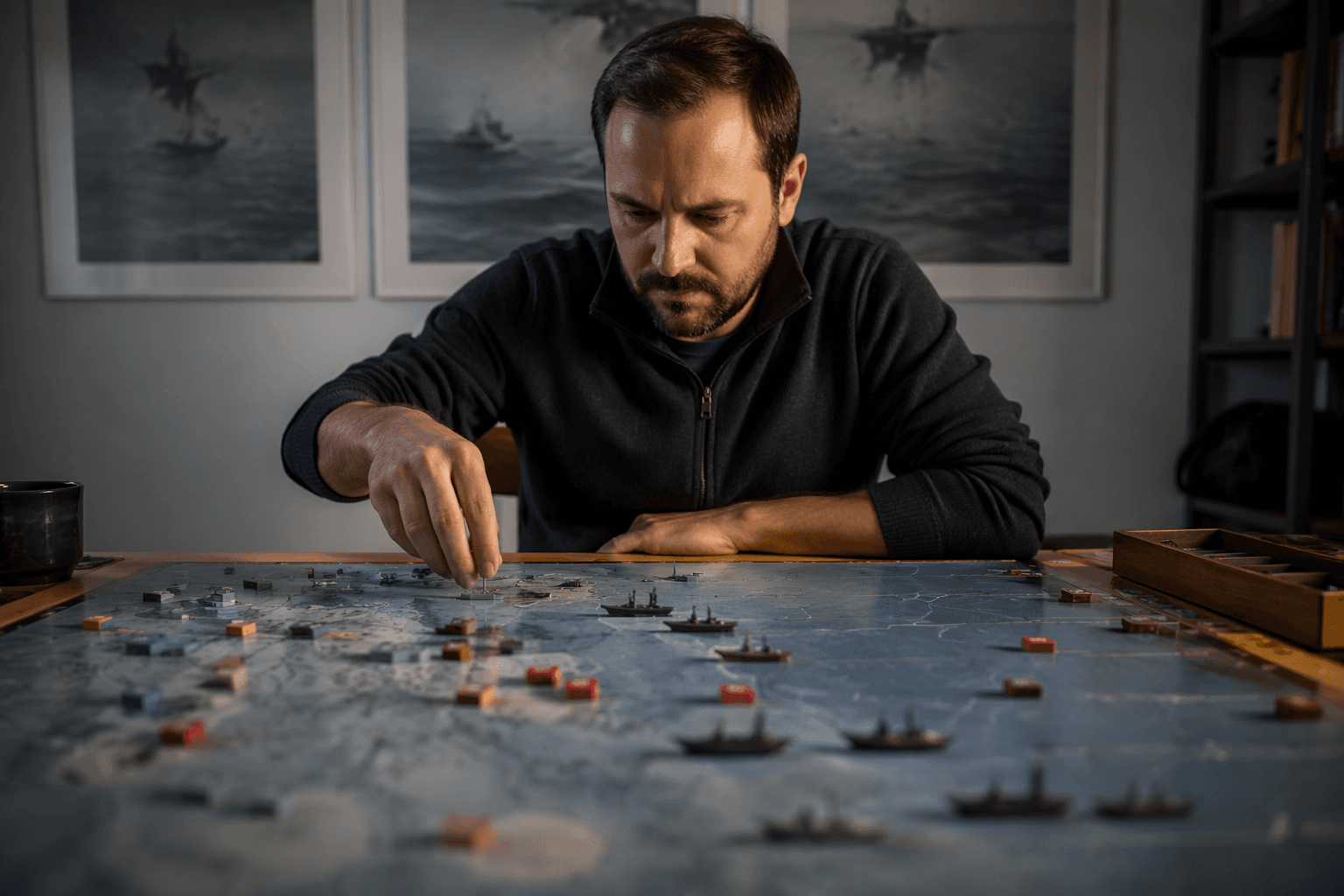
In a classroom, a game has to earn every minute. If students spend too long consulting tables, tracking edge cases, or waiting for a turn to come back around, the lesson disappears behind the procedure. Warren-Davey’s design response has been to build games that capture the essence of a conflict with a minimum of rules, components, and downtime, so that the mechanics stay close to the historical problem rather than drifting into administration.
One Hour World War II as a design statement
That philosophy is visible in his 2024 title, One Hour World War II, published by Worthington Publishing. It is a strategic-level design for 2 to 5 players that plays in about one hour, with actions and reactions driving the experience so players stay engaged and little or no downtime creeps in.
The title itself announces the constraint, but the real design move is deeper than the box label. Compressing the entire Second World War into an hour means the game cannot afford to model every weapon system or every theater at full fidelity. It has to identify the pressure points that make the period feel like World War II and then strip away the rest, trusting player decisions to carry the history.
The same instinct appears in the Central Powers thread. If a fleet system is only there to remind players that ships exist, it can probably be simplified. If it is there to shape invasions, supply, or operational timing, then it needs to stay, but only in the form that matters most.
The designer behind the abstraction
Warren-Davey has also worked for the Australian Defence College in Canberra on educational wargames, including Exercise Siege Perilous in 2023 and Exercise Haltstate in 2023. He has also worked across strategic and operational World War II games, while dealing with World War I and 21st-century warfare.
That range suggests the abstraction is not a retreat from complexity. It is a method for moving between scales. A designer who works on educational wargames for a defence college and classroom titles for students has to know which layer of conflict is useful for the audience in front of them.
Why the naval rules matter even when they shrink
Great War at Sea: Central Powers is set in September 1915, continuing the naval war after the first year covered in Triple Alliance. In that setting, Italy, Austria-Hungary, Germany, Britain, and France are still struggling while new warships join both fleets.
That context shows why naval rules can be tempting to overbuild. A theater with shifting alliances, fresh ships, and an open-ended maritime contest invites layers of detail. But if the game is about the invasion and the wider war rather than about ship handling for its own sake, then the designer’s job is to keep only the naval rules that affect the larger strategic puzzle.
This article was produced by Prism’s automated news system from verified source data, official records, and press releases, then run through automated quality and moderation checks before publishing. The system is built and supervised by the people who set the standards it runs under. Read our full AI policy.
Did this article answer your question?