Allshapes Bonsai Spring Workshop Covers Repotting, Pruning, and Maintenance
The 30 days after a spring repot are when most bonsai die. Allshapes Bonsai's March 28 clinic was built around exactly that failure window.
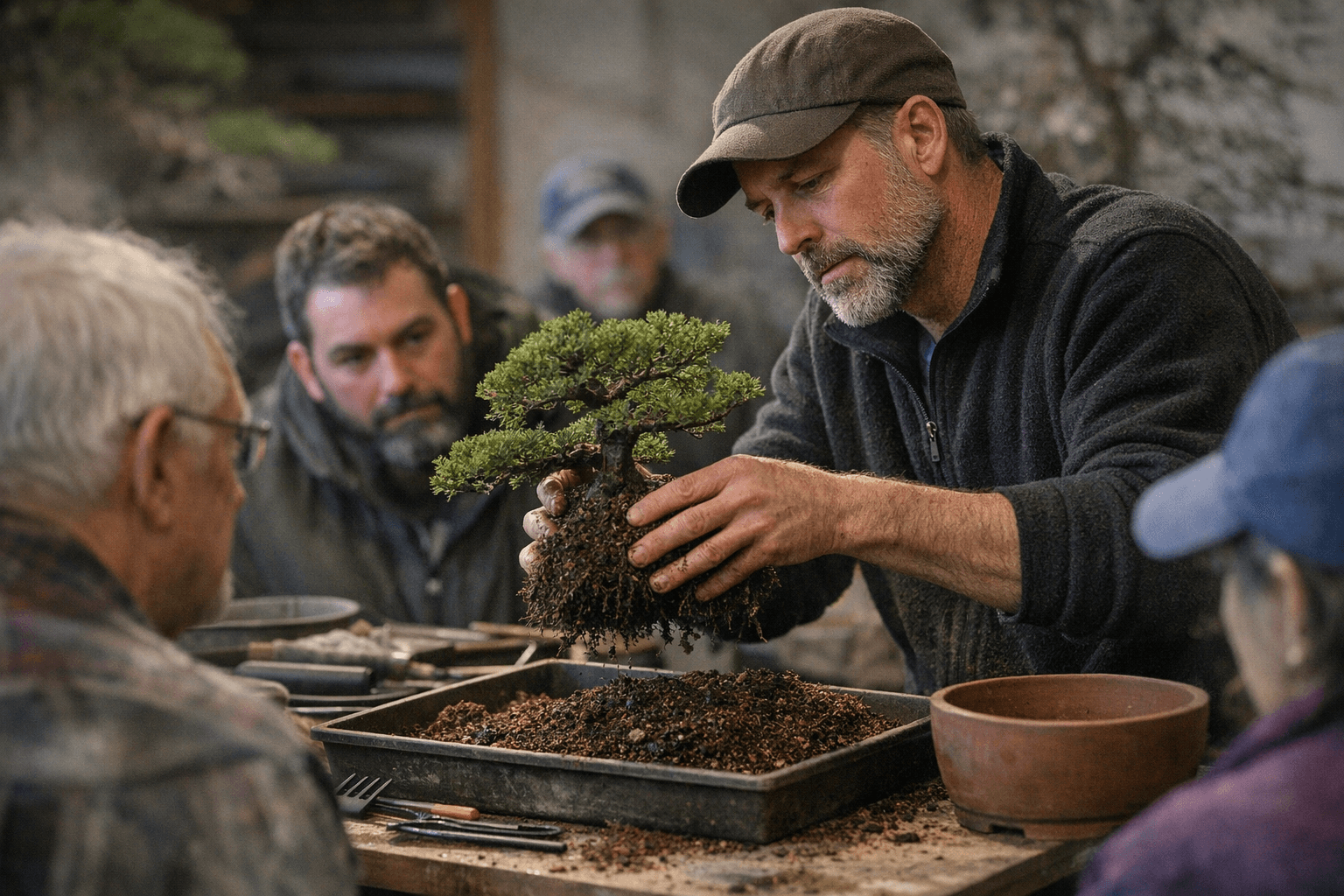
A bonsai repotted with the wrong soil, at the wrong moment in the growth cycle, can look completely healthy for two or three weeks before the canopy collapses. The root system, its absorptive capacity already compromised, cannot sustain new spring foliage once the stored energy runs out. This is the failure window that Allshapes Bonsai's March 28 maintenance workshop was designed to close.
The day-long clinic covered repotting technique, pruning strategy, and soil-mix selection, with four quarts of bonsai substrate included in the registration fee and tools available for loan. Participants were invited to bring as many trees as they needed work on, which effectively turned the session into an individualized consultation rather than a lecture. Both tropical and hardy species were welcome, meaning the failure modes specific to each category could be addressed on site, tree by tree.
Soil selection is where most losses begin, and it rarely gets the attention it deserves. Standard nursery media and potting mixes retain moisture far too long at the root zone, creating conditions for root rot well before the surface soil signals anything wrong. Functional bonsai substrate uses inorganic particles, typically akadama, pumice, and lava rock in various ratios, with no fine material below roughly two to three millimeters. That particle size leaves open channels for oxygen exchange; roots need air as much as water, and a soil that stays wet for days after watering is slowly suffocating them. Bundling a four-quart soil mix with the workshop fee addressed this directly: soil sourcing is a real friction point for first-time repotters, and having correct substrate on hand meant participants could complete their repots the same day rather than returning home to a still-bound tree.
Root pruning is the second documented failure point, and the threshold is more specific than most beginners expect. Removing more than one-third of the root mass in a single spring session exceeds the recovery capacity of most broadleaf and deciduous species. The physiological reason matters: the feeder roots doing the actual work of water and nutrient absorption are rarely more than a few weeks old, even on mature trees. Cut below that one-third limit and the remaining root tips can sustain the canopy through the spring flush. Exceed it and the tree is forced to regenerate from older, already-lignified tissue, which is far slower during the critical weeks before the growing season locks in.
The third failure point is the most counterintuitive one for newer practitioners: knowing when not to repot. The Allshapes listing explicitly framed the workshop as useful for trees that "appear to have no potential," but a tree showing that kind of decline may actually be too weak to survive aggressive root work. Spring repotting works when it catches a tree at bud swell, before full foliage has deployed, because the root system is not yet supporting a heavy canopy load. A tree that has already pushed hard growth, or one whose vigor has declined over successive seasons, is a different calculation entirely, and the right call may be to defer the repot and stabilize the tree first.
Post-repotting aftercare closes the loop on the next 30 days. Frost protection matters immediately after the work is done; a late freeze on a freshly repotted tree is often fatal because exposed root tips have no buffer. Keep trees out of strong wind, water thoroughly once and then hold until the substrate surface is nearly dry, and delay fertilizer for at least four weeks or until new growth is confirmed. Feeding a compromised root system before it has reestablished feeder capacity can burn the very root tips the tree needs to recover.
The no-tree-limit format at the March 28 session gave participants something a single class rarely offers: the chance to test pots against their actual trees before committing to a purchase, and to receive species-specific advice calibrated to what was in front of the instructor. That kind of direct, immediate feedback is where workshop learning parts ways with any written guide, however detailed, and it is the reason hands-on spring clinics remain the highest-leverage intervention available to new and intermediate practitioners before the growing season takes hold.
This article was produced by Prism’s automated news system from verified source data, official records, and press releases, then run through automated quality and moderation checks before publishing. The system is built and supervised by the people who set the standards it runs under. Read our full AI policy.
Did this article answer your question?