Eventbrite lists Bonsai 201 workshop on intermediate techniques in Pomona
Bonsai 201 is built for the leap past beginner work, with pruning, wiring, and styling refinement at Maple Leaf Bonsai in Pomona.
Bonsai 201 is the class for the moment when beginner confidence stops being enough
If you have already kept a few trees alive, wired a branch without cracking it, and realized that “pretty healthy” is not the same thing as “well designed,” Bonsai 201: Intermediate Techniques is aimed right at that gap. Eventbrite lists the workshop for Sunday, May 17, 2026, at 1040 NY-45 in Pomona, New York, and the class description makes its purpose plain: refinement of structure, advanced pruning, wiring techniques, and tree styling.
That matters because this is not pitched like a first-potting demo or a gentle introduction to watering schedules. It sits in the useful middle ground where bonsai starts to become deliberate. The question is no longer whether the tree survives. The question becomes whether the trunk line reads well, whether the branch pads make sense, and whether your cuts and wire are pushing the tree toward a coherent image instead of just keeping it compact.
What the listing tells you about the level
The title alone, Bonsai 201, signals a curriculum built for people who already know the vocabulary and need sharper execution. The listed techniques, especially advanced pruning and wiring, point to the stage where you are working on structure rather than just maintenance. That is the real bridge in bonsai education, because a tree can look healthy and still be badly arranged.
The workshop language also suggests that styling is being treated as a decision-making skill, not a decorative afterthought. Refinement of structure means you are looking at line, balance, taper, and movement. Wiring techniques mean you are shaping with intent, not just wrapping copper around branches. Tree styling means the final composition matters as much as the horticulture.
Why pruning and wiring are the center of the lesson
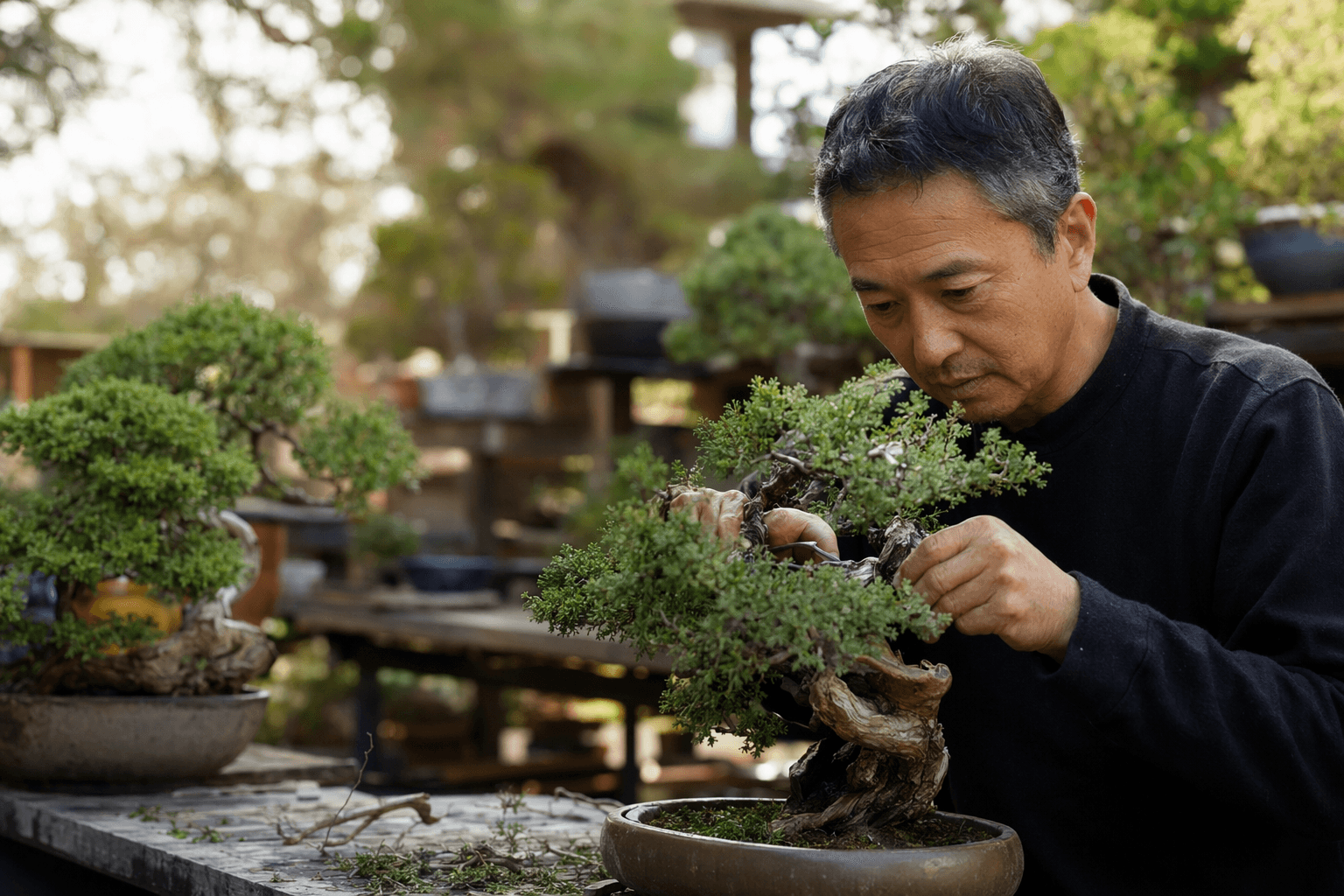
Bonsai Empire describes styling as a process that includes pruning and wiring, and it separates pruning into maintenance pruning and structural pruning. That distinction is exactly where a lot of intermediate students start to stall. Maintenance pruning keeps the canopy under control, while structural pruning changes the framework of the tree itself. If you are only trimming growth, you are maintaining. If you are choosing which branch becomes the future line of the tree, you are styling.
That is why a workshop like this is worth paying attention to. Advanced pruning is not just “cut less” or “cut more.” It is knowing what wood to preserve, what to remove, and what to sacrifice now so the tree reads better later. Wiring carries the same logic. It is easy to make a tree look busy with wire; it is harder to use wire to open spaces, set branch placement, and improve the silhouette without overworking the material.
Bonsai Empire also notes that styling can extend into more advanced techniques such as deadwood creation. Even if the Eventbrite listing does not spell that out, it reinforces the bigger point: intermediate bonsai is where you stop learning isolated tasks and start learning how multiple techniques support one design.
Why Maple Leaf Bonsai is the right kind of host for this
Maple Leaf Bonsai is the listed organizer, and its own profile on Eventbrite says it is dedicated to cultivating a passion for bonsai through expert guidance, hands-on workshops, and quality trees and tools. That is the right sort of setting for an intermediate session because technique classes work best when the instruction is close to real material, not just slides or theory.
The business says it is based in Pomona, New York, and describes itself as the Tri-State area’s largest and most comprehensive bonsai nursery. It says it offers bonsai trees, pots, hand-sifted soil, premium tools, services, and workshops. That mix matters. If you are trying to move from beginner work into more serious development, you need access to material that can actually absorb pruning and wiring decisions, plus the tools and supplies to keep working after class ends.
The about page adds another layer of context. Maple Leaf Bonsai says it is owned and operated by John Dillon, a former United States Marine who was stationed in Japan in the 1980s. A Maple Leaf Bonsai blog post says the business was formerly known as The Bonsai Shack. That history helps explain why the operation feels built around hands-on instruction and practical tree work rather than a casual retail setup.
Why the Pomona location matters
The workshop is listed at 1040 NY-45, Pomona, NY 10970, which places it in a physical nursery and workshop environment rather than a remote lesson or a generic classroom. For bonsai, that is a real advantage. Intermediate work depends on seeing tree material up close, comparing options, and getting feedback while the cuts and bends are still in front of you.
Pomona also appears repeatedly in Maple Leaf Bonsai’s event history, and that pattern says something useful about the organizer. This is not a one-off class dressed up as a community program. It is part of a recurring in-person calendar that gives people a place to return to as their trees advance.
A growing calendar tells you this is part of a larger learning path
Eventbrite shows Maple Leaf Bonsai has been building a steady ladder of bonsai education in Pomona. It listed a Bonsai 101 introduction class on April 6, 2025, a Make Your Own Bonsai session on May 17, 2025, a Third Annual Maple Leaf Bonsai Show on November 1, 2025, and a Make Your Own Bonsai: Tropical workshop at 1040 NY-45 on April 26, 2026.
That timeline matters because it frames Bonsai 201 as the next logical step, not a standalone novelty. The progression from 101 to make-your-own sessions to a tropical workshop and then into intermediate techniques suggests a growing educational pipeline. If your first class taught you how to start, this one is built to help you shape what you started.
Who will get the most from Bonsai 201
This workshop makes the most sense if you already have material that can be improved, not just admired. Trees with obvious branch clutter, weak structure, awkward movement, or an obvious need for better taper are the right candidates. So are students who have already done basic repotting, simple pruning, and beginner wiring, but now want to understand why one cut changes the future of the tree more than ten maintenance trims ever will.
It is also a better fit if you want direct coaching in a nursery setting where quality trees and tools are part of the ecosystem. Maple Leaf Bonsai’s emphasis on workshops, supplies, and hands-on learning suggests that the class is meant to be practical from the start. That is the point of an intermediate bonsai workshop done well: you leave with a clearer eye, a sharper hand, and a tree plan that finally looks like design instead of guesswork.
Bonsai 201 is for the moment when you stop asking how to keep a tree alive and start asking how to make it worth looking at for the next ten years. In Pomona, that next step is being put in front of you with the exact tools that matter most: pruning, wiring, and the discipline to refine the structure instead of merely managing growth.
This article was produced by Prism’s automated news system from verified source data, official records, and press releases, then run through automated quality and moderation checks before publishing. The system is built and supervised by the people who set the standards it runs under. Read our full AI policy.
Did this article answer your question?