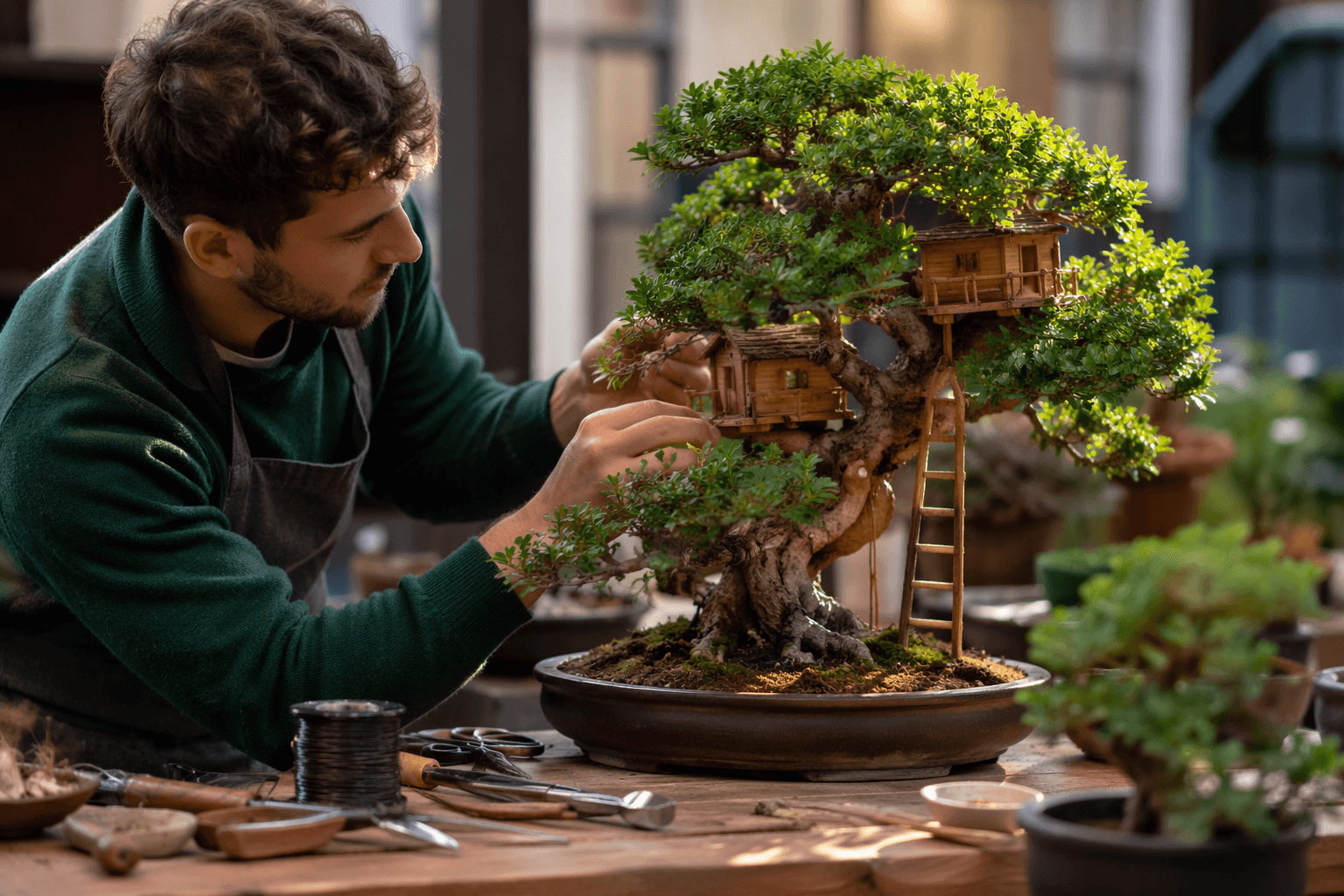
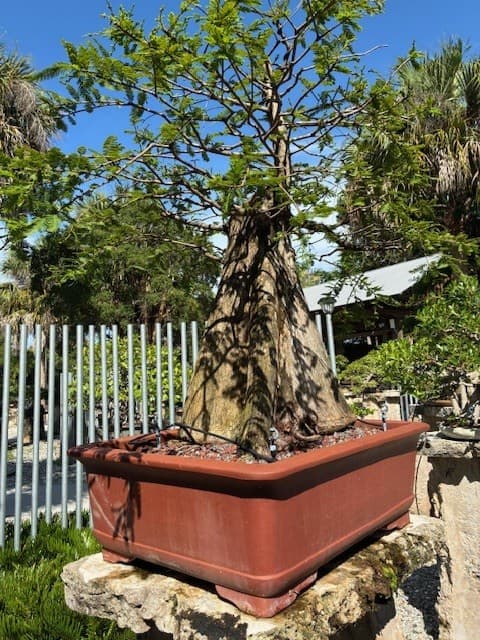
Bjorn Bjorholm Discusses Eisei-En, Bonsai-U, and Cross-Cultural Apprenticeship in New Interview
Eisei-en Kyoto opened early 2026 holding registered national masterpieces; Bjorholm's career makes the case that nine unbroken years in Japan is the real credential.
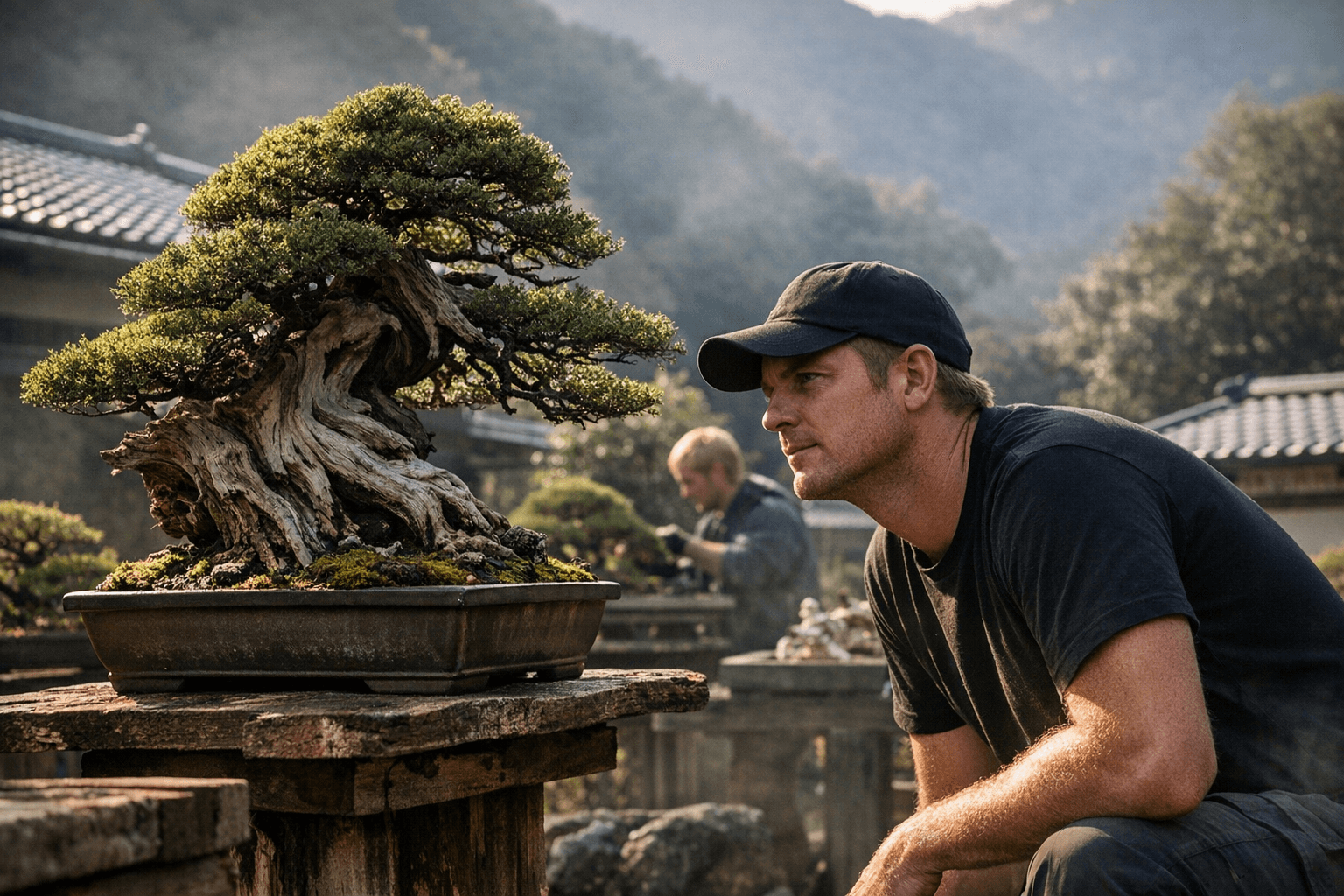
Sometime in the mid-2000s, a college student from Knoxville, Tennessee, walked back into Kouka-en bonsai nursery in Osaka after a chance meeting at age 16 on a Panasonic cultural exchange trip. Keiichi Fujikawa, the second-generation owner of one of the Kansai region's most respected nurseries, did not remember him. Bjorn Bjorholm had spent years hanging onto Fujikawa's business card, following up by email every few weeks after a junior-year language program in Japan, until Fujikawa relented. What followed was a six-year formal apprenticeship, then three more years as artist-in-residence at the same nursery, a PhD in economics at Osaka University on the side, and certification by the Nippon Bonsai Association. By the time he left, Bjorholm had become the first foreign-born working bonsai professional in Japan.
That origin story is well documented by now. What a new long-format interview published this week clarifies is where that investment has arrived in 2026: Eisei-en Kyoto, opened in early 2026 as Japan's newest bonsai garden, gallery, and educational facility, housing a collection that includes Kichou Bonsai, the formal designation for registered national bonsai masterpieces. The interview, posted to YouTube on April 2, covers the full arc of Bjorholm's practice, from nursery logistics to the evolution of Bonsai-U, his online education platform, and to how his return to Japan has reshaped tree selection, training timelines, and design philosophy. Taken together, the conversation surfaces at least four ideas about modern bonsai practice that deserve more attention than the career highlights tend to receive.
The first is the full length of Bjorholm's Kouka-en tenure. Most profiles correctly note the six-year apprenticeship, but the three additional years as artist-in-residence are the piece that matters most for understanding his curatorial decisions now. Apprenticeships in the Japanese bonsai world are not formative in the sense of giving someone a foundation to build on elsewhere; they are formative in the sense that the tree's timeline becomes your timeline. A six-year apprenticeship exposes you to one full development cycle on many trees, but three years of artist-in-residence work means you are making consequential decisions independently, under the watch of a master, with trees that will outlive any workshop you could run. Nine unbroken years at a single nursery is not a credential in the Western continuing-education sense. It is closer to what gives a collector confidence that a practitioner understands why a branch should not be cut today, even when every design instinct says it should be.
The second point concerns the Kichou Bonsai now residing at Eisei-en Kyoto. This designation, which translates roughly as "registered important bonsai masterpiece," is not a marketing category. It is a formal classification within the Japanese bonsai institutional framework, applied to trees with verified historical value and cultural provenance. Western nurseries operate without any equivalent designation; collecting a nationally registered masterpiece is simply not a possibility available to a practitioner operating in Tennessee or California. Eisei-en Kyoto's decision to center these trees in its gallery and educational facility does something specific to the pedagogical environment: it places practitioners and students in daily contact with material that was trained over generations, by hands that predate contemporary bonsai aesthetics. Students working at Eisei-en Kyoto are not learning from demonstration trees. They are learning in proximity to objects that function more like archival documents than horticultural specimens, and that shapes what questions get asked and what answers feel insufficient.
Third, Bjorholm's economics PhD is consistently treated as a biographical footnote, but it is better understood as load-bearing architecture. Bonsai-U, his subscription-based online platform, delivers monthly video tutorials and live Q&A sessions to an international membership base that engages across skill levels, from beginners sorting out soil composition to advanced practitioners working on refinement timing. The Intensive Bonsai School, the in-person residential complement, operates at the other end of the scale: small cohorts, physical trees, direct instruction. The two arms of this model are not redundant. They address the economic reality that the in-person apprenticeship model produces excellent practitioners but has no mechanism for scale, while online content alone produces informed hobbyists but rarely produces artists who can work unsupervised with material of consequence. Bonsai-U is the wide funnel; the Intensive School is the narrow one. The PhD framing matters because this is not how most bonsai educators have thought about the problem. Most treat it as a choice between depth and reach. Bjorholm appears to have structured it as a deliberate two-stage pipeline.
The fourth takeaway is embedded in the sold-out status of both Eisei-en's 100th Anniversary Kokufu-ten tours for 2026, alongside the current waiting list for the Intensive Bonsai School. Both facts appear on the garden's own website, almost in passing, but together they describe a supply-demand imbalance that is not particular to Bjorholm's operation. The demand for authenticated Japan bonsai experiences, from collectors, serious hobbyists, and working professionals, now substantially exceeds what any single practitioner or institution can provide. The Kokufu-ten's centennial this year accelerated that dynamic, but the underlying trend was already present. Bonsai-U exists partly as a response to this bottleneck, offering a form of access that does not require a flight to Osaka or a spot on a waiting list. The question the interview implicitly raises is whether that digital access creates the preconditions for serious apprenticeship or competes with it.
There is a concrete answer to that question sitting inside the Eisei-en Kyoto collection. The Zuisho White Pine that Bjorholm recently added to the Kyoto garden's holdings is not the kind of tree that arrives in a practitioner's collection because of subscriber counts or tour revenue. It arrives because of the relationships built over nine years at an Osaka nursery, a decade of exhibition work at the Kokufu-ten, the Taikan-ten, and the Sakufu-ten, and the credibility that comes from being the practitioner who received Nippon Bonsai Association certification before his Western contemporaries had a clear path to that designation at all. The tree is a data point about what the interview's broader themes are actually pointing toward: that the education infrastructure Bjorholm has built around Bonsai-U and the Intensive School is not a substitute for Japanese institutional formation, but it is the most honest attempt yet to communicate what that formation produces to a global audience that cannot all follow the same nine-year road.
For practitioners deciding how to invest their learning time in the mid-2020s, that distinction matters more than it might seem. The bonsai education landscape has expanded rapidly in the last decade, with online platforms, regional workshops, and masterclass weekends proliferating across the United States and Europe. Bjorholm's model, more than any other currently operating at this scale, has a coherent theory of what each component is and is not capable of producing. Bonsai-U can deliver knowledge. The Intensive School can deliver supervised practice. The collection at Eisei-en Kyoto, its Kichou Bonsai included, can deliver something rarer: the daily experience of working in the aesthetic and historical gravitational field of trees that carry the full weight of the tradition.
That is not something a YouTube upload can fully convey. But the interview is useful precisely because it allows the argument to be heard in full, without the compression of a workshop bio or a social media caption. How the community receives and applies those arguments in the years following the Kyoto opening will say a great deal about what contemporary bonsai education is actually capable of producing.
This article was produced by Prism’s automated news system from verified source data, official records, and press releases, then run through automated quality and moderation checks before publishing. The system is built and supervised by the people who set the standards it runs under. Read our full AI policy.
Did this article answer your question?