Compact Indoor Bonsai Toolkit for Apartment Dwellers, Beginners, Club Members
A compact, reliable bonsai toolkit keeps apartment dwellers, beginning collectors, and club members ready for basic styling and seasonal care with minimal space and fuss.

Why a compact toolkit matters Living in an apartment changes how you store, use, and transport bonsai gear. Apartment dwellers, beginning collectors, and club members need tools that take up little space, do multiple jobs, and travel safely to club tables or swap meets. A pared-down kit reduces decision fatigue during seasonal care and puts the most commonly used implements within reach when a leaf needs pruning or a rootball needs attention.
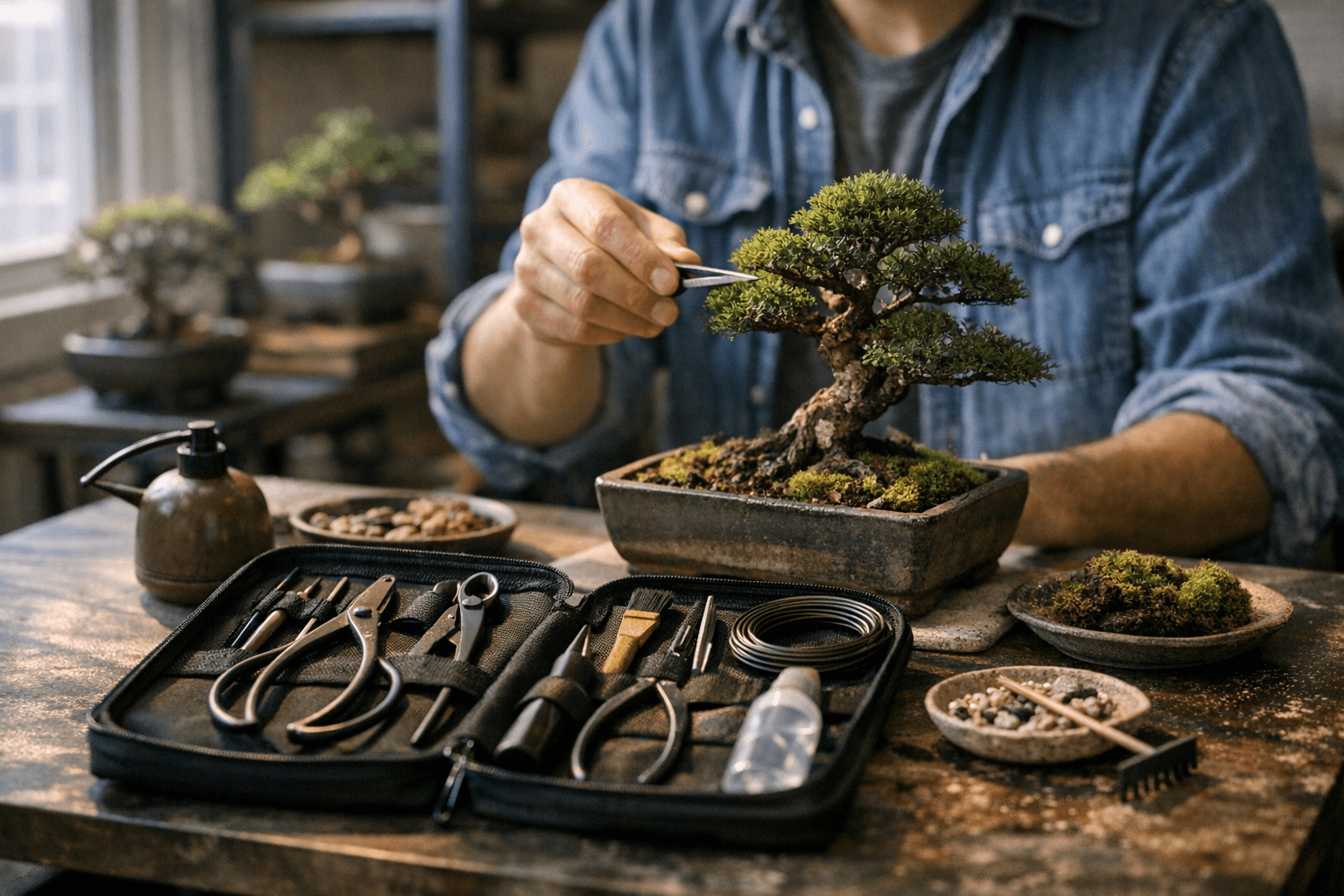
Core tools and why each one belongs in the kit This section lists essentials and explains why each item matters for basic styling and seasonal care.
- Concave cutters, small size. A single good concave cutter is the most important investment for basic styling, because it makes clean branch removals that heal inward and minimize visible scars. Choose a compact model with a 4-6 inch blade length to store easily in a roll or pouch.
- Bonsai shears/scissors. Sharp shears are for fine trimming of foliage pads and inner shoots. Keep one set dedicated to green work and sized for indoor species; a 6-7 inch pair handles most small junipers, ficus, and maples you might keep in an apartment.
- Wire cutters and aluminum training wire. Wire cutters are the tool you reach for immediately after wiring; cutting wire flush prevents damage and saves time in club demonstrations. Include a small spool each of 1.0 mm and 1.5 mm aluminum wire, which cover most interior wiring tasks for young trunks and shoots.
- Root rake or hook and chopsticks. Root work is compact but essential during repotting and seasonal substrate refreshes. A narrow root rake or root hook plus a pair of hardwood chopsticks lets you tease roots in tight pots without needing a large bench.
- Small hand trowel and soil sieve. Indoor bonsai repottings use measured quantities of substrate. A narrow trowel and a handheld sieve keep soil work tidy in a small tub or sink inside an apartment.
- Watering can with narrow spout and spray bottle. Indoor watering demands control to avoid overwatering. A 0.5 to 1 liter watering can with a narrow gooseneck spout gives precise pours, while a spray bottle keeps foliage clean and increases local humidity on dry days.
- Humidity tray and simple thermometer/hygrometer. Many apartment dwellers struggle with low humidity; a shallow humidity tray and a compact thermometer-hygrometer help you monitor conditions and prevent sudden leaf drop in ficus and Satsuki azaleas kept indoors.
- Small disinfectant, gloves, and labeling tape. A travel-size bottle of isopropyl alcohol or a horticultural disinfectant keeps tools sanitary between plants and club exchanges. Lightweight nitrile gloves protect hands during soil work. Use a small roll of labeling tape and a fine Sharpie for shorthand notes when moving trees to and from club events.
How to arrange the kit for compact living Space in an apartment is at a premium; organize for vertical and portable storage. A zippered tool roll or compact canvas pouch holds shears, concave cutter, wire cutters, and a few spools of wire without taking up shelf space. Stack a collapsible plastic basin under the kit for repotting; it doubles as a temporary tray for damp soil during seasonal care. For club members who attend table-top critiques, keep a small tote with your humidity tray, watering can, and a folded mat so you can set up within a 2-foot square footprint.
Seasonal indoor care, simplified for apartment schedules Seasonal care indoors follows the same principles as outdoor bonsai, but timing and intensity change because of indoor light and HVAC.
Spring: Prepare for active growth. This is the main time for repotting many indoor species and refreshing substrate. Use your root rake, chopsticks, sieve, and fresh mix to remove old soil and assess root health. Wiring done after repotting benefits from more elastic, active shoots; store your spools and wire cutters in the kit ready for this work.
Summer: Manage humidity and watering. Indoor summers often bring stronger indoor heat from air conditioning; keep the humidity tray topped and check the hygrometer daily during heat waves. Prune lightly to maintain shape with your shears and reduce heavy structural work that stresses trees in higher indoor temperatures.
Fall: Reduce fertilization and prepare for reduced light. Move trees to brighter spots if possible. Tighten wire if needed, and use the concave cutters for any branch removals you want to heal over before dormancy or rest periods.
Winter: Watch for low humidity and lower light. Indoor bonsai often need more frequent misting and the occasional supplemental grow light during short daylight months. Keep the watering can and spray bottle handy; resist the urge to overwater since indoor species use less moisture in cooler, darker conditions.
Packing and hygiene for club meetings Club members who attend critiques or swaps must balance readiness with portability. Pack the essentials in this order: tool roll with sharp implements, small tote with humidity tray and watering can, and a transport blanket for the pot. Sanitize blades and cutters with your disinfectant between handling other members' trees; this protects both plants and your reputation at club tables. Label any material you leave behind and pack the kit so that the sharp edges point inward to prevent punctures.
Building the kit on a budget You do not need a full cabinet of tools to start. Prioritize purchase and upgrade in this order: concave cutter, bonsai shears, wire cutters, watering can, and a hygrometer. Borrow or buy used root tools and spools of wire from club members while you learn which sizes you use most. Many clubs operate swap tables where experienced members will sell or trade tools at low cost; bring a small roll of cash and your tool roll to pick up bargains.
Tool care and simple maintenance Sharpen and oil as you go to keep a compact kit performing like a larger workshop. After each session, wipe blades clean, apply a light oil to pivot points, and store tools dry inside the roll. For repotting tools that contact soil, sterilize between uses with a small spray of isopropyl alcohol to prevent pathogen transfer; this is especially important when you switch between ficus, azalea, and bonsai from club exchanges.
- Concave cutter, bonsai shears, wire cutters
- Two spools of aluminum training wire (1.0 mm and 1.5 mm)
- Root rake or hook, chopsticks
- Small trowel and handheld soil sieve
- 0.5-1 L watering can and spray bottle
- Humidity tray and thermometer/hygrometer
- Disinfectant, gloves, labeling tape, compact tool roll
A final, practical checklist
Pack these items for a minimal but effective indoor kit:
Compactness is not just convenience; it is a strategy that keeps apartment dwellers, beginning collectors, and club members consistent with basic styling and seasonal care. With these focused tools, a small repotting setup, and simple seasonal rhythms, you can keep trees healthy, learn technique at club tables, and scale your collection without needing a garden shed.
This article was produced by Prism’s automated news system from verified source data, official records, and press releases, then run through automated quality and moderation checks before publishing. The system is built and supervised by the people who set the standards it runs under. Read our full AI policy.
Did this article answer your question?