Longwood Gardens Showcases 60 Deciduous Bonsai During Spring Blooms Season
Longwood's Bonsai Courtyard reopened March 27 with 60 deciduous trees and a Kurume azalea display running only through April, the narrowest window in the spring lineup.
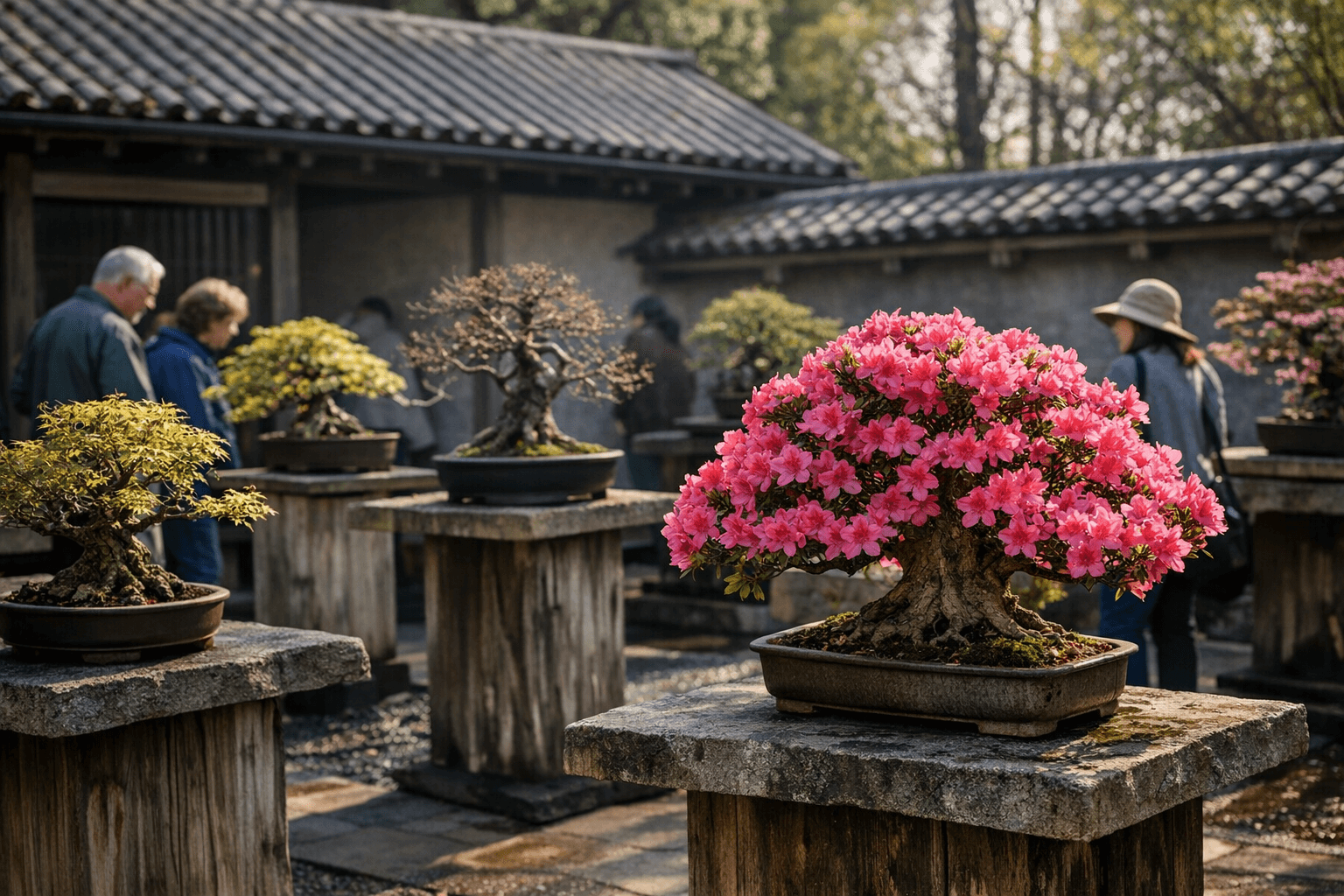
The window is narrow. Kurume azaleas bloom hard and briefly in late March and early April, and Longwood Gardens built an institutional argument around exactly that fact when it reopened the Bonsai Courtyard on March 27 as part of its Spring Blooms season, which runs through May 3, 2026.
The courtyard now holds a rotating display of up to 50 to 60 deciduous trees leafing out in scale alongside flowering cherry trees, all drawn from a core collection of nearly 200 specimens housed in a 12,500-square-foot space framed by a carpinus hedge that functions less like a garden border and more like a gallery wall. That collection's depth traces directly to a 2022 transformative gift from Doug Paul's Kennett Collection, the largest private bonsai collection outside Asia, which committed 150 masterpiece trees, including designated kicho or Important Bonsai Masterpieces, and a $1 million endowment to Longwood. What visitors see leafing out in the courtyard right now is, in part, a reflection of that gift: trees trained in Japan, staged inside a space designed to let their scale and proportion read against a living architectural backdrop.
The Kurume azalea display, which runs from late March through April, is the most time-sensitive element of the spring program. Rhododendron kiusianum and R. kaempferi, the species behind most Kurume bonsai, front-load their energy before the canopy fills in, making the bloom window both the most visually intense moment of the year and the cue for the most consequential maintenance decision. Pruning immediately after flowering, before buds for next season begin to set in late spring, lets the tree direct energy into the structure you want rather than wood you will remove in autumn. Delay that cut by even a few weeks and you surrender structural control for the entire growing season.
Repotting follows the same spring logic. Azalea roots are thin, matted, and easily torn; working them in early spring or directly after flowering lets the tree recover through its peak growth months. Soil matters more here than with most bonsai subjects. Kanuma, the acidic volcanic growing medium sourced from Tochigi Prefecture in Japan, keeps moisture without waterlogging and maintains the low pH that Kurume roots require. Longwood's staging mirrors this care: the carpinus hedge buffers wind, the courtyard's ambient humidity supports hydration, and the cherry trees overhead diffuse direct light. Protecting blooming azaleas from rain and midday sun extends the flower display; bringing that principle to a home bench, even by moving a pot to a covered position during peak bloom, can stretch a two-week display noticeably longer.
Kevin Bielicki, Longwood's bonsai curator, has approached the courtyard's rotating displays with attention to composition over spectacle, selecting specimens for variety of flower type, tree size, and training style to build arrangements that reflect the breadth of the species rather than centering a single showpiece. That framing is consistent with how Dan Sekowski, Longwood's associate director of outdoor landscapes, characterized the season overall: as "one of the most beautiful and fleeting seasons at Longwood Gardens," designed around layered, evolving displays rather than static botanical arrangements. For azalea bonsai, the description is structurally precise: once the flowers drop in April, the design conversation shifts entirely to foliage density, ramification, and the form decisions that post-bloom pruning will either reinforce or forfeit.
Spring Blooms runs through May 3. Extended evening hours and "Tulip Tuesdays" programming run through April. The Kurume azalea display does not.
This article was produced by Prism’s automated news system from verified source data, official records, and press releases, then run through automated quality and moderation checks before publishing. The system is built and supervised by the people who set the standards it runs under. Read our full AI policy.
Did this article answer your question?