Mastering Indoor Bonsai Light Requirements for Healthier, Thriving Trees
Most apartment windows peak at 100-150 µmol/m²/s of usable photosynthetic light, far below what even the most tolerant indoor bonsai need to stay dense and back-bud reliably.
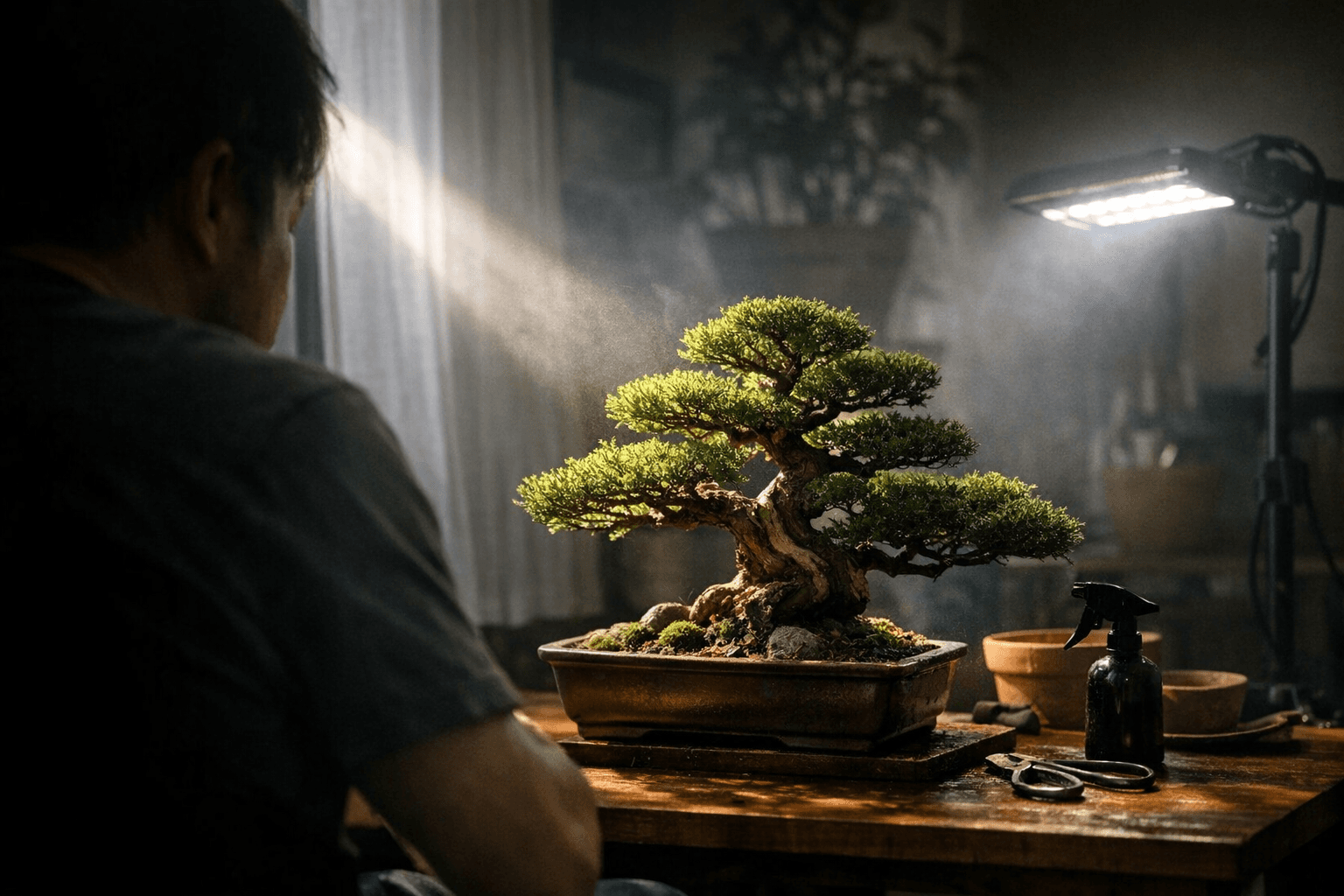
The bright-window assumption has killed more indoor bonsai than spider mites ever will. A south-facing apartment windowsill on a clear day can register 5,000 to 10,000 lux, which looks impressive on a phone light-meter app and feels genuinely bright to human eyes. Convert that reading to the unit plants actually use, photosynthetic photon flux density (PPFD), measured in micromoles of photons per square meter per second (µmol/m²/s), and the picture sharpens into something considerably less reassuring. At best, that south window is delivering roughly 100 to 200 µmol/m²/s at the sill, and only for a few peak hours before the sun angle shifts. Move the pot back a metre for display, as most living spaces demand, and the canopy may be receiving 50 to 100 µmol/m²/s. A north-facing window in winter delivers as little as 3 to 10 µmol/m²/s. These are not quibbles about instrumentation. They are the difference between a tree that builds density over years and one that slowly retreats from the inside out.
Why PPFD and DLI Replace "Bright Light"
Lux and foot-candles measure brightness as human vision perceives it, weighting green wavelengths heavily because that is where our eyes are most sensitive. Bonsai trees do not care about green. Photosynthesis runs primarily on blue light (400-500 nm) and red light (600-700 nm), the very ranges that lux readings undercount. PPFD captures only those photosynthetically active photons, which is why it has become the operative metric in horticultural science and why serious indoor growers now use PAR meters rather than standard light meters.
The companion metric, daily light integral (DLI), expressed in mol/m²/day, integrates PPFD across the full photoperiod to give the total photon budget a tree accumulates in a day. The relationship is straightforward: a ficus receiving 120 µmol/m²/s under lights for 13 hours accumulates a DLI of approximately 5.6 mol/m²/day. The same tree sitting on a south-facing sill that delivers 120 µmol/m²/s for only five effective hours lands at roughly 2.2 mol/m²/day. That gap, invisible to the eye, is why a ficus on a "bright" windowsill can still etiolate and shed interior foliage while appearing, superficially, to be in reasonable light.
The Species Benchmarks That Should Drive Every Placement Decision
Light tolerance varies substantially across the species most commonly kept indoors. The table below anchors the three groups you are most likely working with:
| Species / Group | Minimum PPFD (µmol/m²/s) | Target DLI (mol/m²/day) | Practical Photoperiod |
|---|---|---|---|
| Ficus (retusa, microcarpa, benjamina) | 100-150 | 5-8 | 12-14 hours |
| Schefflera / Hawaiian Umbrella / Jade | 150-250 | 8-13 | 14-16 hours |
| Juniper / Pine / Maple (seasonal only) | 300+ | 15+ | Not suited for long-term indoor keeping |
Ficus spp. should be ok with 120 µmol/m²/s, making it the most tolerant genus in the bonsai canon for indoor conditions, but "tolerant" does not mean "unbothered." Below that floor, interior foliage begins to thin and new growth loses the compactness that makes a ficus worth keeping. Schefflera and jade push the threshold higher; these are technically low-light performers by outdoor standards, but they still need more than a typical apartment window delivers reliably across seasons. The juniper row exists in this table as a caution, not a guide. Species such as juniper, pine, and maple are naturally adapted to full sun, calibrated to outdoor photon loads of 40,000 to 100,000 lux. Keeping one indoors, even briefly, without supplemental lighting matched to a DLI requirement of 15 mol/m²/day or more, is not a display strategy; it is slow decline managed invisibly.
The Failure Cascade: Etiolation and the Death of Back-Budding
When PPFD drops below a species threshold, the first sign is internode elongation. Shoots grow longer between leaf nodes, stretching visibly toward the light source, and leaves increase in size as the tree attempts to capture more photons per unit of growth energy. This condition, known as etiolation, is a sign that your bonsai is desperately reaching out for more light, and it can quickly compromise the tree's overall structure and longevity. Extended internodes are mechanically weaker and compositionally useless; the tight ramification and compact silhouette that define a refined tree require the opposite: short internodes, small leaves, and dense branching.
The second consequence is the one most practitioners underestimate until significant time has been lost: the collapse of back-budding. Vigorous back-budding, the emergence of new shoots from interior wood along established branches, depends on a tree running a genuine photosynthetic surplus. When a tree is operating near its light floor, metabolic resources concentrate at the apical tips where return on each photon is highest. Interior dormant buds receive no hormonal or energetic signal to activate. The tree thins from the inside outward over multiple growing seasons, shedding the very branch density that years of pinching and pruning worked to build. By the time the foliage loss is visually dramatic, the underlying structural problem has typically been accumulating for one to two full growing seasons.
Leaves may become pale or yellow because the tree cannot produce enough chlorophyll without sufficient light. This compounds the problem by further reducing the tree's capacity to photosynthesise even the limited available light, accelerating the downward spiral.
Grow Lights That Actually Deliver the Numbers
Basic T5 shop lights deliver around 200 PPFD at close canopy distance. That clears the ficus minimum and serves well for basic tropical maintenance through winter, but it falls short for schefflera, jade, and any tree being actively developed rather than held in stasis. LED lights such as the Spider Farmer SF2000 can reach around 3,000 PPFD at maximum output, though practical canopy positioning typically brings working PPFD into the 300 to 600 range at 18 to 24 inches. For bonsai, a mid-power LED run at partial output is almost always preferable to a high-power unit at maximum; you need controlled, consistent PPFD at canopy level, not peak output figures from the spec sheet.
Spectral balance matters as much as raw intensity. Household incandescent bulbs and warm-white LEDs, despite appearing bright, are deficient in the blue range (400-500 nm) that drives compact vegetative growth. Trees placed under these sources will etiolate even at adequate lux readings because the photon wavelengths driving tight internode development are absent. Fixtures rated at 5,000 to 6,500 Kelvin, or full-spectrum panels with a genuine blue-red output curve, are the correct tool for bonsai applications.
Setup Variables That Determine What Your Canopy Actually Receives
Fixture height is the most mismanaged variable in amateur indoor setups. Light intensity falls with the inverse square of distance: a panel delivering 400 µmol/m²/s at 12 inches drops to roughly 100 µmol/m²/s at 24 inches. Always measure at canopy level with a PAR meter or a calibrated PAR-reading smartphone app; manufacturer PPFD charts are measured at a single central point and typically represent best-case figures.
Timer control is non-negotiable for consistent DLI delivery. It may be sufficient to switch on the grow lights for a few hours in the morning and after sunset, controlled by a timer, to give the bonsai trees a total of 12 to 15 hours of light (natural plus supplementary). This approach preserves the spectral character of daylight while guaranteeing the minimum daily photon budget the tree requires. Avoid exceeding 16 hours for any species, and do not extend photoperiod for temperate trees being overwintered indoors, as continuous light suppresses the dormancy cues they depend on for long-term health.
Rotation belongs in the same maintenance routine as watering. A pot placed against a window or under a single overhead fixture accumulates photons asymmetrically. Uneven light distribution produces uneven growth rates across the canopy, and the compositional imbalance compounds quickly. A quarter-turn weekly is sufficient to keep development uniform.
Measuring to Know, Not Guessing to Hope
The transition from "near a bright window" to "maintaining 120 to 200 µmol/m²/s for 12 to 14 hours" is the practical leap that separates growers who keep losing trees from growers who keep building them. Supplementing with artificial light when natural light is insufficient is not an advanced technique; it is the baseline requirement for any indoor setup that takes species-level PPFD thresholds seriously. A PAR-reading smartphone app, while not laboratory-grade, is accurate enough to reveal whether your south-facing sill is delivering 150 µmol/m²/s or 40. That distinction determines whether your indoor collection gains density year on year or spends its energy reaching for light it never quite finds.
Bonsai kept indoors will always be fighting physics. But the growers who understand exactly how much that fight costs, in quantitative terms, are the ones whose trees look better each spring than they did the year before.
This article was produced by Prism’s automated news system from verified source data, official records, and press releases, then run through automated quality and moderation checks before publishing. The system is built and supervised by the people who set the standards it runs under. Read our full AI policy.
Did this article answer your question?